Journal of Tropical AgriFood (JTAF) – scholarly journal in tropical agrifood, food science, and agricultural technology

About the Journal

Journal of Tropical AgriFood (JTAF)
 
Journal Facts
e-ISSN: 2685-3604
p-ISSN: 2685-3590
DOI Prefix: 10.35941
Publication Frequency: Quarterly — March, June, September, and December
First Published: June 2019
Peer Review: Double-blind peer review
Journal of Tropical AgriFood (JTAF) is a peer-reviewed scholarly journal for original research, short communications, and critical reviews on the science, technology, engineering, nutrition, sustainability, and socioeconomic dimensions of tropical agrifood systems. The journal prioritizes research with clear scientific novelty, methodological rigor, and relevance beyond a single locality.
🌿 Tropical relevance
Tropical biological resources, climates, production systems, supply chains, and food cultures.
🔬 Scientific novelty
New knowledge, methods, technologies, or evidence with a clear scientific contribution.
📐 Methodological rigor
Sound study design, analysis, interpretation, and appropriate reproducibility.
🌐 Wider relevance
Findings should offer value beyond a narrowly local description or isolated case.
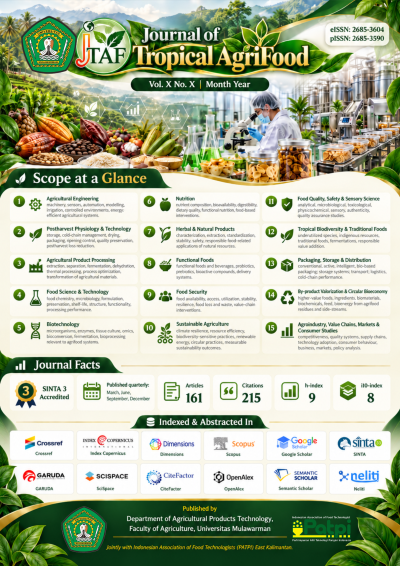
Scope at a Glance
Agricultural Engineering Engineering principles, machinery, sensors, automation, modelling, irrigation, controlled environments, and energy-efficient systems for producing, handling, and processing tropical agricultural commodities. Priority is given to technologies adapted to smallholder operations, humid climates, remote or archipelagic settings, and locally available resources.
Postharvest Physiology and Technology Physiological, biochemical, physical, and microbiological changes in tropical crops after harvest, together with harvesting, curing, storage, cold-chain, ripening control, drying, packaging, and non-thermal or thermal interventions that reduce losses and preserve quality, safety, and marketability.
Agricultural Product Processing Technology Development, optimization, scale-up, and performance evaluation of unit operations for tropical crops, plantation products, fisheries, livestock products, and other biological materials, including extraction, separation, fermentation, dehydration, thermal processing, and process intensification. Studies should connect process variables with product quality, efficiency, or practical utilization.
Food Science and Technology Chemistry, physics, microbiology, engineering, formulation, preservation, shelf-life, and structure-property relationships of foods and ingredients derived from tropical resources. The journal welcomes mechanistic and application-oriented studies that advance product quality, stability, safety, authenticity, or processing performance.
Biotechnology Use of microorganisms, enzymes, plant tissue culture and other cell-based systems, omics, bioconversion, and bioprocess engineering to improve tropical foods, ingredients, agricultural commodities, planting materials, and coproducts. Relevant work includes starter cultures, traditional and controlled fermentation, microbial metabolites, enzyme-assisted processing, micropropagation, in vitro conservation, callus and organ culture, production of plant-derived bioactive compounds, and other biosafety-informed applications.
Nutrition Nutrient composition, bioavailability, digestibility, dietary quality, and health-related effects of tropical foods and food products, including studies on local dietary patterns, nutrient deficiencies, and food-based interventions. Human or animal studies must provide an appropriate ethical and experimental basis and should not make unsupported clinical claims.
Herbal and Natural Products Scientific characterization, extraction, standardization, stability, safety, and food-related application of tropical botanicals, spices, medicinal plants, and other natural materials. Emphasis is placed on linking chemical profiles and bioactivity with processing conditions, quality specifications, and realistic product applications rather than reporting screening results alone.
Functional Foods Design and evaluation of foods, beverages, ingredients, probiotics, prebiotics, and bioactive delivery systems derived from tropical resources, with evidence linking composition and processing to physiological function. Studies should include appropriate controls and avoid equating in vitro antioxidant or antimicrobial activity alone with demonstrated health benefits.
Food Security Availability, access, utilization, stability, resilience, and food loss and waste within tropical agrifood systems. Contributions may examine local-resource diversification, value chains, trade, market competitiveness, consumer access, community food systems, and technology or policy interventions when these are supported by robust empirical or modelling approaches.
Sustainable Agriculture Resource-efficient and climate-resilient production and processing systems for tropical agrifood commodities, including life-cycle thinking, low-input technologies, biodiversity-sensitive practices, renewable energy integration, and adaptation to tropical environmental stresses. Studies should demonstrate measurable environmental, technical, social, or economic outcomes.
Food Quality, Safety, and Sensory Science Analytical, microbiological, toxicological, physicochemical, and sensory approaches for assessing the safety, quality, authenticity, acceptability, and storage stability of tropical foods. This area includes method validation, hazard control, quality assurance, consumer-based sensory research, and the effects of processing or formulation on product performance.
Tropical Biodiversity, Indigenous Resources, and Traditional Foods Scientific documentation, validation, improvement, and responsible commercialization of underutilized tropical species, indigenous knowledge, and traditional foods or fermentations. JTAF particularly encourages studies that connect the distinctive biodiversity and food cultures of Borneo and other tropical regions with reproducible science, safety, value addition, and wider relevance.
Food Packaging, Storage, and Distribution Conventional, active, intelligent, and bio-based packaging; packaging-product interactions; storage systems; transport conditions; and cold-chain or distribution technologies for tropical foods. Contributions should quantify effects on safety, quality, shelf-life, resource use, or supply-chain performance.
By-product Valorization and Circular Tropical Bioeconomy Conversion of tropical agricultural and food-processing residues into safe, higher-value foods, ingredients, biomaterials, biochemicals, feed components, or bioenergy through technically and environmentally sound pathways. Studies should address material characterization, process performance, product functionality, safety, and, where appropriate, techno-economic or life-cycle feasibility.
Agroindustry, Value Chains, Markets, and Consumer Studies Management, competitiveness, quality systems, supply-chain performance, adoption, consumer behaviour, and business or policy analysis directly related to tropical agricultural and food products. Papers must be analytically rigorous and demonstrate a clear connection between socioeconomic evidence and technology, product quality, resource utilization, or resilience of the tropical agrifood system.

Announcements

Current Issue

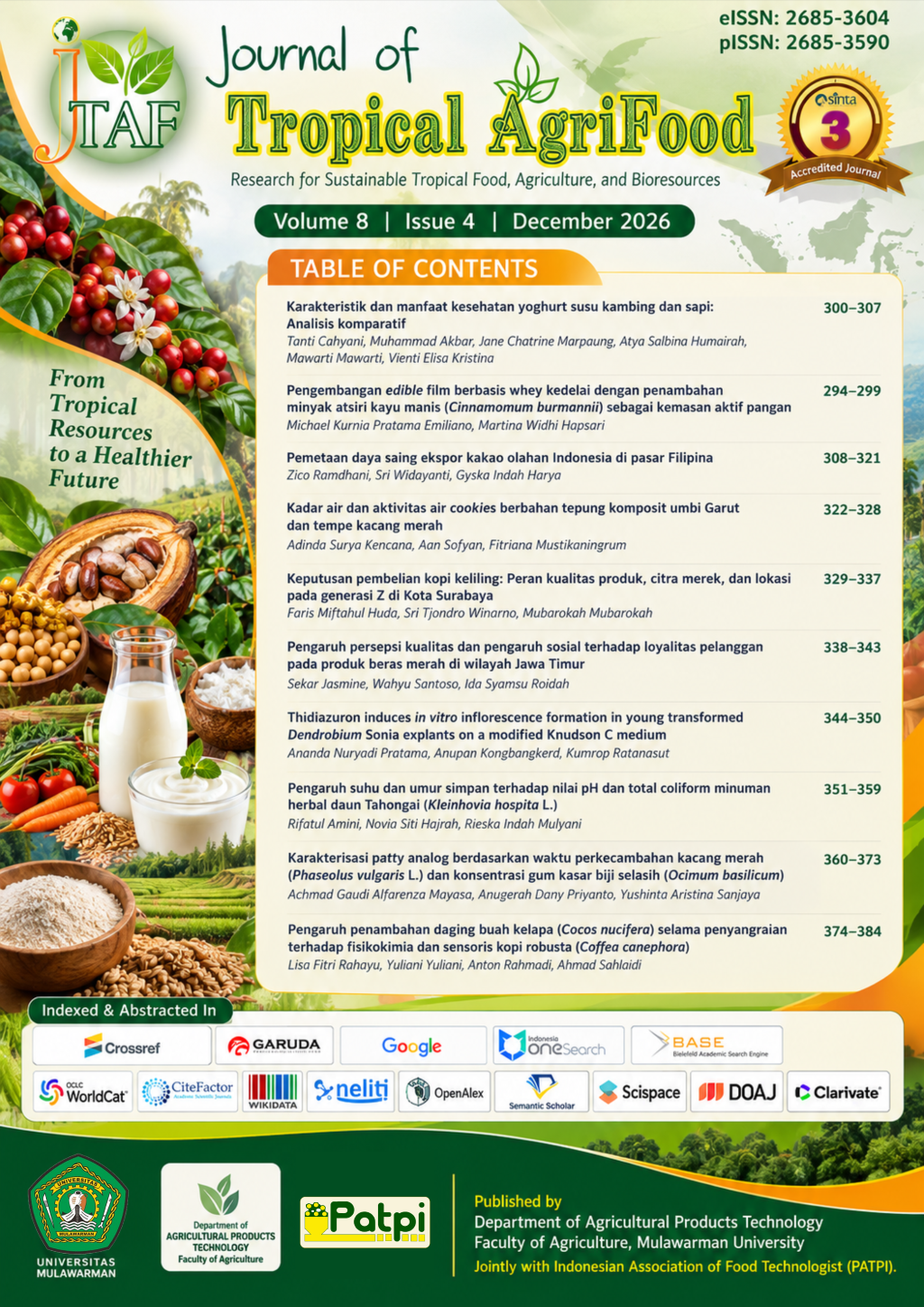
Volume 8 Nomor 4 Tahun 2026
					View Volume 8 Nomor 4 Tahun 2026

Journal of Tropical AgriFood, Desember 2026

Published: 2026-07-23
View All Issues

Indexed & Abstracted In

Selected indexing, abstracting, registration, and discovery services.