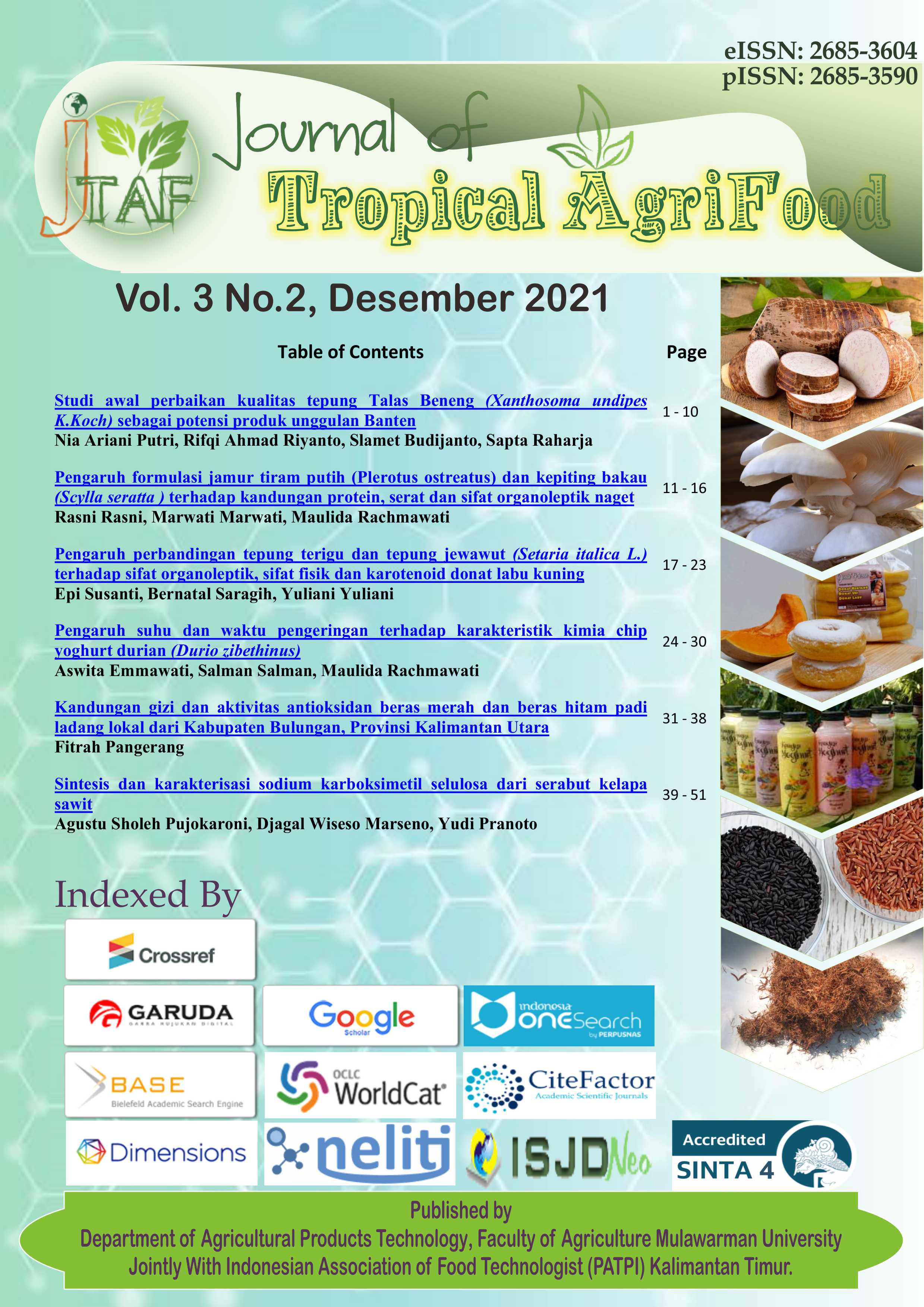
Kandungan gizi dan aktivitas antioksidan beras merah dan beras hitam padi ladang lokal dari Kabupaten Bulungan, Provinsi Kalimantan Utara
DOI:
https://doi.org/10.35941/jtaf.3.2.2021.8475.93-100Keywords:
Beras lokal, Beras merah, Beras hitam, Kabupaten Bulungan, Aktivitas antioksidanAbstract
Beras merah dan beras hitam lokal Bulungan Kalimantan Utara dibudidayakan secara turun temurun oleh petani ladang. Penelitian ini bertujuan untuk menguji nilai gizi dan aktivitas antioksidan beras merah dan beras hitam lokal padi ladang yang tersebar di beberapa daerah Bulungan. Beras merah lokal yang diuji berasal dari daerah Klubir, Tanjung Palas, Pimping, Teras Baru dan Selimau. Sedangkan beras hitam berasal dari daerah Pejalin, Selimau dan Tobulo. Pengujian nilai gizi beras dilakukan meliputi pengujian kadar protein, lemak, serat kasar, abu, dan karbohidrat. Aktivitas antioksidan ditentukan dengan metode DPPH. Kandungan nilai gizi menunjukkan protein beras merah mencapai 7,72-9,10%, lemak 1,00-2,07%, serat kasar 0,24-1,77%, total abu 0,43-1,01%, karbohidrat 73,16-79,58%. Sedangkan pada beras hitam memiliki protein 7,44-10,08%, lemak 0,22-0,42%, serat kasar 0,06-0,10%, total abu 0,14-0,78%, karbohidrat 75,80-78,68%. Pengujian nilai aktivitas antioksidan beras merah maupun beras hitam lokal menunjukkan nilai IC50 beras merah 85,69-290,54 ppm. Sedangkan beras hitam memiliki IC50 176,62-287,14 ppm. Kesimpulan beras hitam lokal Bulungan memiliki protein cenderung lebih tinggi dari beras merah lokal. Umumnya beras merah maupun beras hitam lokal memiliki kadar lemak dibawah 3% dan mineral (abu) maksimal 4%. Kandungan serat beras merah maupun beras hitam lokal tergolong rendah yaitu kurang dari 36% dan kandungan karbohidrat (BETN) cukup tinggi. Aktivitas antioksidan beras merah cenderung lebih kuat dibandingkan beras hitam lokal.Downloads
References
AOAC, 2005. Official Methods of Analysis. Association of Official Analytical Chemists. Benjamin Franklin Station, Washington.
Azis, A., M. Izzati, and S. Haryanti. 2015. “Aktivitas Antioksidan Dan Nilai Gizi Dari Beberapa Jenis Beras Dan Millet Sebagai Bahan Pangan Fungsional Indonesia.” Jurnal Akademika Biologi.
Badarinath, A. V, K. Mallikarjuna Rao, C. Madhu, Sudhana Chetty, S. Ramkanth, T. V. S. Rajan, and K. Gnanaprakash. 2010. “A Review On In-Vitro Antioxidant Methods: Comparisions, Correlations and Considerations.” International Journal of PharmTech Research 2(2):1276–85.
BPOM. 2011. “Peraturan Kepala BPOM RI No. HK.03.1.23.11.11.09605 TAHUN 2011.”
Barker, A, V and Pilbeam, D, J. 2007. Hand Book of Plant Nutritiont. CRC Press. New York.
Beja, H., Mella, W. I. I., & Soetedjo, I. N. P. (2015). Slash And Burn System Components And Effect On Soil Physical Chemical And Vegetation In The Farm And Land Bera (A Case Study in The Village of Sikka Regency Waiblama Pruda District of East Nusa Tenggara). Jurnal Keteknikan Pertanian, 03(2), 1–8. https://doi.org/10.19028/jtep.03.2.129-136
BSN, 1992. Analisis Serat Kasar. SNI-01-2891-1992. Badan Standardisasi Nasional, Jakarta.
Fitriyah, D., M. Ubaidillah, and F. Oktaviani. 2020. “Analisis Kandungan Gizi Beras Dari Beberapa Galur Padi Transgenik Pac Nagdong/Ir36.” ARTERI: Jurnal Ilmu
Goufo P, Trindade H. 2013. Rice Antioxidants: Phenolic Acids, Flavonoids, Anthocyanins, Proanthocyanidins, Tocopherols, Tocotrienols, γ-Oryzanol, and Phytic Acid. Food Science & Nutrition. Vol. 2 (2): 75–104
Indrasari, dan S Dewi, 2010. Padi Aek Sibundong: Pangan Fungsional. Warta Penelitian dan Pengembangan Pertanian 28 (6) : 1-3
Khalekuzzaman, M., Datta, K., Olivia, N., Attam, M.F., Joarder, I., dan Datta, S.K.. 2006. Stable Integration, Expression and Inheritance of The Ferritin Gene In Transgenic Elite Indica Rice Cultivar BR 29 with Enhanced Iron Level In The Endosperm. Indian Journal of Biotechnology. 5 (3) : 26-31.
Okonogi S, Kaewpinta A, Junmahasathien T, Yotsawimonwat S. 2018. Effect of Rice Variety and Modification on Antioxidant and Anti-Inflammatory Activities. Drug Discoveries & Therapeutics. Vol. 12 (4): 206–213.
Pengkumsri N., Chaiyasut C., Saenjum C., Sirilun S., Peerajan S., Suwannalert P., Sirisattha S., dan Sivamaruthi B.S. 2015. Physicochemical and Antioxidative Properties of Black, Brown and Red Rice Varieties of Northern Thailand. Food Science and Technology. Vol. 35(2). Jun : 331–338.
Reddy C.K, Kimi L, Haripriya S, Kang N. 2017. Effects of Polishing on Proximate Composition, Physico- Chemical Characteristics, Mineral Composition and Antioxidant Properties of Pigmented Rice. Rice Science. Vol. 24 (5): 241–252.
Rusyanti, Nila, Didi Adriansyah, And Siti Rosmina. 2018. “Analisis Usahatani Padi Ladang Berpindah Di Desa Pejalin Kecamatan Tanjung Palas Kabupaten Bulungan Provinsi Kalimantan Utara (1(2):110. Doi: 10.35941/Jakp.1.2.2018.1712.110-115.
Sompong R, Siebenhandl-Ehn S, Linsberger-Martin G, Berghofer, E. 2011 Physicochemical and antioxidative. Properties of red and black rice varieties from Thailand, China and Sri Lanka. J. Food Chem. 124 (2011) 132–140.Doi:10.1016.
Sudarmadji, S. Bmbang Haryono dan Suhardi. 1997. Prosedur Analisa Untuk Bahan Makanan dan Pertanian. Yogyakarta: Liberty
Wanti S, Andriani M.A.M, Parnanto N.H.R. 2015. Pengaruh Berbagai Jenis Beras terhadap Aktivitas Antioksidan pada Angkak oleh Monascus purpureus. Biofarmasi. Vol. 13 (1): 1–5
Downloads
Published
Issue
Section
License
As a journal Author, you have rights for a large range of uses of your article, including use by your employing institute or company. These Author rights can be exercised without the need to obtain specific permission.
Authors publishing in JTAF have wide rights to use their works for teaching and scholarly purposes without needing to seek permission, including: use for classroom teaching by Author or Author's institutionand presentation at a meeting or conference and distributing copies to attendees; use for internal training by author's company; distribution to colleagues for their reseearch use; use in a subsequent compilation of the author's works; inclusion in a thesis or dissertation; reuse of portions or extrcats from the article in other works (with full acknowledgement of final article); preparation of derivative works (other than commercial purposes) (with full acknowledgement of final article); voluntary posting on open web sites operated by author or author’s institution for scholarly purposes (follow CC by SA License).
Authors and readers can copy and redistribute the material in any medium or format, as well as remix, transform, and build upon the material for any purpose, even commercially, but they must give appropriate credit (cite to the article or content), provide a link to the license, and indicate if changes were made. If you remix, transform, or build upon the material, you must distribute your contributions under the same license as the original.