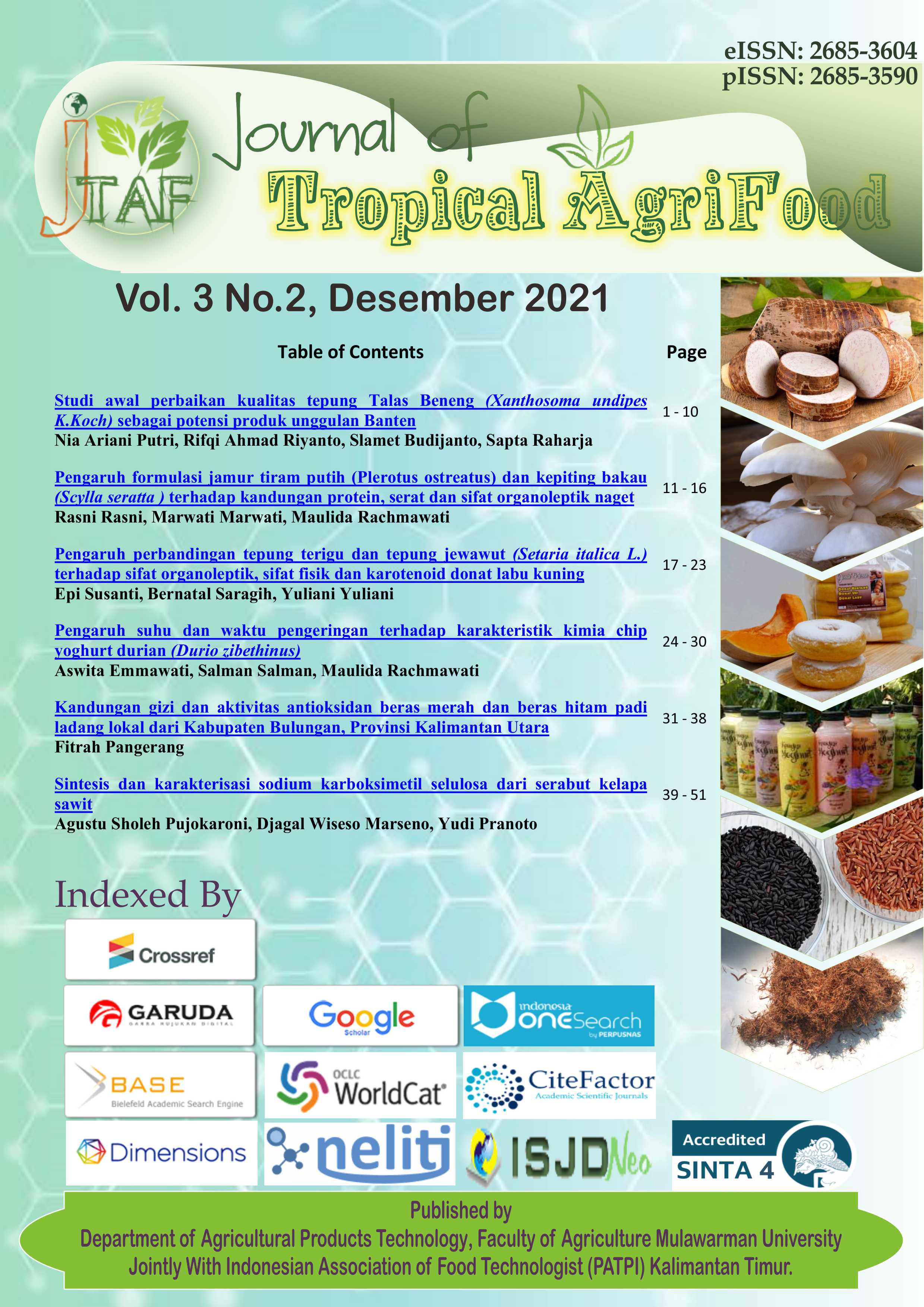
Sintesis dan karakterisasi sodium karboksimetil selulosa dari serabut kelapa sawit
DOI:
https://doi.org/10.35941/jtaf.3.2.2021.6656.101-113Keywords:
Palm fiber, Cellulose, CMCAbstract
Penelitian ini bertujuan untuk mendapatkan metode pembuatan CMC dari serabut buah kelapa sawit (SBS). Dua tahapan percobaan dilakukan, yaitu penyiapan selulosa dari SBS dan pembuatan CMC menggunakan selulosa SBS dari perlakuan terpilih. Percobaan tahap pertama merupakan percobaan faktor tunggal (konsentrasi NaOH 5,0-17,5%), sedangkan percobaan tahap kedua merupakan percobaan faktorial (konsentrasi NaOH 5-20%, dan kadar Natrium monokhloro asetat/NaMCA 3-7 g). Setiap perlakuan diulang lima kali. Parameter yang diamati pada percobaan tahap pertama adalah rendemen, kadar selulosa, kadar air, dan kadar abu. Parameter yang diamati pada percobaan tahap kedua adalah hasil, kadar air, kemurnian, kelarutan, viskositas, dan derajat substitusi. CMC SBS dengan karakter terbaik dari percobaan kedua kemudian dianalisis dengan sinar-X dan FTIR. Kecuali data difraksi sinar-X dan spektrum FTIR yang dianalisis secara deskriptif, data lainnya dianalisis dengan ANOVA. Hasil penelitian menunjukkan bahwa metode penyiapan selulosa dari SBS dengan formula 5% w/v dalam 15% NaOH merupakan metode paling potensial (rendemen dan kadar selulosa bertuut-turut adalah 25,50% dan 63,34%) dan dipilih sebagai metode penyiapan selulosa SBS. Pada percobaan CMC dari selulosa SBS, ditunjukkan bahwa konsentrasi NaOH dan kadar NaMCA serta interaksinya memberikan pengaruh nyata (p<0,05) terhadap hasil, kadar air, kemurnian, kelarutan, viskositas, dan derajat substitusi CMC. Metode penyiapan CMC menggunakan formula 5 g selulosa SBS dalam sistem 100 mL isopropanol dan 20 mL 15% NaOH dan 6 gram NaMCA merupakan metode potensial yang menghasilkan CMC SBS dengan karakteristik derajat substitusi 1,19, viskositas 4,1 cps, dan kelarutan 60,25%. Hasil, kemurnian, dan kadar air CMC SBS yang dihasilkan berturut-turut adalah 156,35%, 86,44%, dan 11,83%. CMC SBS yang dihasilkan tersebut mempunyai karakter difraksi sinar-X dan spektrum FTIR yang serupa dengan tepung selulosa dan CMC komersial.
Downloads
References
Abdel-Mohdy, F.A., Abdel-Halim, E.S., Abu-Ayana, Y.M., Al-Sawy, S.M., 2009. Rice straw as a new resource for some beneficial uses. Carbohydrate Polymers 75, 44-51. doi: 10.1016/j.carbpol.2008.06.002.
Adinugraha, M. P., Marseno, D.W., Haryadi, 2005. Synthesis and characterization of sodium carboxymethylcellulose from cavendish banana pseudo stem (Musa cavendishii LAMBERT). Carbohydrate Polymers 62, 164-169. doi: 10.1016/j.carbpol.2005.07.019.
Bicu, I., Mustata, F., 2013. Optimization of isolation of cellulose from orange peel using sodium hydroxide and chelating agents. Carbohydrate Polymers 98, 341-348. doi: 10.1016/j.carbpol.2013.06.009.
Casaburi, A., Rojo, Ú.M., Cerrutti, P., Vázquez, A., Foresti, M.L., 2018. Carboxymethyl cellulose with tailored degree of substitution obtained from bacterial cellulose. Food Hydrocolloids 75, 147–156. doi: 10.1016/j.foodhyd.2017.09.002.
Cash, M.J., Caputo, S.J., 2010. Cellulose derivatives In: Food Stabilisers, Thinkeners and Gelling Agents. Edited by Imeson, A., Blackwell Publishing Ltd.
Cheng, H.N., Biswas, A., 2011. Chemical modification of cotton-based natural materials: Products from carboxymethylation. Carbohydrate Polymers 84, 1004–1010. doi: 10.1016/j.carbpol.2010.12.059.
Chesson, A., 1981. Effects of sodium hydroxide on cereal straws in relation to the enhanced degradation of structural polysaccharides by rumen microorganisms. J. Sci. Food Agric 32, 745-758
Dapía, S., Santos, V., Parajó, J.C., 2003. Carboxymethylcellulose from totally chlorine-free-bleached milox pulps. Bioresource Technology 89, 289-296. doi: 10.1016/S0960-8524(03)00066-X.
Golbaghi, L., Khamforoush, M., Hatami, T., 2017. Carboxymethyl cellulose production from sugarcane bagasse with steam explosion pulping: Experimental, modeling, and optimization. Carbohydrate Polymers 174, 780-788. doi: 10.1016/j.carbpol.2017.06.123.
Hutomo, G.S., 2010. Sintesis dan Karakterisasi CMC dan HPC dari Pod Kako (Theobroma cacao L.). Laporan Akhir Kegiatan Penelitian Hibah Disertasi Doktor. LPPM UGM, Yogyakarta.
Joshi, G., Naithani, S., Varshey, V.K., Bisht, S.S., Rana, V., Gupta, P.K., 2015. Synthesis and characterization of carboxymethyl cellulose from office waste paper: A greener approach towards waste management. Waste Management 38, 33-40. doi: 10.1016/j.wasman.2014.11.015.
Nisa, D., Putri, W.D.R., 2014. Pemanfaatan selulosa dari kulit buah kakao (Teobroma cacao L.) sebagai bahan baku pembuatan CMC (Carboxymethyl Cellulose). Jurnal Pangan dan Agroindustri 2, 34-42
Olaru, N., Olaru, L., Stoleriu, A., Ţi˘mpu, D., 1998. Carboxymethylcellulose synthesis in organic media containing ethanol and/or acetone. Journal of Applied Polymer Science 67, 481-486.
Pouyet, F., Chirat C., Potthast, A., Lachenal, D., 2014. Formation of carbonyl groups on cellulose during ozone treatment of pulp: Consequences for pulp bleaching. Carbohydrate Polymers 109, 85-91. doi: 10.1016/j.carbpol.2014.02.082.
Rachtanapun, P., Luangkamin, S., Tanpraset, K., Suriyatem, R., 2012. Carboxymethyl cellulose film from durian rind. LWT - Food Science and Technology 48, 52-58. doi: 10.1016/j.lwt.2012.02.029.
Ren, J.L., Sun, R.C., Peng, F., 2008. Carboxymethylation of hemicelluloses isolated from sugarcane bagasse. Polymer Degradation and Stability 93, 786-793. doi: 10.1016/j.polymdegradstab.2008.01.011.
Salama, A., Etri, S., Mohamed, S.A.A, El-Sakhawy, M., 2018. Carboxymethyl cellulose prepared from mesquite tree: New source for promising nanocomposite materials. Carbohydrate Polymers 189, 138-144. doi: 10.1016/j.carbpol.2018.02.016.
Saputra, A.H., Qadhayna, L., Pitaloka, A.B., 2014. Synthesis and characterization of Carboxymethyl Cellulose (CMC) from water hyacinth using ethanol-isobutyl alcohol mixture as the solvents. International Journal of Chemical Engineering and Applications 5, 36-40. doi: 10.7763/ijcea.2014.v5.347.
Toǧrul, H., Arslan, N., 2003. Production of carboxymethyl cellulose from sugar beet pulp cellulose and rheological behaviour of carboxymethyl cellulose. Carbohydrate Polymers 54, 73-82. doi: 10.1016/S0144-8617(03)00147-4.
Varshney, V.K., Gupta, P.K., Naithani, S., Khullar, R., Bhatt, A., Soni, P.L., 2006. Carboxymethylation of α-cellulose isolated from Lantana camara with respect to degree of substitution and rheological behavior. Carbohydrate Polymers 63, 40-45. doi: 10.1016/j.carbpol.2005.07.001.
Yeasmin, M.S., Mondal, M.I.H., 2015. Synthesis of highly substituted carboxymethyl cellulose depending on cellulose particle size. International Journal of Biological Macromolecules 80, 725-731. doi: 10.1016/j.ijbiomac.2015.07.040.
Yokota, H., 1985. Mechanism of cellulose alkalization in the isopropyl-alcohol/water/sodium-hydroxide/cellulose system 30, 263-277.
Downloads
Published
Issue
Section
License
As a journal Author, you have rights for a large range of uses of your article, including use by your employing institute or company. These Author rights can be exercised without the need to obtain specific permission.
Authors publishing in JTAF have wide rights to use their works for teaching and scholarly purposes without needing to seek permission, including: use for classroom teaching by Author or Author's institutionand presentation at a meeting or conference and distributing copies to attendees; use for internal training by author's company; distribution to colleagues for their reseearch use; use in a subsequent compilation of the author's works; inclusion in a thesis or dissertation; reuse of portions or extrcats from the article in other works (with full acknowledgement of final article); preparation of derivative works (other than commercial purposes) (with full acknowledgement of final article); voluntary posting on open web sites operated by author or author’s institution for scholarly purposes (follow CC by SA License).
Authors and readers can copy and redistribute the material in any medium or format, as well as remix, transform, and build upon the material for any purpose, even commercially, but they must give appropriate credit (cite to the article or content), provide a link to the license, and indicate if changes were made. If you remix, transform, or build upon the material, you must distribute your contributions under the same license as the original.