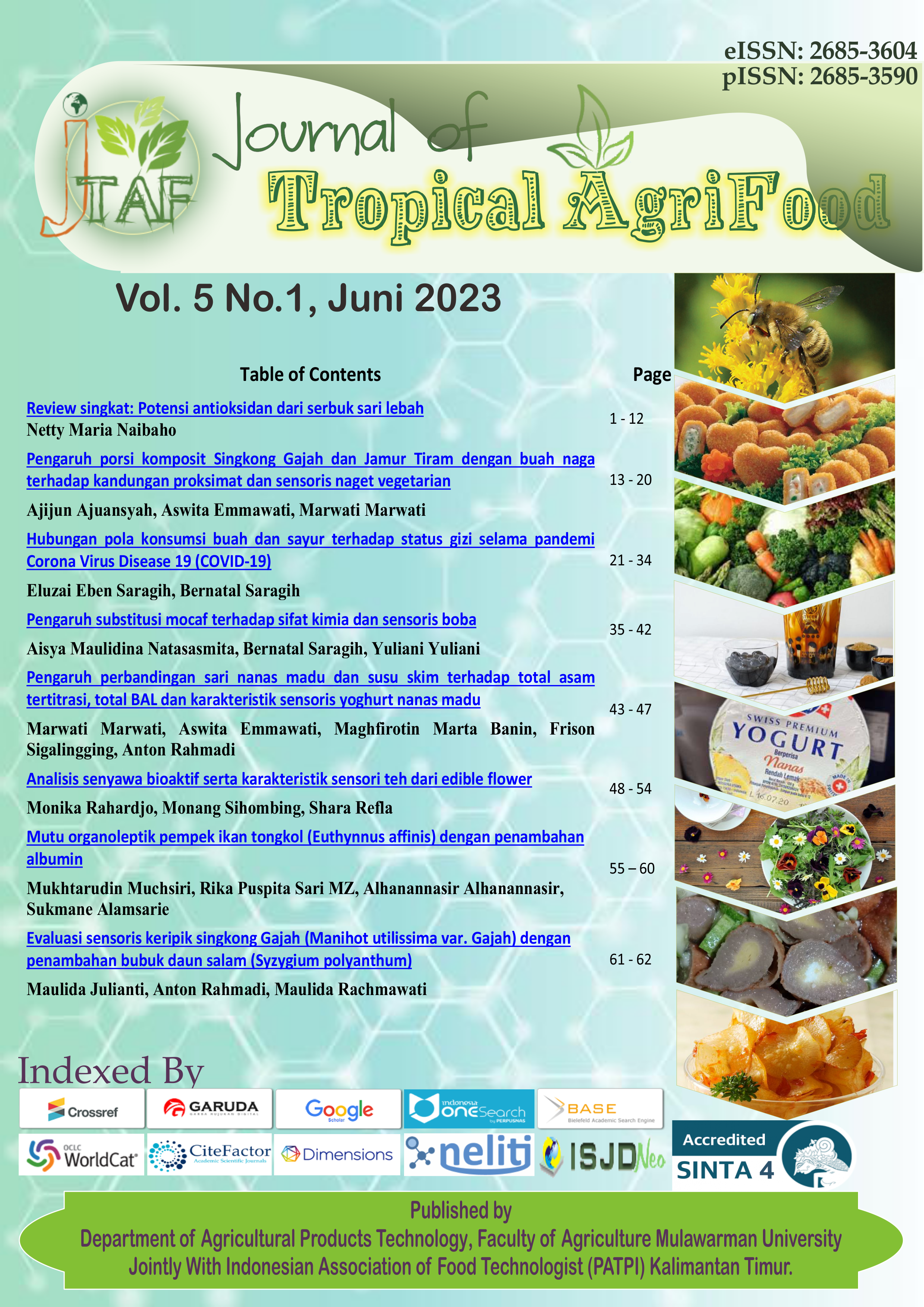
Analisis senyawa bioaktif serta karakteristik sensori teh dari edible flower
DOI:
https://doi.org/10.35941/jtaf.5.1.2023.10853.48-54Keywords:
Nasturtium, Tropaeolum maius, Torenia, Torenia fournieri, Teh, Senyawa BioaktifAbstract
Edible flower adalah jenis bunga yang aman untuk dikonsumsi. Edible flower kaya akan senyawa bioaktif seperti asam fenolik, karotenoid, dan flavonoid. Penelitian ini bertujuan untuk mengeksplorasi dua jenis edible flower, yaitu Nasturtium (Tropaeolum majus) dan Torenia (Torenia fournieri) guna pengembangannya sebagai produk teh celup. Teh celup bunga Rosella yang sudah dikenal luas digunakan sebagai produk pembanding. Pengolahan teh celup terdiri dari beberapa tahapan yaitu persiapan dan pengeringan edible flower dan proses penyeduhannya. Seduhan teh edible flower kemudian dianalisis total flavonoid, aktivitas antioksidan, dan sifat sensorisnya. Hasil penelitian menunjukkan bahwa seduhan teh celup bunga Torenia mempunyai total fenol dan aktivitas antioksidan paling tinggi, yaitu 58,04 mg QE/g ekstrak dan IC50 9,18 mg/L, disusul oleh seduhan teh celup bunga Nasturtium (45,12 mg WE/g ekstrak dan 11,62 mg/L) dan teh celup bunga Rosella (19,55 mg QE/g ekstrak dan 19,77 mg/L). Seduhan teh bunga Torenia mendapatkan respons sensoris hedonik yang setara dengan seduhan teh bunga Rosella untuk atribut warna, aroma dan rasa, yaitu disukai, tetapi lebih baik untuk atribut keseluruhan (disukai dibanding agak disukai). Sedangkan teh bunga Nasturtium mendapatkan respons sensoris hedonik lebih rendah dari keduanya. Diantara dua teh edible flower yang diuji, teh bunga Torenia lebih berpotensi untuk dikembangkan menjadi teh herbal karena mempunyai respons sensoris setara dengan teh bunga Rosella tetapi mempunyai aktivitas antioksidan yang lebih tinggi.
Downloads
References
Astuti, R.D., 2012. Evaluasi suhu penyeduhan terhadap aktivitas antioksidan teh Rosella (Hibiscus sabdariffa). Jurnal Teknologi Pangan, 6(2) p.12.
Martini, N.K.A., Ekawati, N.G.A., Ina, P.T., 2020. Pengaruh suhu dan lama pengeringan terhadap karakteristik teh bunga Telang (Clitoria ternatea L.). Jurnal Ilmu dan Teknologi Pangan, 9(3): 327-340. https://doi.org/10.24843/itepa.2020.v09.i03.p09
Catur, N., 2020. Uji Kimia dan Organoleptik Teh Mawar (Rossa sp) Berdasarkan Waktu Pengeringan. Skripsi. Universitas Widya Dharma Klaten, Klaten.
Drava, G., Iobbi, V., Govaerts, R., Minganti, V., Copetta, A., Ruffoni, B., Bisio, A., 2020. Trace elements in edible flowers from Italy: Further insights into health benefits and risks to consumers. Molecules, 25(12): 2891. https://doi.org/10.3390/molecules25122891
Hartanto, R., Fitri, S.R.F., Kawiji, K., Prabawa, S., Sigit, B., Yudhistira, B., 2021. Analisis fisik, kimia dan sensoris teh bunga Krisan Putih (Chrysanthemum morifolium Ramat.) dengan pengeringan kabinet. Agrointek, 15: 1011-1025.
Hussain, N., Ishak, I., Harith, N.M., Kuan, G.L.P., 2019. Comparison of bioactive compounds and sensory evaluation on edible flowers tea infusion. Italian Journal of Food Science, 31(2): 264-273. https://doi.org/10.14674/IJFS-1071.
Kusuma, I.G.N.B.P.B., Ratna, N.K.A.N., Kalalinggi, A.G., Widarta, I.W.R., 2020. Aktivitas antioksidan dan evaluasi sensoris teh herbal bunga Gumitir (Tagetes erecta L.). Jurnal Ilmiah Teknologi Pertanian Agrotechno, 5(2): 39-48. https://doi.org/10.24843/JITPA.2020.v05.i02.p01.
Kelley, K.M.; Behe, B.K.; Biernbaum, J.A.; Poff, K.L., 2001. Consumer preference for edible-flower color, container size, and price. HortScience, 36(4): 801-804. https://doi.org/10.21273/HORTSCI.36.4.801
Kelley, K.M.; Behe, B.K.; Biernbaum, J.A.; Poff, K.L., 2002. Combinations of colors and species of containerized edible flowers: effect on consumer preferences. HortScience, 37(1): 218-221. https://doi.org/10.21273/HORTSCI.37.1.218
Kumari, P., Ujala, Bhargava, B., 2021. Phytochemicals from edible flowers: Opening a new arena for healthy lifestyle. J Funct Foods, 78: 104375. https://doi.org/10.1016/j.jff.2021.104375.
Neves, M.I.L., Silva, E.K., Meireles, M.A.A., 2021. Natural blue food colorants: consumer acceptance, current alternatives, trends, challenges, and future strategies. Trends in Food Science & Technology, 112: 163-173. https://doi.org/10.1016/j.tifs.2021.03.023
Mlcek, J., Plaskova, A., Jurikova, T., Sochor, J., Baron, M., Ercisli, S., 2021. Chemical, nutritional and sensory characteristics of six ornamental edible flowers species. Foods, 10(9): 2053. https://doi.org/10.3390/foods10092053
Pires, T.C.S.P., Barros, L., Santos-Buelga, C., Ferreira, I.C.F.R., 2019. Edible flowers: Emerging components in the diet. Trends Food Sci Technol, 93: 244-258. https://doi.org/10.1016/j.tifs.2019.09.020
Rohkyani, I., 2015. Aktivitas Antioksidan Dan Uji Organoleptik Teh Celup Batang Dan Bunga Kecombrang Pada Variasi Suhu Pengeringan. Skripsi. Pendidikan Biologi, Universitas Muhammadiyah Surakarta, Surakarta.
Shimamura, T., Sumikura, Y., Yamazaki, T., Tada, A., Kashiwagi, T., Ishikawa, H., Matsui, T., Sugimoto, N., Akiyama, H., Ukeda, H., 2014. Applicability of the DPPH assay for evaluating the antioxidant capacity of food additives-inter-laboratory evaluation study. Analytical Sciences, 30(7): 717–721. https://doi.org/10.2116/analsci.30.717
Singh, R., Verma, P.K., Singh, G., 2012. Total phenolic, flavonoids and tannin contents in different extracts of Artemisia absinthium. Journal of Intercultural Ethnopharmacology, 1(2): 101-104. https://doi.org/10.5455/jice.20120525014326
Susiwi, S., 2009. Penilaian organoleptik. Jurusan Pendidikan Kimia FPMIPA, Universitas Pendidikan Indonesia, Bandung.
Yuan, J., Hao, L.-J., Wu, G., Wang, S., Duan, J., Xie, G.-Y., Qin, M.-J., 2015. Effects of drying methods on the phytochemicals contents and antioxidant properties of chrysanthemum flower heads harvested at two developmental stages. J Funct Foods, 19: 786-795. https://doi.org/10.1016/j.jff.2015.10.008
Downloads
Published
Issue
Section
License
As a journal Author, you have rights for a large range of uses of your article, including use by your employing institute or company. These Author rights can be exercised without the need to obtain specific permission.
Authors publishing in JTAF have wide rights to use their works for teaching and scholarly purposes without needing to seek permission, including: use for classroom teaching by Author or Author's institutionand presentation at a meeting or conference and distributing copies to attendees; use for internal training by author's company; distribution to colleagues for their reseearch use; use in a subsequent compilation of the author's works; inclusion in a thesis or dissertation; reuse of portions or extrcats from the article in other works (with full acknowledgement of final article); preparation of derivative works (other than commercial purposes) (with full acknowledgement of final article); voluntary posting on open web sites operated by author or author’s institution for scholarly purposes (follow CC by SA License).
Authors and readers can copy and redistribute the material in any medium or format, as well as remix, transform, and build upon the material for any purpose, even commercially, but they must give appropriate credit (cite to the article or content), provide a link to the license, and indicate if changes were made. If you remix, transform, or build upon the material, you must distribute your contributions under the same license as the original.