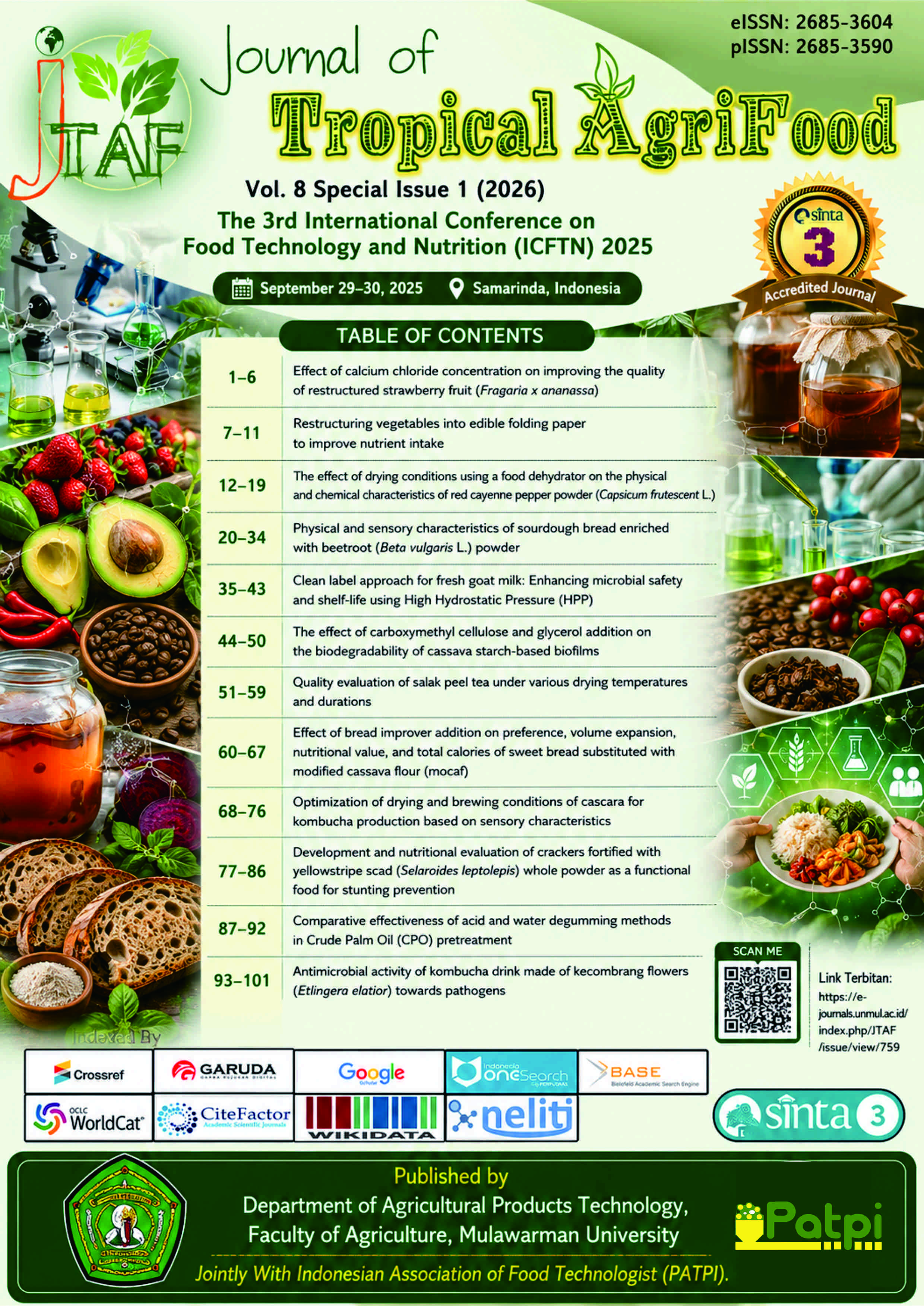
Effect of bread improver addition on preference, volume expansion, nutritional value, and total calories of sweet bread substituted with modified cassava flour (mocaf)
DOI:
https://doi.org/10.35941/jtaf.8.5.2026.26724.60-67Keywords:
Bread improver, mocaf, nutritional value, sweet bread, total caloriesAbstract
Modified cassava flour (mocaf) can be used as an alternative to wheat flour to reduce wheat flour consumption. Previous research has shown that substituting wheat flour with mocaf to produce sweet bread with physical and sensory characteristics similar to those of sweet bread made from 100% wheat flour requires a maximum of 20%. Efforts to increase the mocaf substitution to 40% must be accompanied by product modifications, such as the addition of a bread improver, to ensure that the resulting bread remains soft and palatable. This study aimed to determine the effect of adding a bread improver on the preference, volume expansion, nutritional value, and total calories of sweet bread substituted with 40% mocaf. The study was designed using a non-factorial Completely Randomized Design. The amount of bread improver added was 0 g (control), 0.2, 0.4, 0.6, and 0.8 g. The results of the study showed that the addition of bread improvers had a significant effect (p <0.05) (based on the Duncan Multiple Range Test) on total calories, as well as water, ash, protein, and carbohydrate content, and preference for texture, outer color, and inner color of sweet bread (based on the Dunn post hoc test). There was an increase in water, ash, and protein content and a decrease in carbohydrate and total calorie content with increasing amounts of bread improver added to sweet bread, making it a healthier alternative to bread. Meanwhile, the fat content and bread volume expansion were not affected by the amount of bread improver. The panelists liked the color, aroma, texture, and taste of the sweet bread. The addition of a bread improver of 0.8 g / 100 g produced bread that could match the nutritional value and total calories of sweet bread made from 100% wheat flour (without mocaf substitution).
Downloads
References
Abidin, A.Z., Devi, C., Adeline, 2013. Development of wet noodles based on cassava flour. Journal of Engineering and Technological Sciences 45(1), 97–111. https://doi.org/ 10.5614/j.eng.technol.sci.2013.45.1.7
Almatsier, S. 2002. Prinsip Dasar Ilmu Gizi. PT Gramedia Pustaka utama, Jakarta.
AOAC., 1995. Official Methods of Analysis of AOAC International. In L. GW (Ed.), Journal Of AOAC International (21 ed., Vol. 1).
BPS, 2023. Impor Biji Gandum dan Meslin menurut Negara Asal Utama, 2017-2022. Badan Pusat Statistik. https://www.bps.go.id/id/statisticstable/1/MjAxNiMx/impor-biji-gandum-dan-meslin-menurut-negara-asal-utama2017-2022.html
Chen, Y., Eder, S., Schubert, S., Gorgerat, S., Boschet, E., Baltensperger, L., Boschet, E., St, C., Kuster, S., Fischer, P., Windhab, E. J., 2021. Influence of amylase addition on bread quality and bread staling. ACS Food Science & Technology 1, 1143–1150. https://doi.org/10.1021/acsfoodscitech.1c00158
Dinas Pangan, Tanaman Pangan, dan Hortikultara, Kalimantan Timur, 2021. Data Pertanian tanaman pangan 2016-2020. Satu Data Kalimantan Timur. https://data.kaltimprov.go.id/dataset/datapertanian-provinsi-kaltim-tahun-2016-2020.
Dwipayanti, H., Agustini, N.P., Antarini, A.A.N., 2020. Pengaruh rasio tepung mocaf dan tepung tempe terhadap karakteristik brownies kukus. Jurnal Ilmu Gizi: Journal of Nutrition Science 11(2), 96–104. https://doi.org/10.33992/jig.v11i2.1185
Fadilah, A.N., Widodo, W., Widodo, A.S., 2015. Sikap konsumen terhadap produk donat berbahan mocaf sebagai pengganti tepung terigu. AGRARIS: Journal of Agribusiness and Rural Development Research 1(2), 149–156. https://doi.org/10.18196/agr.1218
Hastian, Basir, E., 2022. Pengaruh jenis tepung terhadap karakteristik karbohidrat dan organoleptik kerupuk stick tempe. Sultra Journal of Economic and Business 3(1), 79–92.
Helilusiatiningsih, N., 2023. Teknologi pengolahan tepung mocaf dengan 3 metode fermentasi, kajian analisis proksimat. Journal of Food Technology and Agroindustry 5(2), 97–101. https://doi.org/10.24929/jfta.v5i2.2772
Kartikasari, S.N., Sari, P., Subagio, A., 2019. The effect of improver addition on sweet bread made from wheat flour. Food ScienTech Journal 1(1), 8-19. https://doi.org/10.33512/fsj.v1i1.6193
Koswara, S., 2009. Teknologi Pengolahan Roti. eBookPangan. https://tekpan.unimus.ac.id/wp-content/uploads/2013/07/Teknologi-Roti-Teoridan-Praktek.pdf
Kusnedi, R., 2021. Pengaruh penambahan pengembang roti terhadap parameter organoleptik pada pembuatan roti manis. Jurnal British 1(2), 60–71.
Lambert-Meretei, A., Szendrei, E., Nogula-Nagy, M., 2010. Methode to evaluate the effects of bread improver additive on bread crumb texture properties. Acta Alimentaria, An Internasional Journal of Food Science 39(2), 180-191. https://doi.org/10.1556/aalim.39.2010.2.10
Male, U., Naiu, A. S., Yusuf, N., 2017. Karakteristik gizi roti manis ubi jalar dengan penambahan bubur rumput laut. Jurnal Ilmiah Perikanan dan Kelautan, 5(3), 60–64. https://doi.org/10.37905/.v5i3.5282
Natasia, Facrureza, D., 2023. Pengaruh substitusi alpukat mentega dan alpukat pluwang dalam pembuatan sponge cake terhadap daya terima masyarakat dan uji proksimat. Jurnal Manajemen Perhotelan dan Pariwisata 6(2), 468–478.
Nur’utami, D.A., Fitrilia, T., Oktavia, D., 2020. Pengaruh lama fermentasi terhadap karakteristik sensori dan daya kembang roti mocaf (modified cassava flour). Jurnal Agroindustri Halal 6(2), 197–204. https://doi.org/10.30997/jah.v6i2.3255
Nuraisyah, A., Raharja, S., Udin, F., 2018. Karakteristik kimia roti tepung beras dengan tambahan enzim transglutaminase. Jurnal Teknologi Industri Pertanian 28(3), 319–331.
Puspitasari, B.C., Widyastuti, S., Amaro, M., 2023. Pengaruh konsentrasi ragi roti instan dan karagenan terhadap mutu roti tawar tersubstitusi tepung sorgum. Pro Food: Jurnal Ilmu dan Teknologi Pangan 9(1), 33–45. https://doi.org/10.29303/profood.v9i1.296
Putri, D.A., 2023. Review: Evaluasi fisik terhadap penggunaan tepung komposit pada kualitas cookies. Food Scientia Journal of Food Science and Technology 3(1), 1–26. https://doi.org/10.33830/fsj.v3i1.3696.2023
Putri, N.P.Y.A.E., Damiati, D., Marsiti, C.I.R., 2021. Uji kualitas red velvet cake dengan menggunakan ekstrak umbi bit (Beta vulgaris L.) sebagai bahan pewarna. Jurnal Kuliner 1(1), 1–14. https://doi.org/10.23887/jk.v1i1.32811
Ridhani, M.A., Vidyaningrum, I.P., Akmala, N.N., Fatihatunisa, R., Azzahro, S., Aini, N., 2021. Potensi penambahan berbagai jenis gula terhadap sifat sensori dan fisikokimia roti manis: Review. Pasundan Food Technology Journal 8(3), 61– 68. https://doi.org/ 10.23969/pftj.v8i3.4106
Riskiani, D., Ishartani, D., Affandi, D.R., 2014. Pemanfaatan tepung ubi ganyong (Canna edulis Ker.) sebagai pengganti tepung terigu dalam pembuatan biskuit tinggi energi protein dengan penambahan tepung kacang merah (Phaseolus vulgaris L.). Jurnal Teknosains Pangan 3(1), 96–105.
Rosalina, L., Suyanto, A., Yusuf, M., 2018. Kadar protein, elastisitas, dan mutu hedonik mie basah dengan substitusi tepung ganyong. Jurnal Pangan dan Gizi 8(1), 1–10. https://doi.org/10.26714/jpg.8.1.2018.1-10
Setyaningsih, D., Apriyantono, A., Sari, M. P., 2010. Analisis Sensori untuk Industri Pangan dan Agro. IPB Press, Bogor.
Tako, M., Tamaki, Y., Teruya, T., Takeda, Y., 2014. The Principles of starch gelatinization and retrogradation. Food and Nutrition Sciences (5), 280–291. http://doi.org/ 10.4236/fns.2014.53035
Wardani, D.E., Liviawaty, Junianto, 2012. Fortifikasi tepung tulang tuna sebagai sumber kalsium terhadap tingkat kesukaan donat. Jurnal Perikanan dan Kelautan 3(4), 41–50.
Yasa, I.W.S., Zainuri, Z., Zaini, M.A., Hadi, T., 2016. Mutu roti berbahan dasar mocaf: “formulasi dan metode pembuatan adonan". Pro Food: Jurnal Ilmu dan Teknologi Pangan 2(2), 120–126.
Zarkasie, I.M., Prihandini, W.W., Gunawan, S., Aparamarta, H.W., 2017. Pembuatan tepung singkong termodifikasi dengan kapasitas 300.000 ton/tahun. Jurnal Teknik ITS 6(2), 621-623. https://doi.org/10.12962/j23373539.v6i2.24923
Zhang, A., 2020. Effect of wheat flour with different quality in the process of making flour products. International Journal of Metrology and Quality Engineering 11(6), 1-6. https://doi.org/10.1051/ijmqe/2020005
Downloads
Published
Issue
Section
License
As a journal Author, you have rights for a large range of uses of your article, including use by your employing institute or company. These Author rights can be exercised without the need to obtain specific permission.
Authors publishing in JTAF have wide rights to use their works for teaching and scholarly purposes without needing to seek permission, including: use for classroom teaching by Author or Author's institutionand presentation at a meeting or conference and distributing copies to attendees; use for internal training by author's company; distribution to colleagues for their reseearch use; use in a subsequent compilation of the author's works; inclusion in a thesis or dissertation; reuse of portions or extrcats from the article in other works (with full acknowledgement of final article); preparation of derivative works (other than commercial purposes) (with full acknowledgement of final article); voluntary posting on open web sites operated by author or author’s institution for scholarly purposes (follow CC by SA License).
Authors and readers can copy and redistribute the material in any medium or format, as well as remix, transform, and build upon the material for any purpose, even commercially, but they must give appropriate credit (cite to the article or content), provide a link to the license, and indicate if changes were made. If you remix, transform, or build upon the material, you must distribute your contributions under the same license as the original.