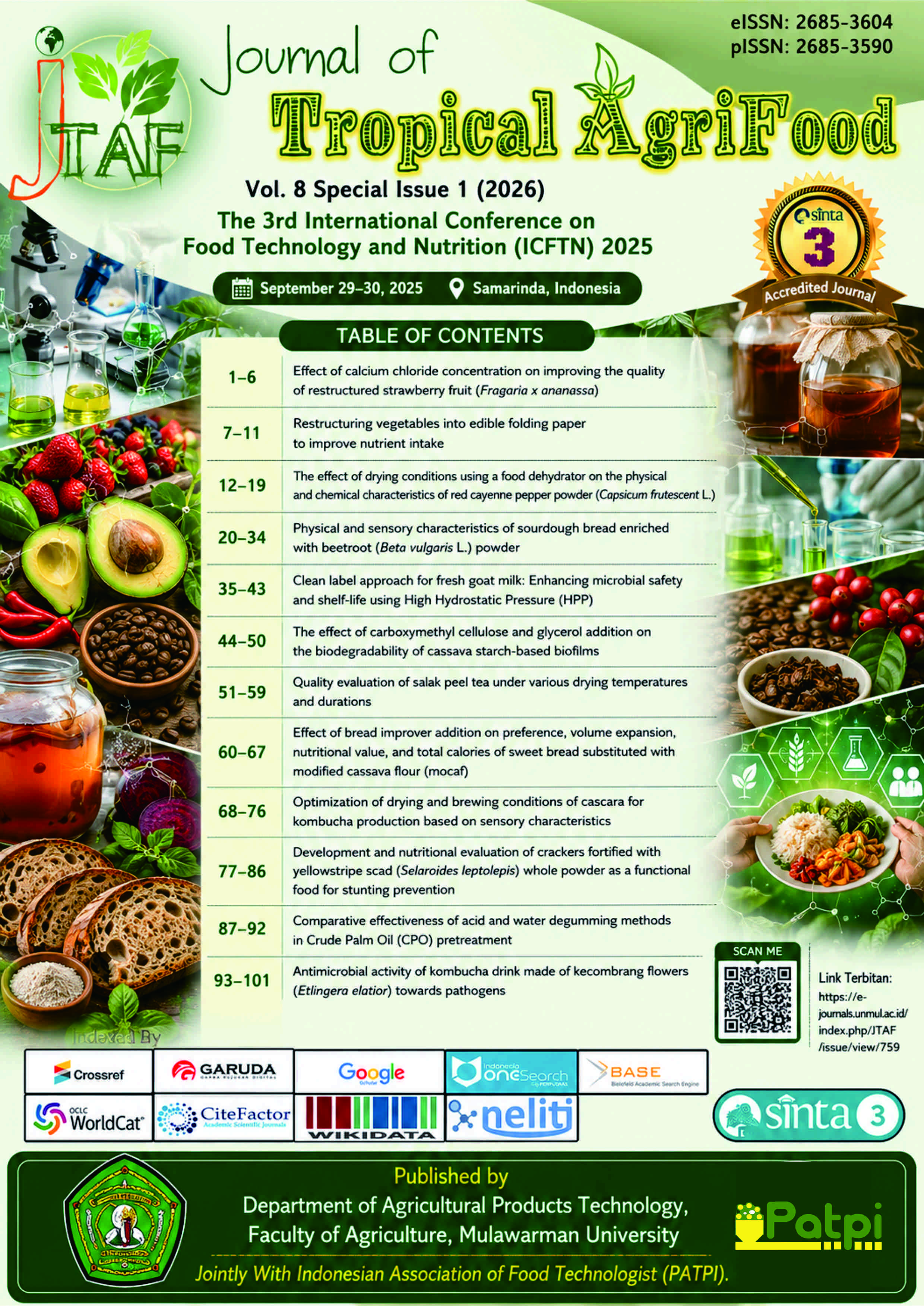
Quality evaluation of salak peel tea under various drying temperatures and durations
DOI:
https://doi.org/10.35941/jtaf.8.5.2026.26723.51-59Keywords:
Salak peel, drying method, organolepticAbstract
Salak peel, commonly discarded as agricultural waste, contains bioactive compounds that can be developed into functional food products, such as herbal tea. The quality of this tea is significantly influenced by the drying process, particularly in terms of temperature and drying duration. This study investigated the effects of different drying temperatures and durations on the sensory and nutritional characteristics of salak peel tea. Drying was carried out at three temperature levels (60, 70, and 80°C) combined with six drying durations (2, 4, 6, 8, 10, and 12 h). Sensory attributes, including color, aroma, and taste, were evaluated, and the data were analyzed using factorial ANOVA, followed by Duncan’s multiple range test at a 5% significance level. The findings revealed that temperature and drying time significantly affected the sensory quality of the salak peel tea. The optimum conditions were observed at 70°C for 4 h, producing scores of 3.8, 3.76, and 3.5 for color, aroma, and taste, respectively. Proximate analysis of the best treatment indicated a moisture content of 3.85%, ash of 5.77%, protein of 0.55%, fat of 0.06%, and carbohydrate of 89.77%. These results suggest that drying at 70°C for 4 h is the most suitable treatment for producing salak peel tea with desirable sensory characteristics and proximate composition.
Downloads
References
AOAC, 2006. Official Methods of Analysis of AOAC International. AOAC International.
Bahar, A., Romadhoni. I.F., Iriyani, D. Phytochemical analysis of herbal teabags based on drying temperature. Amerta Nutri. 2025, 119-127.
Bimo, I., Yusa Ali, D., Bekti Sunarharum, W., Mua, N., Evanarda Athirah, C., Syakira Jatmiko, N., Dyah Pranita, M., n.d. The effects of drying temperature and duration on rose tea chemical and sensory profiles as a functional beverage. Advances in Food Science, Sustainable Agriculture and Agroindustrial Engineering 2025, 21–32.
BPS. Statistik sayur-sayuran dan buah-buahan Provinsi Kalimantan Timur. 2025.
Čepková, P.H., Jágr, M., Janovská, D., Dvořáček, V., Kozak, A.K., Viehmannová, I., 2021. Comprehensive mass spectrometric analysis of snake fruit: Salak (Salacca zalacca). J. Food Qual. 2021. https://doi.org/10.1155/2021/6621811
Devi, Y.P., Kshetri, P., Bhupenchandra, I., Piloo, N.G., Singh, H.N., Devi, A.K., Khangembam, R., Langamba, P., Singh, T.S., Roy, S.S., Devi, Y.J., 2022. Proximate and in vitro bioactivity analysis of fruit tea infusions prepared with locally available fruits of Manipur, India. Journal of Crop and Weed 18, 104–110. https://doi.org/10.22271/09746315.2022.v18.i1.1539
Djaafar, T.F., Marwati, T., Budiyanti, T., Riska, Hadiati, S., 2024. Chemical and sensory evaluation on several varieties of salak (Salacca zalacca) fruit from Indonesia. Int. J. Dv. Sci. Eng. Inf. Technol. 14(2), 723-729. https://doi.org/10.18517/ijaseit.14.2.19175
Dzah, C.S., 2015. Sensory performance, proximate and antioxidant activity of tea from composite formulation of Cymbopogon citratus, Lippia multiflora and Ganoderma lucidum. Journal of Food and Nutrition Sciences 3(3), 131-138. https://doi.org/10.11648/j.jfns.20150303.19
Girsang, E., Ginting, C., Lister, I., Wijayanti, C., Widowati, W., Rizal, R., 2022. Antioxidant properties of Salacca zalacca (Gaertn.) voss peel ethanolic extract compared to chlorogenic acid. Proceedings of the 1st International Conference on Emerging Issues in Technology, Engineering and Science (ICE-TES 2021), 87–94. https://doi.org/10.5220/0010744700003113
Girsang, E., Ginting, C.N., Lister, I.N.E., Gunawan, K.Y., Widowati, W., 2021. Anti-inflammatory and antiaging properties of chlorogenic acid on UV-induced fibroblast cell. PeerJ 7(9), e11419. https://doi.org/10.7717/peerj.11419
Jin, J.C., Liang, S., Qi, S.X., Tang, P., Chen, J.X., Chen, Q.S., Chen, Y.F., Yin, J.F., Xu, Y.Q., 2023. Widely targeted metabolomics reveals the effect of different raw materials and drying methods on the quality of instant tea. Front. Nutr. 10. https://doi.org/10.3389/fnut.2023.1236216
Kowalska, H., Czajkowska, K., Cichowska, J., Lenart, A., 2017. What’s new in biopotential of fruit and vegetable by-products applied in the food processing industry. Trends Food Sci. Technol. https://doi.org/10.1016/j.tifs.2017.06.016
Kusdarini, E., Budianto, A., Nilam Kusuma, M., Atiyatussa, E., Surabaya Jl Arief Rachman Hakim, T., n.d. Adsorption Capacity of Magnetic Activated Carbon Derived from Snake Fruit (Salacca zalacca) Seeds to Cd(II): Characteristics and Isotherm Model 25, 12–18. https://doi.org/10.14710/reaktor
Latarissa, S.H., Breemer, R., Palijama, S., 2022. Effect of Drying time on chemical and sensory characteristics of nutmeg peel herbal tea (Myristica fragrans Houtt). Jurnal Agrosilvopasture-Tech 1, 66–72. https://doi.org/10.30598/j.agrosilvopasture-tech.2022.1.2.66
Luo, Z., Ma, L., Zhang, Y., Liu, Yanhong, Yang, R., Dai, X., Wang, T., Lv, C., Zuo, L., Liu, Yanli, Cao, D., Yuan, H., Yu, L., Jin, X., 2025. Effect of drying methods on aroma profiling of large-leaf green tea (Camellia sinensis var. Assamica) determined by HS-SPME-GC-MS. Foods 14. https://doi.org/10.3390/foods14071275
Mao, Y.L., Wang, J.Q., Wang, F., Cao, Q.Q., Yin, J.F., Xu, Y.Q., 2024. Effect of different drying temperature settings on the color characteristics of Tencha. Food Chem. X 24. https://doi.org/10.1016/j.fochx.2024.101963
Mazumdar, P., Pratama, H., Lau, S.E., Teo, C.H., Harikrishna, J.A., 2019. Biology, phytochemical profile and prospects for snake fruit: An antioxidant-rich fruit of South East Asia. Trends Food Sci. Technol. https://doi.org/10.1016/j.tifs.2019.06.017
Okolo, C.A., Mba, J.C., Chinedum Ezegbe, C., Oladimeji Olubusayo, K., Obiegbuna, J.E., 2022. Comparative study on proximate, phytochemical and sensory evaluation of Asystasia gangetica and market herbal tea. American Journal of Food and Nutrition 10, 24–27. https://doi.org/10.12691/ajfn-10-1-3
Rachmadani, A.D., Aulia, F., Alamzyah Putra, R., Haifan, M., 2025. Pengaruh jenis kulit salak dan suhu pengeringan pada pembuatan teh kulit salak (Salacca edulis). Jurnal IPTEK 9(2), 8-15. https://doi.org/10.31543/jii.v9i2.396
Saleh, M.S.M., Siddiqui, M.J., Soad, S.Z.M., Murugesu, S., Khatib, A., Rahman, M.M., 2018a. Antioxidant and α-glucosidase inhibitory activities and gas chromatography-mass spectrometry profile of salak (Salacca zalacca) fruit peel extracts. Pharmacognosy Res. 10, 385–390. https://doi.org/10.4103/pr.pr_7_18
Saleh, M.S.M., Siddiqui, M.J., Mediani, A., Ismail, N.H., Ahmed, Q.U., So’ad, S.Z.M., Saidi-Besbes, S., 2018b. Salacca zalacca: A short review of the palm botany, pharmacological uses and phytochemistry. Asian Pac. J. Trop. Med. 11(12), 645-652. https://doi.org/10.4103/1995-7645.248321
Saputri, R., Ardianti, A.D., Ardhana, R., Saputra, K., Anwar, M., Huda, M.M., 2024. Pelatihan produksi teh kulit salak bagi ibu rumah tangga sebagai produk wirausaha. Jurnal Penelitian dan Pengabdian Kepada Masyarakat UNSIQ 11(1), 44–51. https://doi.org/10.32699/ppkm.v11i01.5683
Smith, A., Pattiasina, E.B., Simal, R., Karepesina, F.H., Raharusun, A.N., Baysi, A.R., 2024. The effect of drying duration on water content and ash content of red salak fruit (Salacca edulis) herbal tea. Jurnal Keteknikan Pertanian Tropis dan Biosistem 12, 161–167. https://doi.org/10.21776/ub.jkptb.2024.012.03.02
Su, D., Zhu, J., Li, Y., Qin, M., Lei, Z., Zhou, J., Yu, Z., Chen, Y., Zhang, D., Ni, D., 2025. Effect of drying temperature on sensory quality, flavor components, and bioactivity of lichuan black tea processed by echa no. 10. Molecules 30(2), 361. https://doi.org/10.3390/molecules30020361
Suica-Bunghez, I.R., Teodorescu, S., Dulama, I.D., Voinea, O.C., Imionescu, S., Ion, R.M., 2016. Antioxidant activity and phytochemical compounds of snake fruit (Salacca zalacca), in: IOP Conference Series: Materials Science and Engineering. Institute of Physics Publishing. https://doi.org/10.1088/1757-899X/133/1/012051
Sunday, Jane, A., Effiong, Nyong, B., Edima-Nyah, Peter, A., 2024. Production and evaluation of herbal tea blends from zobo (Hibiscus sabdariffa) and jacobinia (Justicia carnea) fortified with ginger (Zingiber officinale). World Journal of Innovation and Modern Technology 8(5), 131-149. https://doi.org/10.56201/wjimt.v8.no5.2024.pg131.149
Surbakti, C.I., Barus, B.R., 2022. Manufacture of active carbon tablets from salacca (Salacca zalacca) seeds as anti-diarrhea treatment. JBIO: Jurnal Biosains 8(1), 30-34. https://doi.org/10.24114/jbio.v8i1.32356
Tan, S.S., Tan, S.T., Tan, C.X., 2020. Antioxidant, hypoglycemic and anti-hypertensive properties of extracts derived from peel, fruit and kernel of Salak. British Food Journal 122(10), 3029–3038. https://doi.org/10.1108/BFJ-03-2020-0233
Wickramarachchi, A.R., Herath, H.M.L.K., Jayasinghe-Mudalige, U.K., Edirisinghe, J.C., Udugama, J.M.M., Lokuge, L.D.M.N., Wijesuriya, W., 2017. An analysis of price behavior of major poultry products in Sri Lanka. J. Agric. Sci. (Belihuloya). 12(2), 138-148. https://doi.org/10.4038/jas.v12i2.8231
Zhao, Y., Peng, Q., Chang, L., Wang, Z., Lin, Z., Shi, J., Dong, C., 2025. Metabolomics and sensory evaluation combined analysis reveal the effect of processing methods and different forms on the flavor of rose herbal tea. NPJ Sci. Food 9, 45. https://doi.org/10.1038/s41538-025-00387-x
Downloads
Published
Issue
Section
License
As a journal Author, you have rights for a large range of uses of your article, including use by your employing institute or company. These Author rights can be exercised without the need to obtain specific permission.
Authors publishing in JTAF have wide rights to use their works for teaching and scholarly purposes without needing to seek permission, including: use for classroom teaching by Author or Author's institutionand presentation at a meeting or conference and distributing copies to attendees; use for internal training by author's company; distribution to colleagues for their reseearch use; use in a subsequent compilation of the author's works; inclusion in a thesis or dissertation; reuse of portions or extrcats from the article in other works (with full acknowledgement of final article); preparation of derivative works (other than commercial purposes) (with full acknowledgement of final article); voluntary posting on open web sites operated by author or author’s institution for scholarly purposes (follow CC by SA License).
Authors and readers can copy and redistribute the material in any medium or format, as well as remix, transform, and build upon the material for any purpose, even commercially, but they must give appropriate credit (cite to the article or content), provide a link to the license, and indicate if changes were made. If you remix, transform, or build upon the material, you must distribute your contributions under the same license as the original.