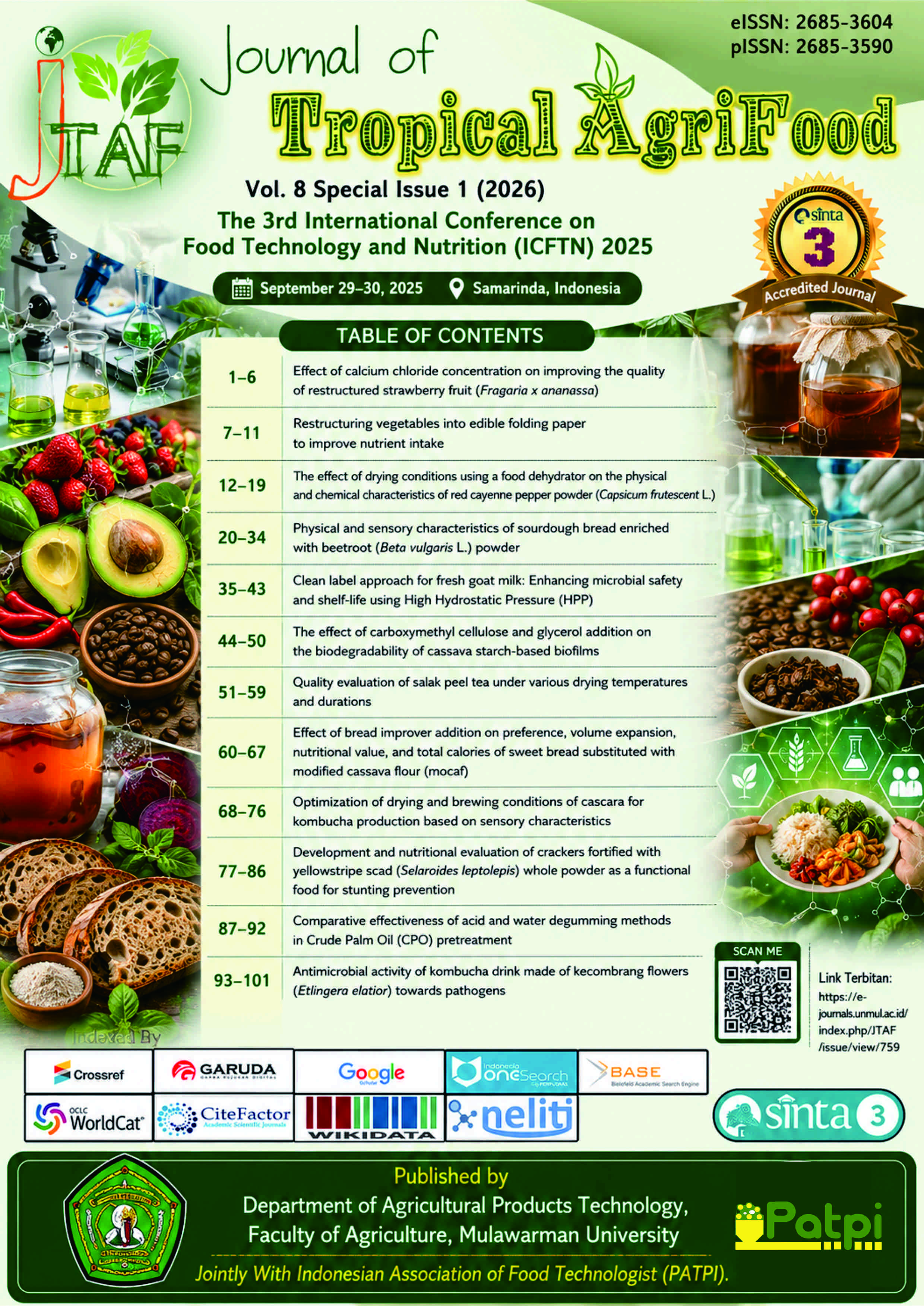
Clean label approach for fresh goat milk: Enhancing microbial safety and shelf-life using High Hydrostatic Pressure (HPP)
DOI:
https://doi.org/10.35941/jtaf.8.5.2026.26717.35-43Keywords:
Clean label, fresh goat milk, high hydrostatic pressure, microbial safety, shelf lifeAbstract
The clean-label approach has gained global interest as consumers increasingly prefer minimally processed foods without synthetic additives. Concurrently, the demand for goat milk products is rising because of their nutritional and health benefits. This study investigated the application of high hydrostatic pressure (HHP) for controlling microbial growth and inactivating Salmonella typhimurium in fresh Saanen goat milk. Microbiological evaluation of HHP-treated milk samples included an S. typhimurium (ATCC 14028) challenge test and monitoring of total plate count, yeast and mold, coliforms, Escherichia coli, Staphylococcus aureus, lactic acid bacteria, and Salmonella during storage. Specifically, HHP was applied at 600 MPa for 6 min using food-grade spout-pouch packaging, based on prior optimization. HHP milk samples achieved complete inactivation of S. typhimurium, with reductions of 6 log10 CFU/mL at high spike levels and 3 log10 CFU/mL at low spike levels, demonstrating microbial decontamination kinetics. Shelf-life evaluation showed that HHP-treated milk retained acceptable microbiological, physicochemical, and sensory qualities for up to 75 d under chilled storage (2±7 °C), while fresh untreated milk spoiled by day 6, exceeding permissible microbial limits. Beyond 75 d, viscosity degradation was observed in HHP-treated milk. These findings confirm that optimized HHP treatment enhances microbial safety and extends shelf life, supporting its role in developing clean-label goat milk products.
Downloads
References
APHA (American Public Health Association) 2000. in: Downes, F.P. and Ito, K. (Eds.) Compendium of Methods for the Microbiological Examination of Foods. 4th ed. Washington D.C., USA.
Alexandros, C.S., Elena, S.I., Mark, L., Joan, T., Liam, M., Nicolae, C., et al., 2019. Effect of high pressure processing on the safety, shelf life and quality of raw milk. Innovative Food Science and Emerging Technologies, 52: 325-333.
AOAC (American Official of Analytical Chemistry), 2000. Official Methods of Analysis. 17th ed. Gaithersburg, USA.
BAM (Bacteriological Analytical Manual), 2002. in: Feng, P., Weagant, S.D., Grant, M.A., Burkhardt, W., Shellfish, M., Water, B. https://www.fda.gov/food/foodscienceresearch/laboratorymethods/ucm064948.htm.
Barraquio, V.L., 2014. Which milk is fresh? International Journal of Dairy Processing and Research 1, 1-6.
Bogahawaththa, D., Buckow, R., Chandrapala, J., Vasiljevic, T., 2018. Comparison between thermal pasteurization and high pressure processing of bovine skim milk in relation to denaturation and immunogenicity of native milk proteins. Innovative Food Science and Emerging Technologies 47, 301-308.
CFSHK (Centre for Food Safety Hong Kong) 2014. Microbiological Guidelines for Food for Ready-To-Eat Food in General and Specific Food Items, Food and Environmental. Hygiene Department. https://www.cfs.gov.hk/english/food_leg/files/food_leg_Microbiological_Guidelines_ for_Food_e.pdf.
Chye, F.Y., Abdullah, A., Ayob, M.K., 2004. Bacteriological quality and safety of raw milk in Malaysia. Food Microbiology 21, 535–541.
Claeys, W.L., Cardoen, S., Daube, G., De Block, J., Dewettinck, K., Dierick, K., et al., 2013. Raw or heated cow milk consumption: Review of risks and benefits. Food Control 31, 251–262.
Erkmen, O., 2011. Effects of high hydrostatic pressure on Salmonella typhimurium and aerobic bacteria in milk and fruit juices. Romanian Biotechnological Letters 16(5), 6540-6547.
Evelyn, E., Silva, F.V.M., 2017. Inactivation of pathogenic microorganisms in foods by high pressure processing, in: Rai, V.R. and Bai, J.A. Food Safety and Protection (Eds.) CRC Press: USA. 341-377. https://doi.org/10.1201/9781315153414-10.
FSANZ (Food Standards Australia New Zealand), 2018. Compendium of Microbiological Criteria for Food, Section 1, Table 1-3. https://www.foodstandards.gov.au/publications/documents/compendiumof_microbiological_criteria_compendium_revised_jan2018.pdf.
Granato, D., Masson, M.L., Ribeiro, J.C.B., 2010. Sensory evaluation and physicochemical optimisation of soy-based desserts using response surface methodology. Food Chemistry 121, 899-906. https://doi.org/10.1016/j.foodchem.2010.01.014.
Liepa, M., Zagorska, J., Galoburda, R., 2017. Effect of high pressure processing on milk coagulation properties. Livestock Research for Rural Development 1, 223-229.
Lim, S.H., Chin, N.L., Sulaiman, A., Tay, C. H., Wong, T. H., 2023. Microbiological, physicochemical and nutritional properties of fresh cow milk treated with industrial High‑Pressure Processing (HPP) during storage. Foods 12, 592. https://doi.org/10.3390/foods12030592
Liu, G., Carøe, C., Qin, Z., Munk, D.M.E., Crafack, M., Petersen, M.A., Ahrné, L., 2020. Comparative study on quality of whole milk processed by high hydrostatic pressure or thermal pasteurization treatment. LWT - Food Science and Technology 127, 109370.
Mahmood, A., Usman, S.A., 2010. Comparative study on the physicochemical parameters of milk samples collected from buffalo, cow, goat and sheep of Gujrat, Pakistan. Pakistan Journal of Nutrition 9, 1192–1197.
Ministry of Agriculture and Food Industries, 2021. Executive Summary: National Agrofood Policy 2021-2030 (NAP 2.0) Agrofood Modernisation: Safeguarding the Future of National Food Security. Ministry of Agriculture and Food Industries, Federal Government Administrative Center, Malaysia.
Mussa, D.M., Ramaswamy, H.S., 1997. Ultra high pressure pasteurization of milk: Kinetics of microbial destruction and changes in physico-chemical characteristics. Journal of Food Science and Technology 30, 551–557.
Mustapa Kamal, S.M., Sulaiman, A., Md Hazmi, N.A., 2021. Effect of High-Pressure processing (HPP) on composition, lactose and microstructure of goat milk. Food Research 5(1), 107-113. https://doi.org/10.26656/fr.2017.5(S1).050.
Park, Y.W., Juárez, M., Ramos, M., Haenlein, G. F. W., 2007. Physico-chemical characteristics of goat and sheep milk. Small Ruminant Research 68(1-2), 88-113.
Pereda, J., Ferragut, V., Quevedo, J.M., Guamis, B., Trujillo, A.J., 2007. Effects of ultra-high pressure homogenization on microbial and physicochemical shelf life of milk. Journal of Dairy Science 90, 1081-1093.
Rademacher, B., Kessler, H.G., 1997. High pressure inactivation of microorga-nisms and enzymes in milk and milk products. In: High Pressure Bio-Science and Biotechnology, Elsevier, Amsterdam, 291–293.
Razali, M.F., Narayanan, S., Hazmi, N.A.M., Shah, N.N.A.K., Kamal, S.M.M., Fauzi, N.A.M., Sulaiman, A., 2021. Minimal processing for goat milk preservation: Effect of high-pressure processing on its quality. Journal of Food Processing and Preservation 45, e15590. https://doi.org/10.1111/jfpp.15590
Roobab, U., Inam-Ur-Raheem, M., Khan, W.W., Arshad, R.N., Zeng, X., Aadil, R.M., 2023. Innovations in high-pressure technologies for the development of clean label dairy products: A review. Food Reviews International 39, 970-991. https://doi.org/10.1080/87559129.2021.1928690.
Serna-Hernandez, S.O., Escobedo-Avellaneda, Z., García-García, R., Rostro-Alanis, M.J., Welti-Chanes, J., 2021. High hydrostatic pressure induced changes in the physicochemical and functional properties of milk and dairy products: A review. Foods 12(10), 1867. https://doi: 10.3390/foods10081867.
Stratakos, A.C., Inguglia, E.S., Linton, M., Tollerton, J., Murphy, L., Corcionivoschi, N., Koidis, A., Tiwari, B.K., 2019. Effect of high pressure processing on the safety, shelf life and quality of raw milk. Innovative Food Science and Emerging Technologies 52, 325-333. https://doi.org/10.1016/j.ifset.2019.01.009.
Tan, S.F., Chin, N. L., Tee, T. P., Chooi, S. K., 2020. Physico‑chemical changes, microbiological properties, and storage shelf life of cow and goat milk from industrial high‑pressure processing. Processes 8, 697.
US-FDA, DHHS, 2001. Hazard Analysis and Critical Control Point (HACCP): Procedures for the safe and sanitary processing and importing of juice. 21 CFR Part 120, Federal Register 66, 6138-6202.
Yang, B., Shi, Y., Xia, X., Xi, M., Wang, X., Ji, B., Meng, J., 2012. Inactivation of foodborne pathogens in raw milk using high hydrostatic pressure. Food Control 28(2), 273–278. https://doi.org/10.1016/j.foodcont.2012.04.030
Zobrist, M.R., Huppertz, T., Uniacke, T., Fox, P.F., Kelly, A.L., 2005. High-pressure-induced changes in the rennet coagulation properties of bovine milk. International Dairy Journal 15(6-9), 655-662. https://doi.org/10.1016/j.idairyj.2004.07.025.
Zhu, L., Fan, Z., Li, W., Shan, Y., 2025. Goat milk exhibits a higher degree of protein oxidation and aggregation than cow milk during cold storage. Foods 14, 852. https://doi.org/10.3390/ foods14050852.
Downloads
Published
Issue
Section
License
As a journal Author, you have rights for a large range of uses of your article, including use by your employing institute or company. These Author rights can be exercised without the need to obtain specific permission.
Authors publishing in JTAF have wide rights to use their works for teaching and scholarly purposes without needing to seek permission, including: use for classroom teaching by Author or Author's institutionand presentation at a meeting or conference and distributing copies to attendees; use for internal training by author's company; distribution to colleagues for their reseearch use; use in a subsequent compilation of the author's works; inclusion in a thesis or dissertation; reuse of portions or extrcats from the article in other works (with full acknowledgement of final article); preparation of derivative works (other than commercial purposes) (with full acknowledgement of final article); voluntary posting on open web sites operated by author or author’s institution for scholarly purposes (follow CC by SA License).
Authors and readers can copy and redistribute the material in any medium or format, as well as remix, transform, and build upon the material for any purpose, even commercially, but they must give appropriate credit (cite to the article or content), provide a link to the license, and indicate if changes were made. If you remix, transform, or build upon the material, you must distribute your contributions under the same license as the original.