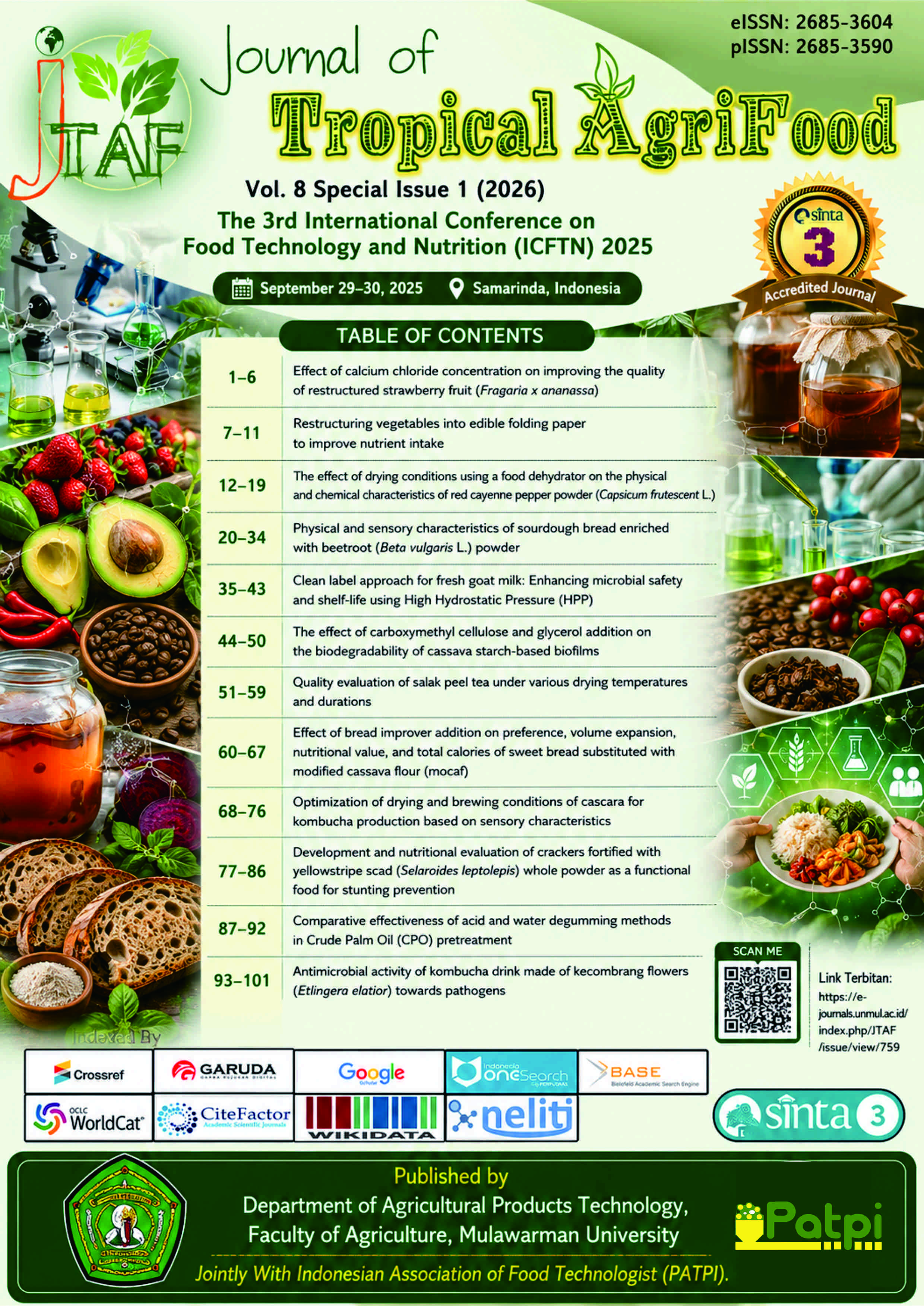
Effect of calcium chloride concentration on improving the quality of restructurized strawberry fruit (Fragaria x ananassa)
DOI:
https://doi.org/10.35941/jtaf.8.5.2026.26707.1-6Keywords:
alginate, anthocyanin, CaCl2, restructurized, strawberryAbstract
Strawberry is a very popular fruit due to their bright red color and aroma. sweet and slightly sour taste and nutritional value, especially vitamin C. Strawberries also contain anthocyanins, a reddish-purple pigment with high antioxidant activity. Nevertheless, they have a relatively short shelf life and are easily damaged because of their soft texture. They are usually processed into jam and other products that use high temperatures, which can damage nutritional compounds, including anthocyanins. Restructuring is an alternative method that can be used to extend the shelf life of strawberries without heat, thereby avoiding damage to the nutritional value and antioxidant activity. This study aimed to determine the effect of various Alginate and CaCl₂ concentrations (0, 0.1, 0.2, 0.3, 0.4, and 0.5%) on the quality of restructurized strawberries. The anthocyanin content was determined using the pH differential method; the texture was determined using a simple test to distinguish differences between treatments; the organoleptic test used hedonic methods with 30 panelists; and the shelf life tests were used to keep the real product until the quality decreased. Preliminary experiments showed that 2% alginate was optimal. The second step showed that 0.4% CaCl₂ was optimal.
Downloads
References
Cheng, G.W., Breen, P.J., 1991. Activity of phenylalanine ammonialyase (PAL) and concentrations of anthocyanins and phenolics in developing strawberry fruit. Journal of the American Society for Horticultural Science 116(5), 865-869. https://doi.org/10.21273/JASHS.116.5.865
Herawati, D., Lestario, L.N., Andini, S., 2016. Pengaruh konsentrasi alginat dan CaCl2 terhadap kadar antosianin, aktivitas antioksidan dan karakteristik sensorik buah duwet (Syzygium cumini Linn) hasil restrukturisasi. agriTECH 36(3), 261-269. https://doi.org/10.22146/agritech.16588
Lestario, N.L., Dewi, A.E., Riyanto, C.A. 2022. Pengaruh konsentrasi natrium alginat dan kalsium klorida terhadap hasil restrukturisasi buah stroberi (Fragaria vesca L.). Prosiding Seminar Nasional Instiper 1(1), 233-244. https://doi.org/10.55180/pro.v1i1.259
Maharani, P., Ikasari, E.D., Purwanto, U.R.E., Bagiana, I.K., 2022. Optimasi Na-alginat dan Ca-klorida pada nanopartikel ekstrak terpurifikasi fukoidan dari rumput laut cokelat (Sargassum polycystum). Pharmacy Medical Journal 5(2), 38-45. https://doi.org/10.35799/pmj.v5i2.45100
Raharjo, S., Utama, Z., 2002. Sifat-sifat fisik dan sensoris produk buah hasil restrukturisasi non-termal selama penyimpanan dingin. Jurnal Teknologi dan Industri Pangan 13(1), 11-19.
Soekarto, S.T., 1985. Penilaian Organoleptik Untuk Industri Pangan dan Hasil Pertanian. Bhratara Karya Aksara, Jakarta.
Susianti, A., 2015. Karakterisasi Morfologi dan Anatomi Stroberi (Fragaria x ananassa D. Cv. Festival) Hasil Induksi Kolkisin. Skripsi. Fakultas Biologi Universitas Gadjah Mada, Yogyakarta.
Winarno, F.G., 1987. Kimia Pangan dan Gizi. PT Gramedia, Jakarta.
Yusuf, K., 2023. Analisis daya simpan pada permen jelly dengan penambahan bubuk daun kelor. Jurnal Ilmiah Manusia dan Kesehatan 6(3), 489-497. https://doi.org/ 10.31850/makes.v6i3.2370
Zaimah, F., Prihastani, E., Haryanti, S., 2013. Pengaruh waktu pemotongan stolon terhadap pertumbuhan tanaman strawberry (Fragaria vesca L.). Buletin Anatomi dan Fisiologi 21(2), 9-20.
Downloads
Published
Issue
Section
License
As a journal Author, you have rights for a large range of uses of your article, including use by your employing institute or company. These Author rights can be exercised without the need to obtain specific permission.
Authors publishing in JTAF have wide rights to use their works for teaching and scholarly purposes without needing to seek permission, including: use for classroom teaching by Author or Author's institutionand presentation at a meeting or conference and distributing copies to attendees; use for internal training by author's company; distribution to colleagues for their reseearch use; use in a subsequent compilation of the author's works; inclusion in a thesis or dissertation; reuse of portions or extrcats from the article in other works (with full acknowledgement of final article); preparation of derivative works (other than commercial purposes) (with full acknowledgement of final article); voluntary posting on open web sites operated by author or author’s institution for scholarly purposes (follow CC by SA License).
Authors and readers can copy and redistribute the material in any medium or format, as well as remix, transform, and build upon the material for any purpose, even commercially, but they must give appropriate credit (cite to the article or content), provide a link to the license, and indicate if changes were made. If you remix, transform, or build upon the material, you must distribute your contributions under the same license as the original.