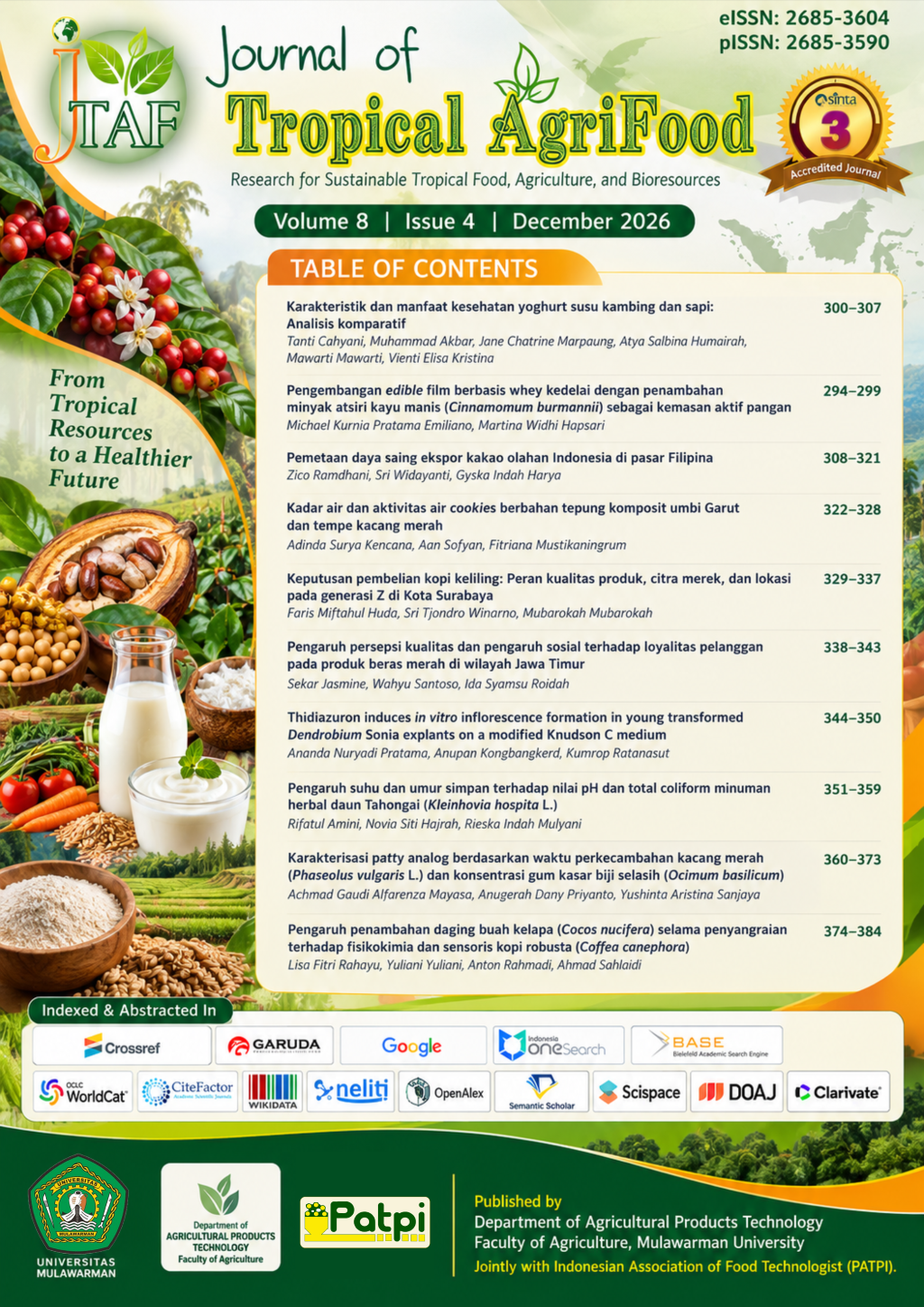
Pengaruh suhu dan umur simpan terhadap nilai pH dan total coliform minuman herbal daun Tahongai (Kleinhovia hospita L.)
DOI:
https://doi.org/10.35941/jtaf.8.4.2026.26961.351-359Keywords:
Kleinhovia hospita L., pH, Suhu penyimpanan, Umur simpan, Total coliformAbstract
Minuman herbal daun Tahongai (Kleinhovia hospita L.) merupakan produk pangan fungsional yang berpotensi dalam bidang kesehatan. Daun Tahongai mengandung senyawa aktif seperti flavonoid dan saponin yang bermanfaat bagi tubuh. Namun, mutu kimia dan mikrobiologis produk ini dapat berubah sesuai umur simpan. Penelitian ini bertujuan mengetahui pengaruh suhu dan umur simpan terhadap nilai pH dan total coliform pada minuman herbal daun Tahongai. Penelitian menggunakan Rancangan Acak Lengkap dua faktor, yaitu suhu simpan ruang (24 °C) dan kulkas (4 °C) serta umur simpan 0, 5, 10, dan 15 hari dengan tiga ulangan. Hasil analisis menunjukkan bahwa suhu simpan berpengaruh signifikan terhadap pH (p < 0,001). Penyimpanan pada suhu kulkas mempertahankan pH lebih stabil dibanding suhu ruang, sementara itu umur simpan berpengaruh tidak signifikan terhadap pH (p = 0,522). Pada total coliform, umur simpan berpengaruh signifikan (p < 0,001). Peningkatan jumlah coliform terdeteksi setelah hari ke-5, sementara suhu simpan berpengaruh tidak signifikan. Rekomendasi penelitian ini adalah minuman herbal daun Tahongai lebih baik disimpan pada suhu kulkas dan dikonsumsi segar (segera setelah penyiapan) untuk menjaga mutu kimia dan keamanan produk.
Downloads
References
BSN, 2008. SNI 2897:2008 Metode Pengujian Cemaran Mikroba dalam Daging, Telur, Susu serta Hasil Olahannya. Badan Standardisasi Nasional, Jakarta.
BSN, 2019. SNI 6989.11:2019 Air dan Air Limbah: Cara Uji Derajat Keasaman (pH) dengan Menggunakan pH Meter. Badan Standardisasi Nasional, Jakarta.
Clarissa, C., Amir, M., Asfirizal, V., 2020. Uji antibakteri ekstrak etanol daun tahongai (Kleinhovia hospita Linn) terhadap pertumbuhan bakteri Actinobacillus actinomycetemcomitans in-vitro. Jurnal Kedokteran Mulawarman 7, 14–22. https://doi.org/10.30872/jkm.v7i3.5020
Fiana, R.M., Refdi, C.W., 2018. Pendugaan umur simpan minuman instan teh kombucha menggunakan pendekatan kadar air kritis dengan metode Accelerated Shelf Life Test (ASLT). Jurnal Teknologi Pertanian Andalas 22, 150–156. https://doi.org/10.25077/jtpa.22.2.150-156.2018
Harvyandha, A., Kusumawardani, M., Rosyid, A., 2019. Telemetri pengukuran derajat keasaman secara realtime menggunakan Raspberry Pi. Jurnal JARTEL 9(4), 519–524. https://doi.org/10.33795/jartel.v9i4.158
Kuncoro, H., Nur Sopiati, M., Rashif Rijai, H., Agustina, R., 2022. Evaluasi parameter mutu ekstrak air daun Tahongai (Kleinhovia hospita Linn). Pharmaceutical Journal of Indonesia 7, 115–122. https://doi.org/10.21776/ub.pji.2022.007.02.6
Li, Z., Huang, Z., Gu, P., 2024. Response of Escherichia coli to acid stress: Mechanisms and applications—A narrative review. Microorganisms 12(9), 1774. https://doi.org/10.3390/microorganisms12091774
Ma, X., Hu, X., Liu, L., Li, X., Ma, Z., Chen, J., Wei, X., 2017. The quality changes and microflora analysis of commercial instant soya milk. Food Science & Nutrition 5(1), 123–130. https://doi.org/10.1002/fsn3.371
Martins, M.L., Pinto, U.M., Riedel, K., Vanetti, M.C.D., 2018. Quorum sensing and spoilage potential of psychrotrophic Enterobacteriaceae isolated from milk. BioMed Research International 2018, 2723157. https://doi.org/10.1155/2018/2723157
Maulidina, R., Marlina, E.T., Utama, D.T., 2023. Kualitas mikroba produk olahan daging yang dijual secara daring dari UMKM di Kota Bandung. Jurnal Teknologi Hasil Peternakan 4, 83–100. https://doi.org/10.24198/jthp.v4i2.47313
Mennah-Govela, Y.A., Cai, H., Chu, J., Kim, K., Maborang, M.-K., Sun, W., Bornhorst, G.M., 2020. Buffering capacity of commercially available foods is influenced by composition and initial properties in the context of gastric digestion. Food & Function 11(3), 2255–2267. https://doi.org/10.1039/C9FO03033F
Paramita, S., 2016. Tahongai (Kleinhovia hospita L.): Review sebuah tumbuhan obat dari Kalimantan Timur. Jurnal Tumbuhan Obat Indonesia 9, 29–36. https://doi.org/10.22435/toi.v9i1.6390.29-36
Pratiwi, I.D.P.K, Suter, I.K., Widpradnyadewi, P.A.S., Wiadnyani, A.A.I.S., 2019. Perubahan fisiko-kimiawi dan mikrobiologis minuman tradisional Bali (Loloh) selama penyimpanan. agriTECH 39, 70–77. https://doi.org/10.22146/agritech.17261
Ramadhan, M.I., Kusumawardani, S.O., Ardiansyah, Cempaka, L., Asiah, N., Astuti, R.M., David, W., 2022. Pendugaan umur simpan produk Ready To Drink (RTD) bunga telang dengan evaluasi sensori menggunakan survival analysis. Warta Industri Hasil Pertanian 39(2), 66–75. https://doi.org/10.32765/wartaihp.v39i2.6847
Rizkawati, M., Rizkita, L.D., 2023. Potensi aktivitas antibakterial ekstrak bunga telang (Clitoria ternatea). Jurnal Sains dan Kesehatan 5, 70–77. https://doi.org/10.25026/jsk.v5i1.1512
Sari, D.P., Rahmawati, R., Rusmiyanto, E.P.W., 2019. Deteksi dan identifikasi genera bakteri coliform hasil isolasi dari minuman lidah buaya. Jurnal Labora Medika 3, 29–35. https://doi.org/10.26714/jlabmed.3.1.2019.29-35
Sudiarto, S., Saleh, R., Sawab, S., Widowati, I., 2022. Nutritional content of functional herbal drinks made from palm sugar powder and spice powder. AGRITEKNO: Jurnal Teknologi Pertanian 11(2), 61–71. https://doi.org/10.30598/jagritekno.2022.11.2.61
Sugianti, G.R., Wirawan, I.M.A., Utami, N.W.A., 2019. Microbiological quality, hygiene, and sanitation of the production processes of a traditional beverage at tourism areas in Bali. Journal of UOEH 41(4), 353–362. https://doi.org/10.7888/juoeh.41.353
United States Department of Agriculture, Food Safety and Inspection Service (USDA-FSIS), 2014. Appendix 2.05: Most Probable Number Procedure and Tables, Revision 5. Microbiology Laboratory Guidebook, Washington, DC.
World Health Organization, 2013. WHO Traditional Medicine Strategy 2014–2023. World Health Organization, Geneva.
Downloads
Published
Issue
Section
License
As a journal Author, you have rights for a large range of uses of your article, including use by your employing institute or company. These Author rights can be exercised without the need to obtain specific permission.
Authors publishing in JTAF have wide rights to use their works for teaching and scholarly purposes without needing to seek permission, including: use for classroom teaching by Author or Author's institutionand presentation at a meeting or conference and distributing copies to attendees; use for internal training by author's company; distribution to colleagues for their reseearch use; use in a subsequent compilation of the author's works; inclusion in a thesis or dissertation; reuse of portions or extrcats from the article in other works (with full acknowledgement of final article); preparation of derivative works (other than commercial purposes) (with full acknowledgement of final article); voluntary posting on open web sites operated by author or author’s institution for scholarly purposes (follow CC by SA License).
Authors and readers can copy and redistribute the material in any medium or format, as well as remix, transform, and build upon the material for any purpose, even commercially, but they must give appropriate credit (cite to the article or content), provide a link to the license, and indicate if changes were made. If you remix, transform, or build upon the material, you must distribute your contributions under the same license as the original.