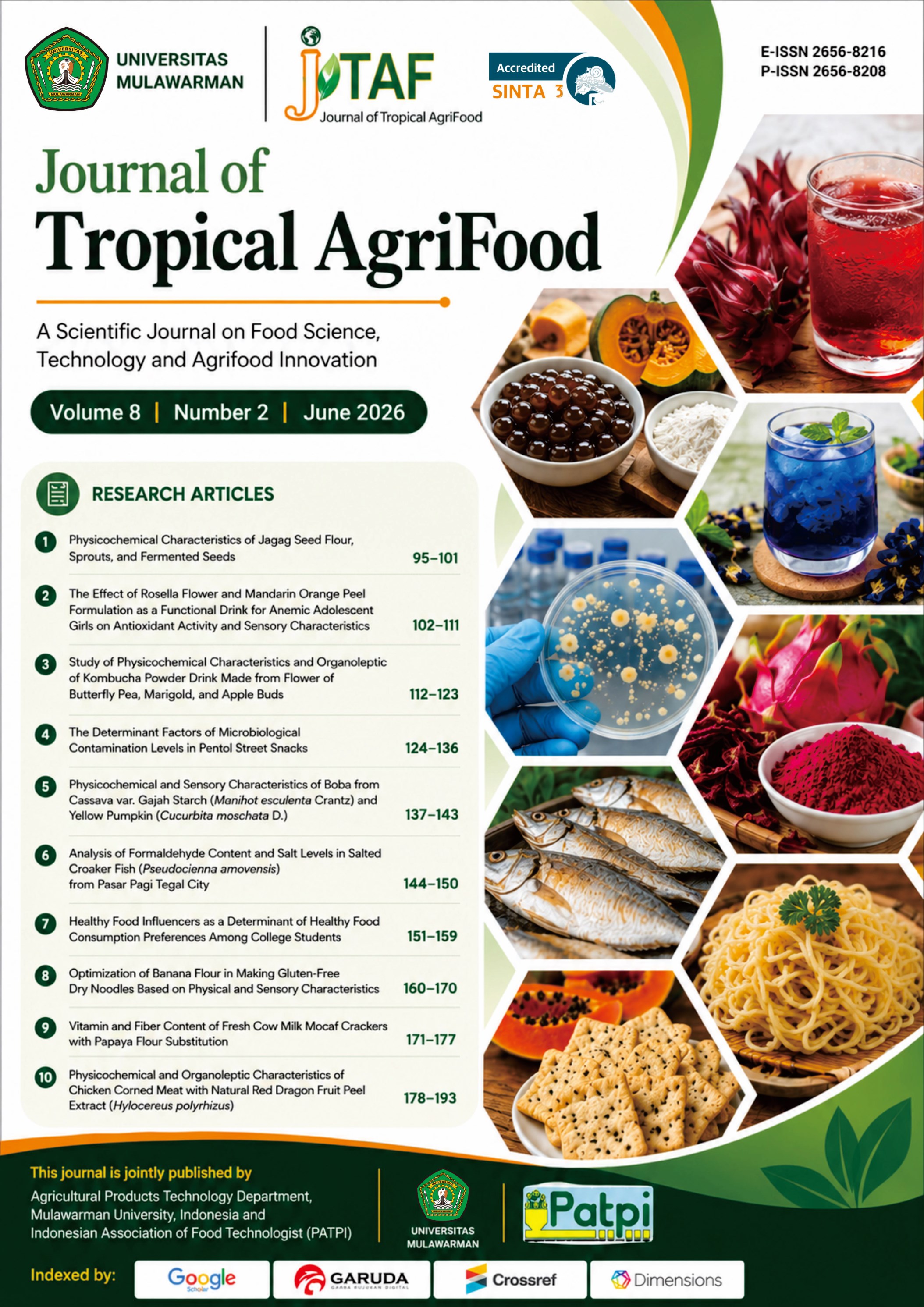
Karakteristik fisikokimia dan sensoris boba dari pati singkong Gajah (Manihot esculenta Crantz) dan labu kuning (Cucurbita moschata D.)
DOI:
https://doi.org/10.35941/jtaf.8.2.2026.22036.137-143Keywords:
boba, yellow pumpkin, cassava var. Gajah starch, physicochemical, sensoryAbstract
Penelitian ini bertujuan untuk mengetahui pengaruh formulasi pati singkong gajah dan labu kuning terhadap karakteristik fisikokimia dan sensoris boba. Bahan baku yang digunakan adalah pati singkong gajah, yang memiliki daya serap air tinggi, dan labu kuning, yang kaya nutrisi. Penelitian menggunakan Rancangan Acak Lengkap Faktor Tunggal dengan 6 taraf perlakuan, yaitu perbandingan pati singkong gajah dan labu kuning (100:0, 95:5, 90:10, 85:15, 80:20, 75:25) dengan 3 ulangan. Parameter yang diamati meliputi sifat fisik (warna, tekstur), kimia (kadar air, abu, serat, β-karoten), dan sensoris (uji hedonik dan mutu hedonik). Hasil analisis menunjukkan bahwa formulasi pati singkong gajah dan labu kuning berpengaruh nyata (p<0,05) terhadap karakteristik fisikokimia dan sensoris boba. Penambahan labu kuning secara signifikan meningkatkan nilai warna serta kadar air, abu, serat, dan β-karoten, sementara nilai kekenyalan dan kekerasan boba menurun. Formulasi boba optimal terdapat pada penggunaan 75 g pati singkong gajah dan 25 g labu kuning.
Downloads
References
Afistia, N.R., Sya'di, Y.K., 2024. Pendugaan umur simpan minuman ekstrak beras hitam dalam kemasan metalized dengan pendekatan Arrhenius. Jurnal Pangan dan Gizi 14(2), 51-61.
Agyepong, J.K., Barimah, J., 2018. Physicochemical properties of starches extracted from local cassava varieties with the aid of crude pectolytic enzymes from Saccharomyces cerevi-siae (ATCC 52712). African Journal of Food Science, 12(7), 151-164.
AOAC, 2005. Official methods of analysis of the Association of Analytical Chemist. Association of Official Analytical Chemist, Int., 4–5. Virginia USA.
Azizah, M., Muhlishoh, A., Nurzihan, N.C., 2023. Kandungan antioksidan, beta karoten dan organoleptik cookies dengan substitusi puré labu kuning dan tepung kacang hijau. Ghidza: Jurnal Gizi dan Kesehatan, 7(1), 40-52. https://doi.org/10.22487/ghidza.v7i1.545
Boulevard, C., 2011. CT3 Texture Analyzer Operating Instructions Manual. Brookfield AMETEK.
Ernisti, W., Riyadi, S., Jaya, M.F. 2019. Karakteristik biskuit (crackers) yang difortifikasi dengan konsentrasi pe-nambahan tepung ikan patin siam (Pangasius hypophthalmus) berbeda. Jurnal Ilmu-ilmu Perikanan dan Budi-daya Perairan 13(2), 88-100. http:// doi.org/10.31851/jipbp.v13i2.2855.
Gardjito, M. 2006. Labu Kuning Sumber Karbohidrat Kaya Vitamin A. Tridatu Visi Komunika, Yogyakarta.
Indrianti, N.N., Sholichah, E., Afifah, N., 2020. Pumpkin flour effects on antioxidant activity, texture, and sensory attributes of flat tubers noodle. IOP Conference Series: Materials Science and Engineering, 1011, 012007. https://doi.org/10.1088/1757-899X/1011/1/012007.
Juliana, J., Pramono, R., Yudistira, I.G.A., Josephine, G.K., 2022. Experimental design sensory quality boba developed from pumpkin. International Journal of Applied Business and International Management 7(1), 17–29.
Maryuniati, A., Murti, S.T.C., 2023. Pengaruh preparasi dan tingkat substitusi uwi ungu (Dioscorea alata L.) terha-dap sifat fisik, kimia dan tingkat kesukaan boba pati sagu (Metroxylon sago). Jurnal Pertanian Khairun 2(1), 133-140. https://doi.org/10.33387/jpk.v2i1.6283
Oladunmoye, O.O., Aworh, O.C., Maziya‐Dixon, B., Erukainure, O.L., Elemo, G.N., 2014. Chemical and functional properties of cassava starch, durum wheat semolina flour, and their blends. Food Science & Nutrition 2(2), 132-138. http://doi.org/10.1002/fsn3.83
Prabowo, L.K.P., Wibisono, Y., 2024. Pengaruh substitusi tepung labu kuning terhadap karakteristik fisik, kimia, dan organoleptik apem panggang. JOFE: Journal of Food Engineering 3(2), 55-67. https://doi.org/10.25047/jofe.v3i2.4362
Priyono, E., Ninsix, R., Apriyanto, M., 2018. Studi pencampuran labu kuning (Cucurbita moschata) dengan tepung beras terhadap karakteristik biskuit yang dihasilkan. Jurnal Teknologi Pertanian, 7(1), 8-20. https://doi.org/10.32520/jtp.v7i1.109
Putranto, K. 2021. Pengaruh suhu dan jangka waktu pengeringan wortel terhadap beberapa karakteristik tepung wortel. AGRITEKH: Jurnal Agribisnis Dan Teknologi Pangan, 2(1), 52–63. https://doi.org/10.32627/agritekh.v2i1.65
Saroinsong, R.M., Mandey, L., Lalujan, L., 2015. Pengaruh penambahan labu kuning (Cucurbita moschata) terhadap kualitas fisikokimia dodol. Cocos 6(15), 1-11. https://doi.org/ 10.35791/cocos.v6i15.8815
Trisnawati, W., Suter, K., Suastika, K., Putra, N.K., 2014. Pengaruh metode pengeringan terhadap kandungan antioksidan, serat pangan dan komposisi gizi tepung labu kuning. Jurnal Aplikasi Teknologi Pangan 3(4), 135-140.
Triyani, A.P., Ishartani, D., Rahadian, D.A. 2013. Kajian karakteristik fisikokimia tepung labu kuning (Cucurbita moschata) termodifikasi dengan variasi lama perendaman dan konsentrasi asam asetat. Jurnal Teknosains Pangan 2(2), 29-38.
Ullah, R., Khan, S., Shah, A., Ali, H., Bilal, M., 2018. Time- temperature dependent variations in beta-carotene contents in carrot using different spectrophotometric techniques. Laser Physics 28(5), 055601. http://doi.org/ 10.1088/1555-6611/aaadee
Yusuf, A.M., Saelan, E., Lestari, S., 2021. Pengaruh penambahan labu kuning dengan persentase yang berbeda terhadap karakteristik organoleptik sosis ayam. JANHUS: Jurnal Ilmu Peternakan 5(2), 195-203. https://doi.org/10.52434/janhus.v5i2.1355
Downloads
Published
Issue
Section
License
As a journal Author, you have rights for a large range of uses of your article, including use by your employing institute or company. These Author rights can be exercised without the need to obtain specific permission.
Authors publishing in JTAF have wide rights to use their works for teaching and scholarly purposes without needing to seek permission, including: use for classroom teaching by Author or Author's institutionand presentation at a meeting or conference and distributing copies to attendees; use for internal training by author's company; distribution to colleagues for their reseearch use; use in a subsequent compilation of the author's works; inclusion in a thesis or dissertation; reuse of portions or extrcats from the article in other works (with full acknowledgement of final article); preparation of derivative works (other than commercial purposes) (with full acknowledgement of final article); voluntary posting on open web sites operated by author or author’s institution for scholarly purposes (follow CC by SA License).
Authors and readers can copy and redistribute the material in any medium or format, as well as remix, transform, and build upon the material for any purpose, even commercially, but they must give appropriate credit (cite to the article or content), provide a link to the license, and indicate if changes were made. If you remix, transform, or build upon the material, you must distribute your contributions under the same license as the original.