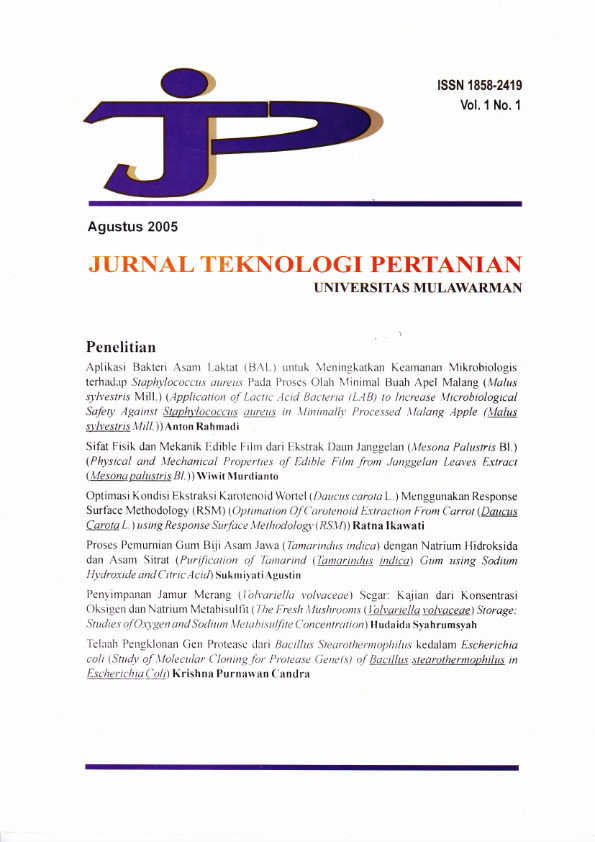
Aplikasi bakteri asam laktat (BAL) untuk meningkatkan keamanan mikrobiologis terhadap Staphylococcus aureus pada proses olah minimal buah apel Malang (Malus sylvestris Mill.)
Keywords:
lactic acid bacteria, LAB, Staphylococcus aureus, malang appleAbstract
Minimally processed apple usually came from partially-broken apple with some parts are still in very good condition. Minimally processed fruits are perishable foods due to quality degradation caused by microorganism activity. Main purpose of this research was to study the application of LAB culture in minimally processed apple fruit of Malang in order to increase safety against Staphylococcus aureus. Malang apple was used in this research while age of ripe 4.5 months and weight of around 90-100 grams. Lactic acid bacteria used were Lactobacillus brevis, and three strains of L. plantarum. Steps of this research are selection of potential LAB strains using well diffusion method, determining LAB concentration and soaking time, study of minimally processed apple shelf life and total acid titration. pH and total LAB colonies (Total Plate Count) in MRS agar medium, as well as total Staphylococcus aureus. Best inhibition-zone of S. aureus are was resulted from strain of L. brevis AE 1.6 (14.33mm). Optimum concentration to inhibit pathogenic bacteria is 10^6 cfu per mL with 30 minutes of soaking. Pathogenic bacteria life colonies decreased for 1 to 2 of log unit following soaking in optimal LAB concentration. LAB application in minimally processed apple did succeeded to increase safety against pathogens specially S. aureus. Shelf life could be extended up to 12 days with S. aureus life colonies not more than 100 cfu per g.Downloads
References
Breidt, Flemming HP (1995) Using lactic acid bacteria to improve the safety of minimally processed fruits and vegetables. J Food Technol Vol 5l(9): 44-
Daly C, Sandine WE, Elliker PR (1972) Interactions of food starter cultures
and food borne pathogens. J Milk Food Technol 35 : 349-357 .
De Vuyst L, Vandamme EJ ( 1994) Antimicrobial Potensial of Lactic Acid Bacteria. Dalam De Vuyst L, Vandarnme EJ (eds) Bacteriocins of Lactic Acid Bacteria Microbiology, Genetics and Applications. Blackie Academic and Professional, London.
Durand B (1990) Les achats des menageres de produits de 4e gamme. Infos-
CTIFL 65: 42-45, Dalam Chervin C, Boisseau P (1996). J Food Sci. 58: 399-402,
Jenie BSL, Suliantari, Nurwitri A (2000) Pengembangan Produk Makanan Tradisional Rendah Garam Berbasis Ikan Melalui Aplikasi Bakteri Asam Laktat Penghasil Bakteriosin. Laporan Penelitian Hibah Bersaing Tahun 1999 /2000. Fateta-lPB, Bogor.
Jenie BSL, Shinta Eka Rini ( 1996) Aktivitas anti Mikroorganisme dari beberapa species Lactobacillus terhadap Mikroorganisme patogen dan Perusak Makanan. Dalam Jenie BSL ( 1996) Penerapan Bioteknologi Asam Laktat pada pengawetan Ikan Rucah. Laporan Penelitian Tahun II/RUT II. Fateta-IPB, Bogor.
Jenie BSL (1996) Peranan bakteri asam laktat sebagai pengawet hayati makanan. J Ilmu dan Teknologi Pangan l(2):60-73.
Haines WC, Hannon LG ( 1973) Effect of selected lactic acid bacteria on
growth of Staphylococcus aureus and production of enterotoxin. J Appl
Microbiol 25: 436-444.
Nguyen-the C, Carlin F ( 1994) The microbiology of minimally processed
fresh fruits and vegetables. Crit Rev Food Sci Nutr 34: 371-401.
Richardson SD ( 1994) Scoping the chemicals in your drink water. Today's
Chemist at work 3(3): 29-32.
Ryall AL, Potzer WT ( 1982) Handling Transportations and Storage of Fruit
and Vegetables. The AVI Production Co Ltd, Connecticut, Salminen S, von Wright A (1998) Lactic Acid Bacteria. Microbiology and Functional Aspects. Edisi ke-2. Marcell Dekker Inc, New York.
Schved F, Lalaz,ar A, Henis Y, Juven B J (1993) Purification, partial characterization and plasmid linkage of pediosin SJ-1, a bacteriocin produced by, Pediococcus acidilactici. J Appl Microbiol 74:67-77.
Spillman H. Puhan Z. Banhagyi M (1978) Antimikrobielle aktivitaet thermophiler lactobazillen. Milchwissenschaft
: 148-153.
Vescovo M, Orsi C, Scolari C, Toniani S (1995) Inhibirory effect of selected acid bacteria on microflora associated with ready-to-use vegetables. J Appl Microbiol 2l: l2l-125.
Downloads
Published
Issue
Section
License
As a journal Author, you have rights for a large range of uses of your article, including use by your employing institute or company. These Author rights can be exercised without the need to obtain specific permission.
Authors publishing in JTAF have wide rights to use their works for teaching and scholarly purposes without needing to seek permission, including: use for classroom teaching by Author or Author's institutionand presentation at a meeting or conference and distributing copies to attendees; use for internal training by author's company; distribution to colleagues for their reseearch use; use in a subsequent compilation of the author's works; inclusion in a thesis or dissertation; reuse of portions or extrcats from the article in other works (with full acknowledgement of final article); preparation of derivative works (other than commercial purposes) (with full acknowledgement of final article); voluntary posting on open web sites operated by author or author’s institution for scholarly purposes (follow CC by SA License).
Authors and readers can copy and redistribute the material in any medium or format, as well as remix, transform, and build upon the material for any purpose, even commercially, but they must give appropriate credit (cite to the article or content), provide a link to the license, and indicate if changes were made. If you remix, transform, or build upon the material, you must distribute your contributions under the same license as the original.