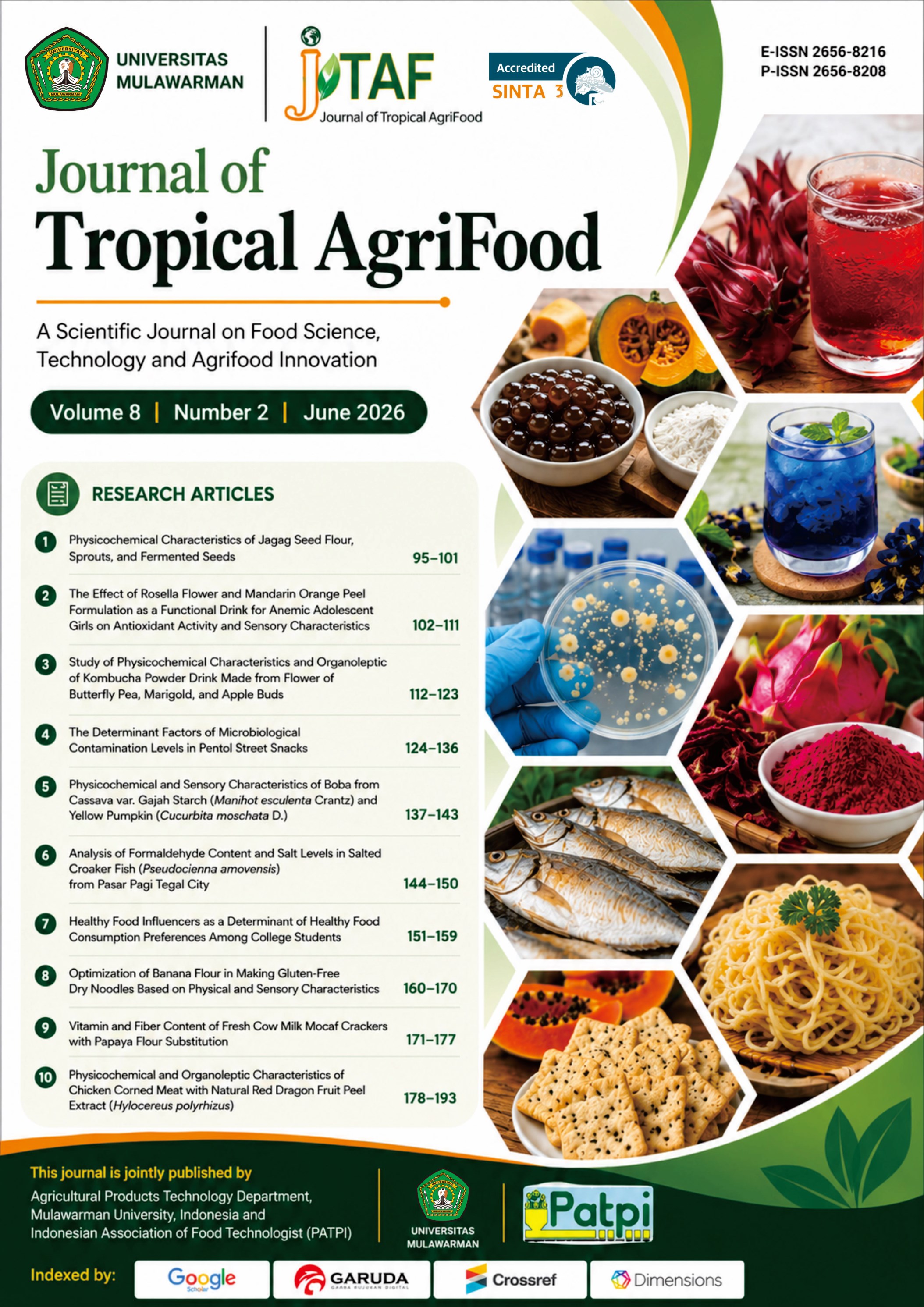
Karakteristik fisikokimia tepung biji jagaq, kecambah, dan biji jagaq terfermentasi
DOI:
https://doi.org/10.35941/jtaf.8.2.2026.11061.95-101Keywords:
Fermentasi, Jagaq, Kecambah, Karakteristik Tepung Jagaq,Abstract
Tanaman jagaq (Setaria italica) merupakan tanaman serelia sejenis millet yang banyak ditanam di antara tanaman padi ladang di daerah Kutai Barat. Jagaq mengandung protein 9-14%, karbohidrat 70-80%, energi, vitamin, mineral serta serat makanan yang lebih tinggi dari beras atau gandum. Tujuan penelitian ini untuk mempelajari pengaruh metode pra-pengolahan biji jagaq (biji, kecambah, dan fermentasi) terhadap sifat fisikokimia tepung dihasilkan. Penelitian menggunakan Rancangan Acak Lengkap dengan 3 perlakuan dan 3 kali ulangan. Data yang diperoleh diolah dengan analisis varians, dilanjutkan dengan uji Beda Nyata Terkecil. Penggunaan biji jagaq, kecambah, dan biji jagaq terfermentasi berpengaruh nyata terhadap kadar air, kadar abu, dan densitas kamba tepung jagaq, sedangkan daya serap air dan daya serap lemak berpengaruh tidak nyata. Kadar air dan kadar abu tepung paling tinggi diperoleh dari biji jagaq dengan pra-pengolahan fermentasi dengan kadar air 11,81% dan kadar abu 7,16%. Pra-pengolahan berpengaruh tidak nyata (p>0,05) terhadap daya serap minyak dan air.
Downloads
References
Aini, N., Wijonarko, G., Sustriawan, B. 2016. sifat fisik, kimia, dan fungsional tepung jagung yang diproses melalui fermentasi. AGRITECH 36(2), 160-169.
Badan Standarisasi Nasional. 2009. SNI 01-3751- 2009 tentang Tepung Terigu Sebagai Bahan Makanan. Badan Standarisasi Nasional. Jakarta.
Badan Standarisasi Nasional. 1995. SNI 01-3728-1995 tentang Syarat Mutu Tepung Kacang Hijau. Badan Standarisasi Nasional. Jakarta.
Badau, M.H., Nkama, I., Jideani, I.A. 2005. Phytic acid content and hydrochloric acid extractability of minerals in pearl millet as affected by germination time and cultivar. Food Chem. 92, 425-435.
Baurhoo, N., Baurhoo, B., Zhao, X. 2011. Effects of exogenous enzymes in corn-based and Canadian pearl milletbased diets with reduced soybean meal on growth performance, intestinal nutrient digestibility, villus development and selected microbial populations in broiler chickens. J Anim Sci. 89, 4100-4108.
Estiasih, T. dan Ahmadi. 2009. Teknologi Pengolahan Pangan. Bumi Aksara: Malang.
FAO. 1980. Appendix Xi: Bulk Density, Pelletability And Particle Size. https://www.fao.org/4/s4314e/s4314e0q.htm
Hassan, A.B., I.A.M. Ahmed, N.M. Osman, M.M. Eltayeb, G.A. Osman, dan E.E. Babiker. 2006. Effect of processing treatments followed by fermentation on protein content and digestibility of pearl millet (Pennisetum thypoideum) cultivars. Pakistan Journal Nutr. 5(1), 86-89.
Kamara, M.T., Zhou, H.M., Zhu,K.X., Amadou, I., Tarawalie, F. 2009. Comparative study of chemical composition and physicochemical properties of two varieties of defatted foxtail millet flour grown in China. Am J Food Technol. 4, 255-267.
Kale, S. J., Jha, S. K., and Nath, P. 2017. Soaking effects on physical characteristics of basmati (Pusa Basmati 1121)rice. Agricultural Engineering International: CIGR Journal, 19(4), 114–123.
Kibar, H., Ozturk,T., and Esen, B. 2010. The effect of moisturecontent on physical and mechanical properties of rice (Oryza sativa L.). Spanish Journal of Agricultural Research, 8(3), 741–749.
Kusumawati, D.D., Sigit, A.B., Muhammad, D.R.A. 2012. Pengaruh perlakuan pendahuluan dan suhu pengeringan terhadap sifat fisik, kimia, dan sensoris tepung biji nangka (Artocarpus heterophyllus). Jurnal Teknologi Pangan 1(1), 41-48.
Muchtadi T. R dan Sugiyono. 1992. Petunjuk Laboratorium Ilmu Pengetahuan Bahan Pangan. Bogor. Pusat Antar Universitas Pangan dan Gizi, Institut Pertanian Bogor.
Ntau, L., Sumual M.F., Assa, J.R. 2017. Pengaruh fermentasi Lactobacillus casei terhadap sifat fisik tepung jagung manis (Zea mays Saccharata Sturt). J. Ilmu dan Teknologi Pangan 5(2), 11-19.
Odoemelam, S.A. 2003. Chemical composition and functional properties ofconophor nut (Tetracarpidium conophorum) flour. International Journal of Food Science and Technology 38(6), 729–734. https://doi.org/10.1046/j.1365-2621.2003.00725.x
Onyango, C.A., Ochanda, S.O., Mwasaru, M.A., Ochieng, J.K., Mathoko, F.M., Kinyuru, J.N. 2013. Effects of malting and fermentation on anti-nutrient reduction and protein digestibility of red sorghum, white sorghum and pearl millet. Journal of Food Research 2(1), 42-44.
Rostami, Z., Haghighat, M., Khoshakhlagh, K. 2022. Effects of lean peanut flour coating on oil absorption and organoleptic characteristics of potato chips. Iranian J Nutr Sci Food Technol 16(4), 87-96.
Saragih, B. 2013. Analisis mutu tepung bonggol pisang dari berbagai varietas dan umur panen yang berbeda. Jurnal Teknologi Industri Boga dan Busana 9(1), 22-29.
Sudarmadji, Haryono, S. B dan Suhardi. 2010. Analisis Bahan Makanan dan Pertanian. Liberti, Yogyakarta.
Suhendra, L. 2005. Studi perubahan protein terlarut selama perkecambahan biji wijen (Sesamun indicum L.) menggunakan pendekatan respon surface methodology.2005.http://download.portalgaruda.org/article.php?article=13641&val=935.
Soeka, Y.S., Sulistiani. 2017. Profil vitamin, kalsium, asam amino dan asam lemak tepung jewawut (Setaria italica L.) fermentasi. Jurnal Biologi Indonesia 13(1), 85-96.
Sulistyaningrum, A., Rahmawati, Aqil, M. 2017. Karakteristik tepung jewawut (foxtail millet) varietas lokal Majene dengan perlakuan perendaman. Jurnal Penelitian Pascapanen Pertanian 14(1), 11–21.
Sutopo. 2010. Teknologi Benih. Rajawali Press, Jakarta.
Yustini E.P, Saragih, B., Ramayana S. 2019. Karakteristik fisikokimia, sifat fungsional dan nilai gizi biji dan tepung jagaq (Setaria italica). Jurnal Riset Teknologi Industri 13(2), 50-62.
Downloads
Published
Issue
Section
License
As a journal Author, you have rights for a large range of uses of your article, including use by your employing institute or company. These Author rights can be exercised without the need to obtain specific permission.
Authors publishing in JTAF have wide rights to use their works for teaching and scholarly purposes without needing to seek permission, including: use for classroom teaching by Author or Author's institutionand presentation at a meeting or conference and distributing copies to attendees; use for internal training by author's company; distribution to colleagues for their reseearch use; use in a subsequent compilation of the author's works; inclusion in a thesis or dissertation; reuse of portions or extrcats from the article in other works (with full acknowledgement of final article); preparation of derivative works (other than commercial purposes) (with full acknowledgement of final article); voluntary posting on open web sites operated by author or author’s institution for scholarly purposes (follow CC by SA License).
Authors and readers can copy and redistribute the material in any medium or format, as well as remix, transform, and build upon the material for any purpose, even commercially, but they must give appropriate credit (cite to the article or content), provide a link to the license, and indicate if changes were made. If you remix, transform, or build upon the material, you must distribute your contributions under the same license as the original.