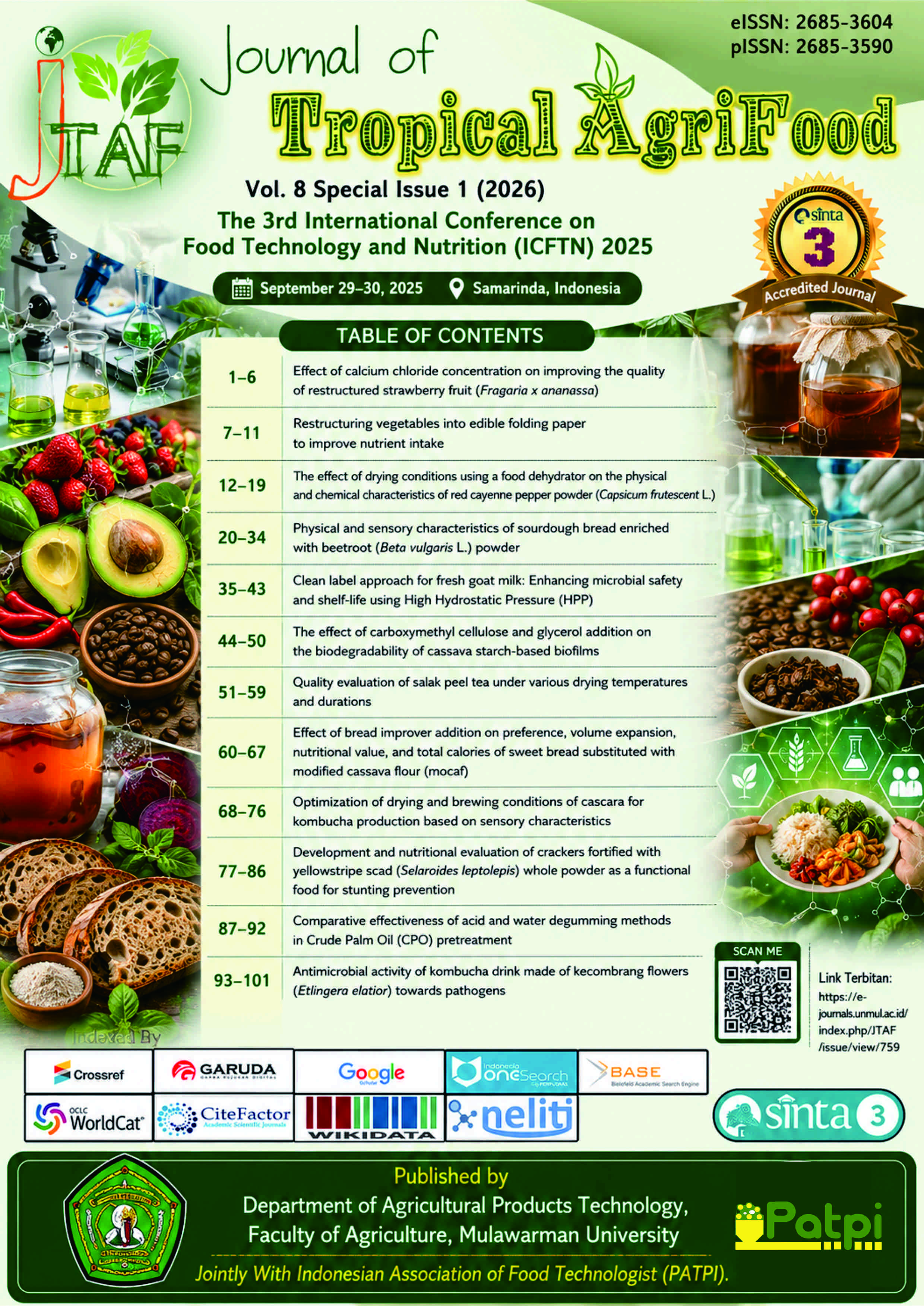
Development and nutritional evaluation of crackers fortified with yellowstripe scad (Selaroides leptolepis) whole powder as a functional food for stunting prevention
DOI:
https://doi.org/10.35941/jtaf.8.5.2026.26727.77-86Keywords:
Selar Fish, Flour, Snack, Stunting, SubstitutionAbstract
Yellowstripe Scad (Selaroides leptolepis) has potential as a fortificant to enhance the nutritional quality of crackers. The incorporation of yellowstripe scad whole fish powder not only improves the nutrient content but also reduces processing waste. Fish-based crackers can serve as dietary food products, nutrient-dense snack alternatives, and supplementary foods to support stunting prevention. This study aimed to evaluate the nutritional composition (moisture, lipid, dietary fiber, protein, and ash content) and physical quality (texture) of fish crackers. The experiment was designed using a Completely Randomized Design with a single factor, namely, the addition of yellowstripe scad whole powder (SFF) at six levels: 0, 3, 6, 9, 12, and 15%. The data obtained were analyzed using Analysis of Variance, followed by Duncan’s Multiple Range Test to determine significant differences. The results revealed that the addition of yellow stripe scad whole powder significantly affected (p<0.05) the physicochemical properties of the yellow stripe scad crackers. Crackers with 15% yellowstripe scad whole powder exhibited the highest protein, lipid, and ash contents of 18.5, 8.97, and 8.97%, respectively. Meanwhile, the addition of 3% yellowstripe scad whole powder produced crackers with the most desirable moisture content, dietary fiber, and texture characteristics of 3.59%, 3.87%, and 1,101 N/cm², respectively.
Downloads
References
Ahmed, Z.S., Abozed, S.S., 2015. Functional and antioxidant properties of novel snack crackers incorporated with Hibiscus sabdariffa by-product. J Adv Res 6, 79–87. https://doi.org/10.1016/j.jare.2014.07.002
AOAC, 2005. Official methods of analysis, 18th ed. AOAC International, Maryland (US).
AOAC, 2012. Official Methods of Analysis of AOAC International, 19th ed. AOAC International, Washington (US).
Batista, A.P., Niccolai, A., Bursic, I., Sousa, I., Raymundo, A., Rodolfi, L., Biondi, N., Tredici, M.R., 2019. Microalgae as functional ingredients in savory food products: Application to wheat crackers. Foods 8(12), 611. https://doi.org/10.3390/foods8120611
Bolek, S., 2020. Olive stone powder: A potential source of fiber and antioxidant and its effect on the rheological characteristics of biscuit dough and quality. Innovative Food Science and Emerging Technologies 64, 102423. https://doi.org/10.1016/j.ifset.2020.102423
Breemer, R., Lahagu, O., Palijama, S., 2023. Effect of Skipjack Tuna (Katsuwonus pelamis) fish meal concentration and drying time on the organoleptic characteristics of purple sweet potato (Ipomoea batatas L.) Tortilla Chips. Jurnal Agrosilvopasture-Tech 2, 54–61. http://doi.org/10.30598/j.agrosilvopasture-tech.2023.2.1.54
Ernisti, W., Riyadi, S., Jaya, F.M., 2018. Karakteristik biskuit (crackers) yang difortifikasi dengan konsentrasi penambahan tepung ikan patin siam (Pangasius hypopthalmus) berbeda. Jurnal Ilmu-Ilmu Perikanan dan Budidaya Perairan 13(2), 88–100.
Giannoutsos, K., Zalidis, A.P., Koukoumaki, D.I., Menexes, G., Mourtzinos, I., Sarris, D., Gkatzionis, K., 2023. Production of functional crackers based on non-conventional flours. Study of the physicochemical and sensory properties. Food Chemistry Advances 2. https://doi.org/10.1016/j.focha.2023.100194
Hallaç, S., Altiner, D.D., 2017. Examination of some chemical and functional properties of carob and soy flours and their use in bakery products. Internasional Journal of Food Engineering Research 3(1), 23-31.
Kementan (Kementerian Pertanian), 2024. Statistik konsumsi pangan 2024. Kementerian Pertanian, Jakarta.
Millar, K.A., Barry-Ryan, C., Burke, R., Hussey, K., McCarthy, S., Gallagher, E., 2017. Effect of pulse flours on the physiochemical characteristics and sensory acceptance of baked crackers. Int J Food Sci Technol 52, 1155–1163. https://doi.org/10.1111/ijfs.13388
Mustofa, M.B., Setyobudiandi, I., 2020. Keterkaitan kematangan gonad ikan selar kuning (Selaroides leptolepis Cuvier, 1833) dengan suhu permukaan laut di perairan selat Sunda. Journal of Tropical Fisheries Management 3(1), 24-29. https://doi.org/ 10.29244/jppt.v3i1.29583
Mutamimah, D., Arista, Y.L.V., Untari, D., Liasari, A., 2024. Nutritional enrichment from Bali sardinella (Sardinella lemuru) head meal in fish crackers as emergency food. Jurnal Pengolahan Hasil Perikanan Indonesia 27(12), 1146–1155. http://doi.org/10.17844/jphpi.v27i12.59233
Nammakuna, N., Barringer, S.A., Ratanatriwong, P., 2016. The effects of protein isolates and hydrocolloids complexes on dough rheology, physicochemical properties and qualities of gluten-free crackers. Food Sci Nutr 4, 143–155. https://doi.org/10.1002/fsn3.266
Nawaz, A., Xiong, Z., Xiong, H., Chen, L., Wang, P., Ahmad, I., Hu, C., Irshad, S., Ali, S.W., 2019. The effects of fish meat and fish bone addition on nutritional value, texture and microstructure of optimised fried snacks. International Journal of Food Science and Technology 54(4), 1045–1053. https://doi.org/10.1111/ijfs.13974
Huda, N., Ikhlas, B., 2009. The effect of different ratio of Dory fish to tapioca flour on the linear expansion, oil absorption, colour and hardness of fish crackers. International Food Research Journal 16(2), 159-165.
Pangestuti, E.K., Darmawan, P., 2021. Analisis kadar abu dalam tepung terigu dengan metode gravimetri. Jurnal Kimia dan Rekayasa 2(1), 16-21.
Sharfina, M., Boer, M., Ernawati, Y., 2014. Potensi lestarai ikan selar kuning (Selaroides leptolepis) di perairan selat Sunda. Marine Fisheries 5(1), 101-108.
Sinaga, F., Tilaar, F.F., Bataragoa, 2018. Characteristics of reproductive of yellowstripe scad Selaroides leptolepis (Cuvier, 1833) in Manado Bay waters. Jurnal Ilmiah Platax 6(2), 46-57. https://doi.org/10.35800/jip.6.2.2018.20622
Surajati, A., 2006, Studi pertumbuhan, mortalitas, dan tingkat eksploitasi ikan selar kuning, Selaroides leptolepis (Cuvier dan Valenciennes) di Perairan Pulau Bintan, Riau. Jurnal Perikanan 8(2), 223-228.
Tunick, M.H., Onwulata, C.I., Thomas, A.E., Phillips, J.G., Mukhopadhyay, S., Sheen, S., Liu, C.K., Latona, N., Pimentel, M.R., Cooke, P.H., 2013. Critical evaluation of crispy and crunchy textures: A review. Int J Food Prop 16(5), 949–963. https://doi.org/10.1080/10942912.2011.573116
Venkatachalam, K., Nagarajan, M., 2017. Physicochemical and sensory properties of savory crackers incorporating green gram flour to partially or wholly replace wheat flour. Ital. J. Food Sci. 29(29), 599-612.
Widiyastuti, H., Pane, A.R.P., Mardlijah, S., Fauzi, M., Zamroni, A., 2023. Yellowstripe scad fishery (Selaroides leptolepis) in FMA 712: A short review. IOP Conference Series: Earth and Environmental Science. Institute of Physics 1260, 012035. https://doi.org/10.1088/1755-1315/1260/1/012035
Yanti et al 2023. Kajian karakteristik organoleptik dan nilai gizi biskuit tinggi protein berbasis tepung kedelai (Glycine max L. Merill) dan tepung umbi talas (Calocasia esculenta L. Schott). Jurnal Riset Pangan 1(1), 108-124
Yilmaz, E., Karaman, E., 2017. Functional crackers: incorporation of the dietary fibers extracted from citrus seeds. J Food Sci Technol 54(10), 3208–3217. https://doi.org/10.1007/s13197-017-2763-9
Downloads
Published
Issue
Section
License
As a journal Author, you have rights for a large range of uses of your article, including use by your employing institute or company. These Author rights can be exercised without the need to obtain specific permission.
Authors publishing in JTAF have wide rights to use their works for teaching and scholarly purposes without needing to seek permission, including: use for classroom teaching by Author or Author's institutionand presentation at a meeting or conference and distributing copies to attendees; use for internal training by author's company; distribution to colleagues for their reseearch use; use in a subsequent compilation of the author's works; inclusion in a thesis or dissertation; reuse of portions or extrcats from the article in other works (with full acknowledgement of final article); preparation of derivative works (other than commercial purposes) (with full acknowledgement of final article); voluntary posting on open web sites operated by author or author’s institution for scholarly purposes (follow CC by SA License).
Authors and readers can copy and redistribute the material in any medium or format, as well as remix, transform, and build upon the material for any purpose, even commercially, but they must give appropriate credit (cite to the article or content), provide a link to the license, and indicate if changes were made. If you remix, transform, or build upon the material, you must distribute your contributions under the same license as the original.