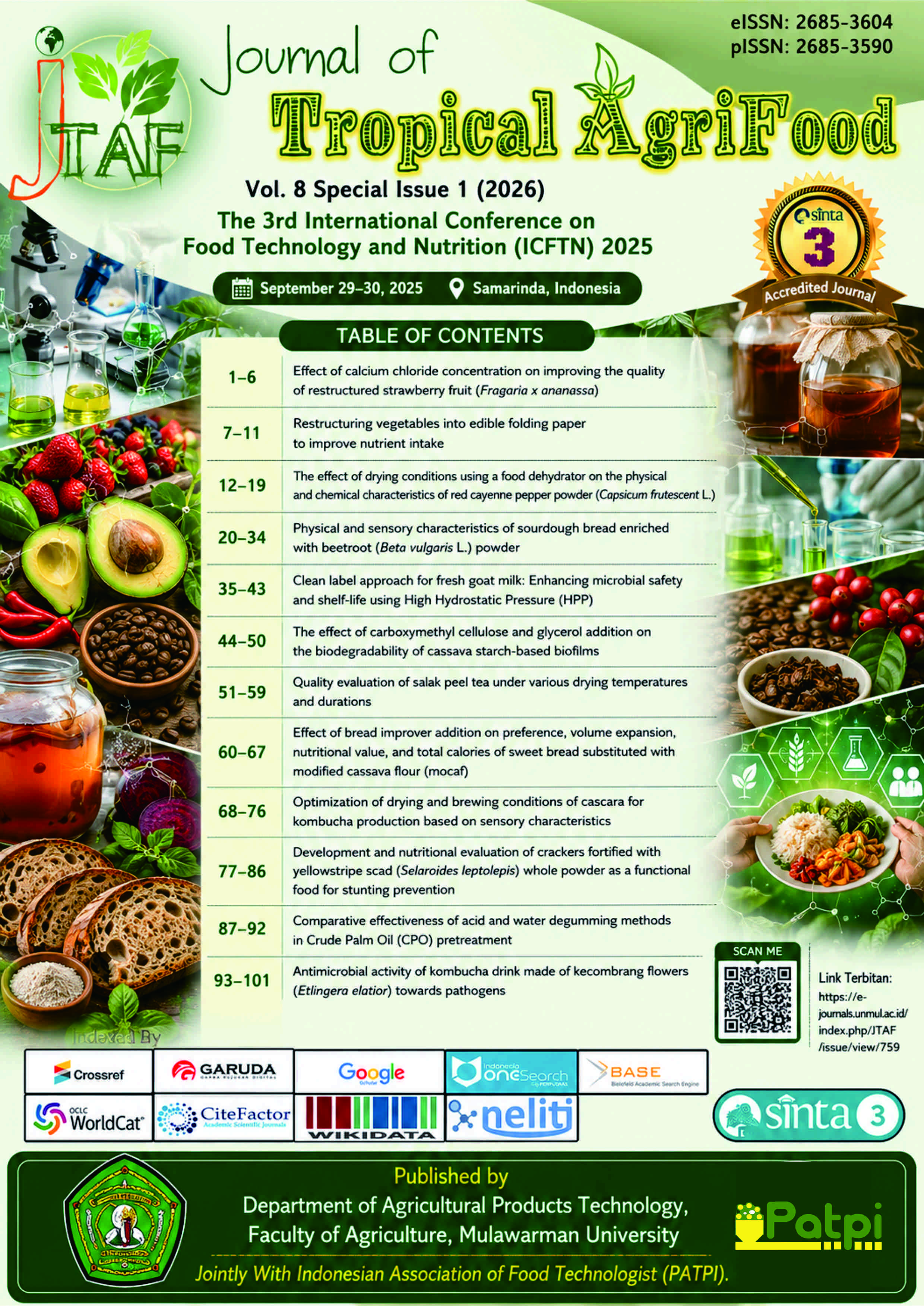
The effect of carboxymethyl cellulose and glycerol addition on the biodegradability of cassava starch-based biofilms
DOI:
https://doi.org/10.35941/jtaf.8.5.2026.26720.44-50Keywords:
Biodegradability, Biofilm, Carboxymethyl Cellulose, Cassava Starch, GlycerolAbstract
The growing concern over plastic pollution has accelerated the development of biodegradable packaging materials derived from natural polymers. Cassava starch has been widely studied as a potential raw material because of its abundance and biodegradability. However, its properties are often modified with additives such as carboxymethyl cellulose (CMC) and glycerol to improve film performance, which may influence its biodegradation. This study aimed to investigate the effects of different concentrations of CMC and glycerol on the biodegradability of cassava starch-based biofilms. Biofilms were prepared using three levels of cassava starch (5, 10, and 15 g), three concentrations of CMC (1, 2, and 3%), and three levels of glycerol (6, 9, and 12 mL). Thebiodegradability test was performed using the soil burial method for seven days, with weight loss as the primary parameter.The results showed that all biofilm samples achieved more than 60% degradation within seven days, thus meeting the Indonesian National Standard (SNI) for biodegradability. At low starch concentrations (5 g), the addition of higher CMC and glycerol levels reduced biodegradability due to matrix compaction and reduced porosity. At 10 g starch, biodegradability was more stable, with several formulations reaching 100% degradation by day seven. The highest starch concentration (15g) yielded the best results, with nearly all formulations reaching complete biodegradation, supported by sufficient substrate availability and synergistic interactions betweenCMC and glycerol. Overall, the findings indicate that starch concentration plays a dominant role, whereas excessive CMC and glycerol can slow degradation by limiting microbial accessibility.
Downloads
References
Acharjee, S.A., Bharali, P., Gogoi, B., Sorhie, V., Walling, B., Alemtoshi, 2023. PHA-based bioplastic: a potential alternative to address microplastic pollution. Water Air Soil Pollut. 234, 21. https://doi.org/10.1007/s11270-022-06029-2
Affanti, R., Zulferiyenni, Nurainy, F., Hidayati, S., 2024. Karakteristik biodegradable film berbasis serat selulosa eceng gondok (Eichhornia crassipes (Mart.) Solms) dengan penambahan gliserol dan Carboxy Methyl Cellulose (CMC). Jurnal Agroindustri Berkelanjutan 3(1), 29–40. https://doi.org/10.23960/jab.v3i1.8801
Bergel, B.F., Leite Araujo, L., dos Santos da Silva, A.L., Campomanes Santana, R.M., 2020. Effects of silylated starch structure on hydrophobization and mechanical properties of thermoplastic starch foams made from potato starch. Carbohydr. Polym. 241, 116274. https://doi.org/10.1016/j.carbpol.2020.116274
Brion-Espinoza, I.A., Iñiguez-Moreno, M., Ragazzo-Sánchez, J.A., Barros-Castillo, J.C., Calderón-Chiu, C., Calderón-Santoyo, M., 2021. Edible pectin film added with peptides from jackfruit leaves obtained by high-hydrostatic pressure and pepsin hydrolysis. Food Chem. X 12, 100170. https://doi.org/10.1016/j.fochx.2021.100170
Cheng, H., Chen, L., McClements, D.J., Yang, T., Zhang, Z., Ren, F., Miao, M., Tian, Y., Jin, Z., 2021. Starch-based biodegradable packaging materials: A review of their preparation, characterization and diverse applications in the food industry. Trends Food Sci. Technol. 114, 70–82. https://doi.org/10.1016/j.tifs.2021.05.017
Cui, C., Ji, N., Wang, Y., Xiong, L., Sun, Q., 2021. Bioactive and intelligent starch-based films: A review. Trends Food Sci. Technol. 116, 854–869. https://doi.org/10.1016/j.tifs.2021.08.024
Dewi, R., Rahmi, R., Nasrun, N., 2021. Perbaikan sifat mekanik dan laju transmisi uap air edible film bioplastik menggunakan minyak sawit dan plasticizer gliserol berbasis pati sagu. Jurnal Teknologi Kimia Unimal 10, 61–77. https://doi.org/10.29103/jtku.v10i1.4177
Fahrullah, F., Ervandi, M., 2022. Karakterisasi mikrostruktur film whey dengan penambahan konjac glucomannan. Agrointek : Jurnal Teknologi Industri Pertanian 16, 396–404. https://doi.org/10.21107/agrointek.v16i3.12303
George, N., Debroy, A., Bhat, S., Singh, S., Bindal, S., 2021. Biowaste to bioplastics: An ecofriendly approach for a sustainable future. Journal of Applied Biotechnology Reports 8, 221–233. https://doi.org/ 10.30491/jabr.2021.259403.1318
Giubertoni, G., Hilbers, M., Caporaletti, F., Laity, P., Groen, H., Van der Weide, A., Bonn, D., Woutersen, S., 2023. Hydrogen bonds under stress: strain-Induced structural changes in polyurethane revealed by rheological two-dimensional infrared spectroscopy. Journal of Physical Chemistry Letters 14, 940–946. https://doi.org/10.1021/acs.jpclett.2c03109
Hidayat, J.P., Romadhona, H.A., Sholihah, N., Munfarida, S., 2023. Karakteristik edible coating gel Aloe vera dengan fortifikasi bawang putih sebagai antimikroba. Agrointek 17(3), 493–501. https://doi.org/10.21107/agrointek.v17i3.14607
Jiang, B., Yu, J., Liu, Y., 2020. The environmental impact of plastic waste. Journal of Environmental and Earth Sciences 2, 26–35. https://doi.org/10.30564/jees.v2i2.2340
Kuswytasari, N.D., Kurniawati, A.R., Alami, N.H., Zulaika, E., Shovitri, M., Oh, K.M., Puspaningsih, N.N.T., Ni’Matuzahroh, 2019. Plastic degradation by Coriolopsis byrsina, an identified white-rot, soil-borne mangrove fungal isolate from Surabaya, East Java, Indonesia. Biodiversitas 20, 867–871. https://doi.org/10.13057/biodiv/d200334
Munfarida, S., Hidayat, J.P., 2023. Karakterisasi pati Canna edulis Kerr. termodifikasi dan uji produk pada pembuatan roti tawar. Jurnal Keteknikan Pertanian 11(1), 16–28. https://doi.org/10.19028/jtep.011.1.16-28
Natalia, M., Hazrifawati, W., Wicakso, D.R., 2019. Pemanfaatan limbah daun nanas (Ananas comosus) sebagai bahan baku pembuatan plastik biodegradable. EnviroScienteae 15(3), 357–364. https:/doi.org/10.20527/es.v15i3.7428
Ramakrishnan, R., Kim, J.T., Roy, S., Jayakumar, A., 2024. Recent advances in carboxymethyl cellulose-based active and intelligent packaging materials: A comprehensive review. Int. J. Biol. Macromol. 259, 129194. https://doi.org/10.1016/j.ijbiomac.2023.129194
Tapia-Blácido, D.R., Aguilar, G.J., de Andrade, M.T., Rodrigues-Júnior, M.F., Guareschi-Martins, F.C., 2022. Trends and challenges of starch-based foams for use as food packaging and food container. Trends Food Sci. Technol. 119, 257–271. https://doi.org/10.1016/j.tifs.2021.12.005
Downloads
Published
Issue
Section
License
As a journal Author, you have rights for a large range of uses of your article, including use by your employing institute or company. These Author rights can be exercised without the need to obtain specific permission.
Authors publishing in JTAF have wide rights to use their works for teaching and scholarly purposes without needing to seek permission, including: use for classroom teaching by Author or Author's institutionand presentation at a meeting or conference and distributing copies to attendees; use for internal training by author's company; distribution to colleagues for their reseearch use; use in a subsequent compilation of the author's works; inclusion in a thesis or dissertation; reuse of portions or extrcats from the article in other works (with full acknowledgement of final article); preparation of derivative works (other than commercial purposes) (with full acknowledgement of final article); voluntary posting on open web sites operated by author or author’s institution for scholarly purposes (follow CC by SA License).
Authors and readers can copy and redistribute the material in any medium or format, as well as remix, transform, and build upon the material for any purpose, even commercially, but they must give appropriate credit (cite to the article or content), provide a link to the license, and indicate if changes were made. If you remix, transform, or build upon the material, you must distribute your contributions under the same license as the original.