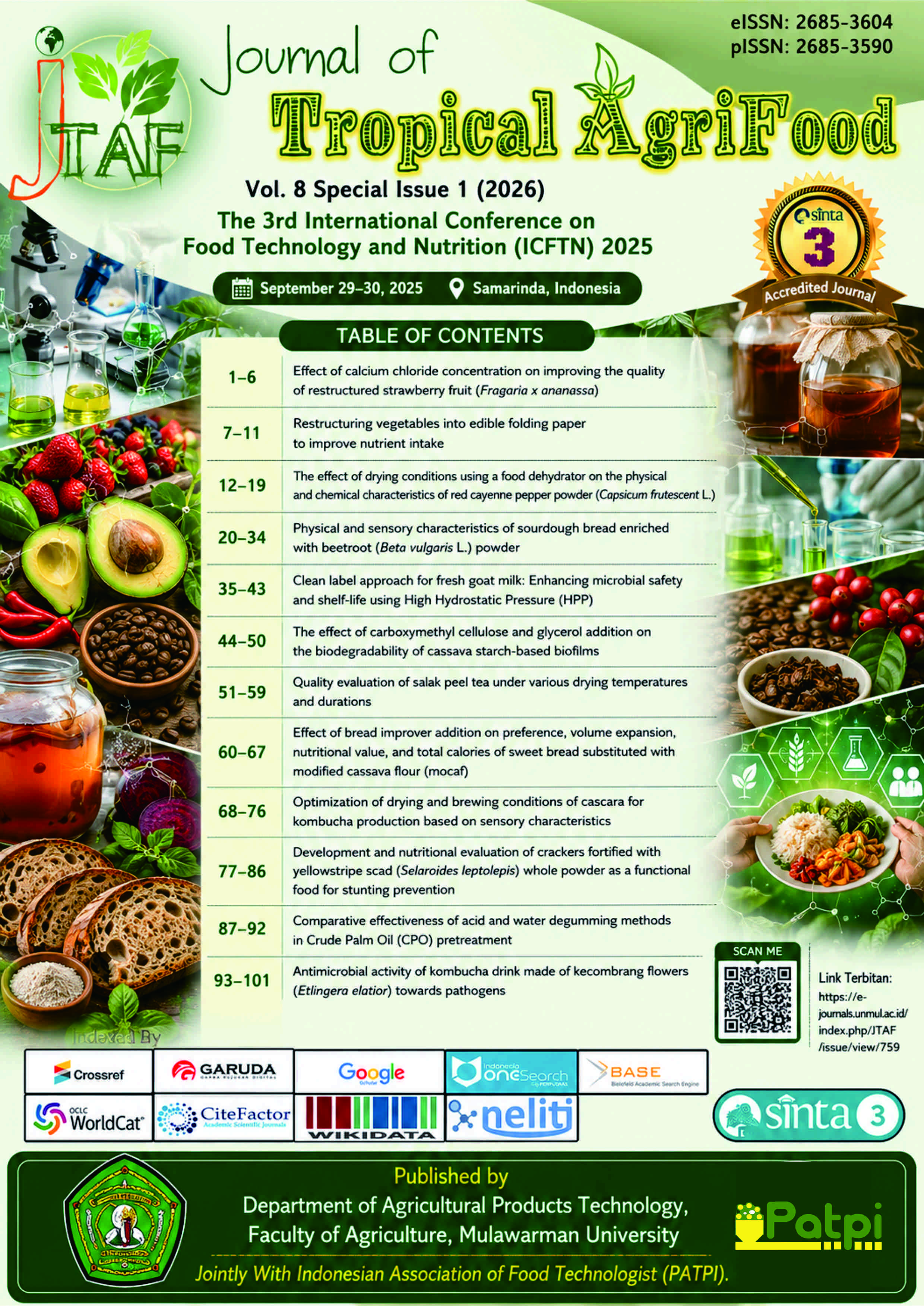
The effect of drying conditions using a food dehydrator on the physical and chemical characteristics of red cayenne pepper powder (Capsicum frutescent L.)
DOI:
https://doi.org/10.35941/jtaf.8.5.2026.26713.12-19Keywords:
red cayenne pepper, drying, food dehydrator, physicochemical characteristicAbstract
Red cayenne pepper (Capsicum frutescens L.) is an important horticultural commodity in Indonesia with high demand; however, its high moisture content makes it highly perishable. One way to extend its shelf life is to process it into powder through drying. Drying using a food dehydrator is considered more effective because it allows precise control of temperature and time, which affects the final product quality, including moisture content, color, and vitamin C, β-carotene, and capsaicin levels. This study aimed to determine the effects of different drying temperatures and durations using a food dehydrator on the physicochemical characteristics of red cayenne pepper powder. A Completely Randomized Factorial Design was used with two factors: drying temperature (50, 60, and 70°C) and drying time (16, 20, and 24 h), resulting in nine treatment combinations with three replicates. The parameters observed included moisture content, yield, color (L*, a*, and b*), vitamin C, β-carotene, and capsaicin content. The results showed that increasing temperature and drying time significantly decreased the moisture content, yield, and vitamin C content, while increasing the brightness and redness of the pepper powder. β-carotene content increased at moderate temperatures and decreased at higher temperatures, while the highest capsaicin content was found at 60 °C for 20 h (998.96 ppm or 16,083.33 SHU) and decreased at 70 °C. Overall, drying at 60 °C for 20 h produced red cayenne pepper powder with optimal physicochemical quality.
Downloads
References
Amaliah, N., 2018. Penentuan kadar capsaicin menggunakan metode kromatografi lapis tipis (KLT) pada cabe katokkon. JST. Jurnal Sains Ter. 4(1), 49–56. https://doi.org/10.32487/jst.v4i1.452
Citra, M., Suharyono, S., Sugiharto, R., Koesoemawardani, D., 2023. Pengaruh perlakuan awal dan cara pengeringan terhadap sifat sensori bubuk cabai daun jeruk purut (Citrus hystric D.C.). J. Agroindustri Berkelanjutan 2(1), 185–195. https://doi.org/10.23960/jab.v2i1.7227
Fadhilatunnur, H., Subarna, Murtadho, Z., Muhandri, T., 2022. Pengeringan cabai merah (Capsicum annuum L.) dengan kombinasi oven microwave dan kipas angin. J. Mutu Pangan Indones. 9(1), 26–35. https://doi.org/10.29244/jmpi.2022.9.1.26
Hagos, M., Redi-Abshiro, M., Chandravanshi, B.S., Yaya, E.E., 2022. Development of analytical methods for determination of β -carotene in pumpkin (Cucurbita maxima) flesh, peel, and seed powder samples. Int. J. Anal. Chem. 11, 9363692. https://doi.org/10.1155/2022/9363692
Halimah, G., Devi, M., Issutarti, I., 2021. Pengaruh suhu pasteurisasi terhadap warna, kandungan vitamin C dan betakaroten pada sari buah belimbing nanas. J. Inov. Teknol. dan Edukasi Tek. 1(3), 162–168. https://doi.org/10.17977/um068v1n3p162- 168
Hayati, R., Rahmawati, M., Ramadhiny, W., 2023. Effect of temperature and drying time on quality redchili powder (Capsicum annuum L.). Int. J. Adv. Res. 11, 671–680. https://doi.org/10.21474/ijar01/17574
Jamilah, M., Kadirman, K., Fadilah, R., 2019. Uji kualitas bubuk cabai rawit (Capsicum frutescens) berdasarkan berat tumpukan dan lama pengeringan menggunakan cabinet dryer. J. Pendidik. Teknol. Pertan. 5(1), 98–107. https://doi.org/10.26858/jptp.v5i1.8200
Khairani, K., Adriana, A., Pardi, P., 2024. Isolasi dan karakterisasi senyawa capsaicin dari cabai rawit (Capsicum frutescens L.) sebagai bahan aditif pangan dengan metode ekstraksi sokletasi. J. Teknol. 24(1), 35–40. https://doi.org/10.30811/teknologi.v24i1.4996
Mar’atuzzahwa, D., Utama, I.M.S., Wirawan, I.P.S., 2022. Pengaruh ketebalan dan suhu pengeringan terhadap karakteristik fisik dan sensoris buah naga merah kering. J. BETA (Biosistem dan Tek. Pertanian) 11(1), 50–61. https://doi.org/10.24843/jbeta.2023.v11.i01.p06
Meriska, Y., 2022. Kadar beta karoten pada tepung wortel (Daucus carota L.) dengan perlakuan perbedaan suhu dan lama pengeringan. Research Report. Fakultas Ilmu Kesehatan, Univ. ’Aisyiyah, Yogyakarta.
Murti, K.H., 2017. Pengaruh suhu pengeringan terhadap kandungan vitamin C buah cabai keriting Lado F1 (Capsicum annuum L.). J. Keteknikan Pertan. Trop. dan Biosist. 5, 245–256.
Histifarina,D., Musaddad, D., Murtiningsih, E., 2004. Teknik pengeringan dalam oven untuk irisan wortel kering bermutu J. Hort. 14(2), 107–112.
Paramita, V.D., 2023. Pengaruh metode pengeringan terhadap kadar vitamin C dan aktivitas antioksidan daun kelor (Moringa oleifera). J. Agritechno 16, 29–35. https://doi.org/10.70124/at.v16i1.1006
Prastikasari, A.S., Pratiwi, E., Putri A.S, Rohadi, 2023. Lama waktu pengeringan terhadap sifat fisik, kimia, dan sensoris fruit leather like dari krokot (Portulaca olereacea). Research Report. https://repository.usm.ac.id/files/journalmhs/D.111.16.0097-20200304020431.pdf
Pratita, A.T.K., Pajriati, D., Wardani, G.A., Fathurohman, M., 2023. Aktivitas antiradikal bebas senyawa b-karoten pada alga merah. Jurnal Kesehatan Bakti Tunas Husada: Jurnal Ilmu0ilmu Keperawatan, Analis Kesehatan dan Farmasi 23(2), 72-80.
Putranto, K., 2021. Pengaruh suhu dan jangka waktu pengeringan wortel terhadap beberapa karakteristik tepung wortel. AGRITEKH (Jurnal Agribisnis dan Teknol. Pangan) 2, 52–63. https://doi.org/10.32627/agritekh.v2i1.65
Rachmat, R., Harris, H., Maruf, A., Ginantaka, A., 2023. Quality evaluation of dried red chili (Capsicum annuum L.) with convection and radiation drying methods. Jurnal Agroindustri Halal 9(2), 167-174.
Rizquna, S.A., Maulida, S.N., Hannifah, H., Syakuron, A.A., Muflihati, I., Suhendriani, S., 2024. Penggunaan ekstrak dari tiga jenis daun jati (daun jati lokal, daun jati super, dan daun jati belanda) sebagai pewarna alami pada sirup. J. Trit. 15, 207–220. https://doi.org/10.47687/jt.v15i1.532
Saputri, L., Lewuras, A.M.P., Minah, F.N., Astuti, S., 2022. Pengaruh suhu dan waktu pengeringan terhadap kadar air dan kadar vitamin C pada bubuk cabai rawit (Capsicum frutescens L.). Pros. SENIATI 6, 636–643. https://doi.org/10.36040/seniati.v6i3.4942
Setyawibawa, R., Ernes, A., Sutrisno, E., 2018. Pengaruh lama pengeringan terhadap kandungan vitamin c pada varietas cabai rawit merah, keriting, dorset naga dan carolina reaper. J. Ilm. Teknol. Pertan. Agrotechno 3, 263. https://doi.org/10.24843/jitpa.2018.v03.i01.p01
Sihotang, L.S., Meilani, D., 2024. Analisis vitamin C daging dan kulit buah semangka merah dan kuning (Citrullus vulgaaris Schard) dengan spektrofotometri UV. J. Indah Sains dan Klin. 05, 25–32.
Downloads
Published
Issue
Section
License
As a journal Author, you have rights for a large range of uses of your article, including use by your employing institute or company. These Author rights can be exercised without the need to obtain specific permission.
Authors publishing in JTAF have wide rights to use their works for teaching and scholarly purposes without needing to seek permission, including: use for classroom teaching by Author or Author's institutionand presentation at a meeting or conference and distributing copies to attendees; use for internal training by author's company; distribution to colleagues for their reseearch use; use in a subsequent compilation of the author's works; inclusion in a thesis or dissertation; reuse of portions or extrcats from the article in other works (with full acknowledgement of final article); preparation of derivative works (other than commercial purposes) (with full acknowledgement of final article); voluntary posting on open web sites operated by author or author’s institution for scholarly purposes (follow CC by SA License).
Authors and readers can copy and redistribute the material in any medium or format, as well as remix, transform, and build upon the material for any purpose, even commercially, but they must give appropriate credit (cite to the article or content), provide a link to the license, and indicate if changes were made. If you remix, transform, or build upon the material, you must distribute your contributions under the same license as the original.