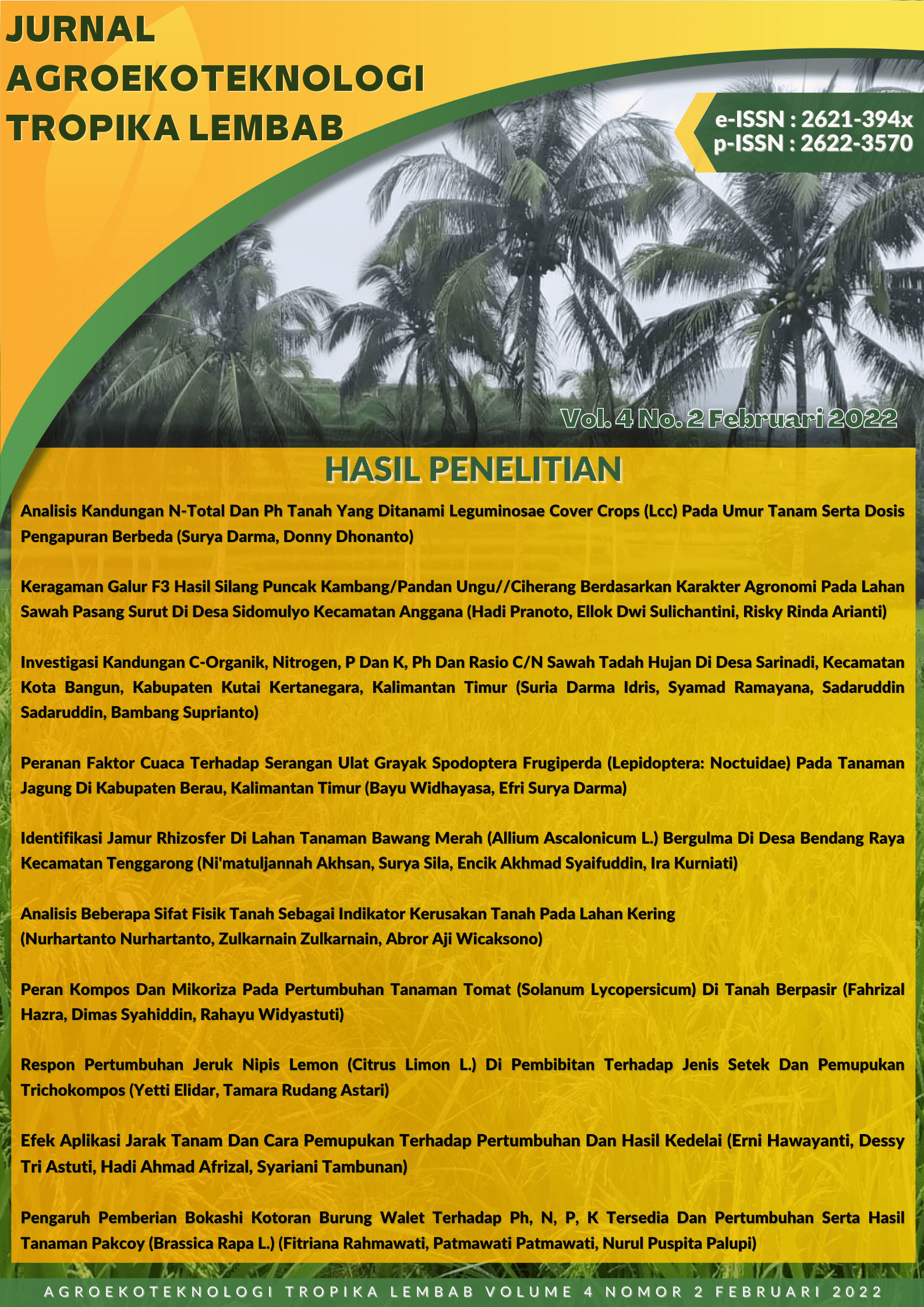
Peran Kompos dan Mikoriza pada Pertumbuhan Tanaman Tomat (Solanum lycopersicum) di Tanah Berpasir
DOI:
https://doi.org/10.35941/jatl.4.2.2022.7003.113-122Keywords:
Kompos merupakan bahan pembenah tanah (amelioran) yang umum digunakan dan dapat ditingkatkan kualitasnya dengan penambahan mikrob fungsional seperti mikoriza. Mikoriza adalah kelompok fungi yang dapat bersimbiosis dengan tanaman pada sistem perakaran. PenAbstract
Kompos merupakan bahan pembenah tanah (amelioran) yang umum digunakan dan dapat ditingkatkan kualitasnya dengan penambahan mikrob fungsional seperti mikoriza. Mikoriza adalah kelompok fungi yang dapat bersimbiosis dengan tanaman pada sistem perakaran. Penelitian ini bertujuan menganalisis pengaruh pemberian kompos dan mikoriza terhadap pertumbuhan tanaman tomat (Solanum lycopersicum) pada tanah berpasir. Penelitian ini dilakukan dengan menggunakan Rancangan Acak Lengkap (RAL) dengan 11 perlakuan yang terdiri dari kontrol dan dua faktor perlakuan. Faktor pertama adalah persentase dosis kompos dan faktor kedua adalah dosis mikoriza. Faktor persentase dosis kompos terdiri atas 150% kompos (K1), 100% kompos (K2), 75% kompos (K3), 50% Kompos (K4), dan 25% Kompos (K5), sedangkan faktor dosis mikoriza terdiri atas 5g (M1) dan 2.5g (M2). Pertumbuhan tanaman diamati hingga fase vegetatif lalu dilakukan analisis kimia dan penghitungan persentase kolonisasi akar serta jumlah spora mikoriza. Perlakuan 150% kompos dengan dosis 2.5g mikoriza memilik nilai tinggi tanaman terbaik sebesar 74.70 cm dan jumlah helai daun sebanyak 314 helai. Kadar N-total tertinggi yaitu 0.30% terdapat pada kombinasi perlakuan 150% kompos dengan 5g mikoriza ataupun dengan 2.5g mikoriza. Persentase kolonisasi akar tertinggi sebesar 50% dan kadar P-tersedia tanah tertinggi yaitu 32.5 mg/100g pada perlakuan 150% kompos dengan dosis 5g mikoriza.Downloads
References
Subhan, N. Nurtika, and N. Gunadi, “Respons tanaman tomat terhadap penggunaan pupuk majemuk NPK 15-15-15 pada tanah Latosol pada musim kemarau,” J. Hortik., vol. 19, no. 1, pp. 313–323, 2009.
R. Sutanto, “Dasar – Dasar Ilmu Tanah Konsep Dan Kenyataan,” Kanisius, 2005.
E. A. S. Pangaribuan, A. Darmawati, and S. Budiyanto, “Pertumbuhan dan Hasil Tanaman Pakchoy Pada Tanah Berpasir Dengan Pemberian Biochar dan Pupuk Kandang Sapi,” Agrosains J. Penelit. Agron., 2020, doi: 10.20961/agsjpa.v22i2.42093.
P. Priyadi, J. Jamaludin, and W. Mangiring, “Aplikasi Kompos dan Arang Aktif Sebagai Bahan Amelioran di Tanah Berpasir Terhadap Pertumbuhan Tanaman Caisim (Brassica juncea L.),” J. Penelit. Pertan. Terap., 2019, doi: 10.25181/jppt.v18i2.1069.
A. Surya Zannah Hasibuan, “Pemanfaatan Bahan Organik dalam Perbaikan Beberapa Sifat Tanah Pasir Pantai Selatan Kulon Progo,” Planta Trop. J. Agro Sci., 2015, doi: 10.18196/pt.2015.037.31-40.
A. Rakun and I. G. Mertha, “PENGARUH KOMPOS TERHADAP HASIL PANEN TOMAT (Lycopersicum esculentum Mill),” J. PIJAR MIPA, 2018, doi: 10.29303/jpm.v13i1.515.
Y. Sastro, , I krarwati, and , Suwandi, “Peran Granulasi dan Pengayaan Terhadap Peningkatan Efektivitas Kompos pada Sawi, Selada, Kangkung, dan Bayam,” J. Hortik. Indones., 2015, doi: 10.29244/jhi.3.1.10-16.
“Effect of Different Rates of Compost Application on Growth Performance and Yield Components of Carrot (Daucus carrota L.) in Gurage Zone, Ethiopia,” Int. J. African Asian Stud., 2019, doi: 10.7176/jaas/54-03.
A. Y. Rahmayanti, M. V. Rini, M. A. S. Arif, and S. Yusnaini, “PENGARUH PEMBERIAN FUNGI MIKORIZA ARBUSKULAR DAN KOMPOS KULIT BUAH KAKAO PADA PERTUMBUHAN BIBIT KAKAO (Theobroma cacao L.),” J. Agrotek Trop., 2013, doi: 10.23960/jat.v1i2.1975.
“KEANEKARAGAMAN FUNGI MIKORIZA ARBUSKULA PADA HUTAN TRI DHARMA UNIVERSITAS SUMATERA UTARA,” Peronema For. Sci. J., 2015.
Khairuna, Syafruddin, and Marlina, “Pengaruh Fungi Mikoriza Arbuskular Dan Kompos Pada Tanaman Kedelai Terhadap sifat Kimia Tanah,” J. Floratek, 2015.
I. Ashofie and B. Prasetya, “Pengaruh Aplikasi Kompos Dan Mikoriza Arbuskuar Pada Tailing Tambang Emas Terhadap Pertumbuhan Dan Serapan Fosfor Tanaman Bunga Matahari,” J. Tanah dan Sumberd. Lahan, vol. 6, no. 1, pp. 1133–1144, 2019, doi: 10.21774/ub.jtsl.2019.00.
H. Hartini, R. Linda, and R. Rahmawati, “Kepadatan Jamur Mikoriza Vesikular Arbuskular (Mva) Di Kawasan Hutan Mangrove Desa Peniti Kabupaten Mempawah Kalimantan Barat,” J. Protobiont, vol. 8, no. 3, pp. 12–18, 2019, doi: 10.26418/protobiont.v8i3.36702.
P. C. Kuswandi and L. Sugiyarto, “Applicaton of Mycorriza on Planting Media of Two Tomato Varieties To Increasevegetable Productivity in Drought Condition,” J. Sains Dasar, vol. 4, no. 1, pp. 17–22, 2016, doi: 10.21831/jsd.v4i1.8432.
S. S. Nuridayati, B. Prasetya, and S. Kurniawan, “PERBANYAKAN BERBAGAI JENIS MIKORIZA ARBUSKULA DI BERBAGAI JENIS TANAMAN INANG,” J. Tanah dan Sumberd. Lahan, 2019, doi: 10.21776/ub.jtsl.2019.006.2.18.
A. Sanggilora, S. Nurhatika, and ..., “Inokulasi Mikoriza Arbuskula pada Media Tanam AMB-P07 terhadap Produksi Buah dan Aktivitas Antioksidan Terong Ungu Solanum melongena var. Mustang F1,” J. Sains dan Seni …, 2020.
M. I. Wicaksono, M. Rahayu, and S. Samanhudi, “Pengaruh Pemberian Mikoriza Dan Pupuk Organik Terhadap Pertumbuhan Bawang Putih,” Caraka Tani J. Sustain. Agric., vol. 29, no. 1, p. 35, 2014, doi: 10.20961/carakatani.v29i1.13310.
S. Rajapakse and J. C. Miller, “Methods for Studying Vesicular-arbuscular Mycorrhizal Root Colonization and Related Root Physical Properties,” Methods Microbiol., 1992, doi: 10.1016/S0580-9517(08)70098-9.
N. Samsi, Y. S. Pata’dungan, and A. R. Thaha, “ISOLASI DAN IDENTIFIKASI MORFOLOGI SPORA FUNGI MIKORIZA ARBUSKULA PADA DAERAH PERAKARAN BEBERAPA TANAMAN HORTIKULTURA DI LAHAN PERTANIAN DESA SIDERA,” e-J . Agrotekbis, 2017.
Oetami Dwi Hajoeningtijas, “Ketergantungan Tanaman Terhadap Mikoriza Sebagai Kajian Potensi Pupuk Hayati Mikoriza Pada Budidaya Tanaman Berkelanjutan,” Agritech, 2009.
N. Subhan, Nurtika, and N. Gunadi, “Respons Tanaman Tomat terhadap Penggunaan Pupuk Majemuk NPK 15-15-15 pada Tanah Latosol pada Musim Kemarau,” vol. 19, no. 1, pp. 40–48, 2009.
Subandi, “PERAN DAN PENGELOLAAN HARA KALIUM UNTUK PRODUKSI PANGAN DI INDONESIA,” Pengemb. Inov. Pertan., 2013
Downloads
Published
Issue
Section
License
Copyright Transfer Statement
The copyright of this article is transferred to Jurnal Agroekoteknologi Tropika Lembab and when the article is accepted for publication. the authors transfer all and all rights into and to paper including but not limited to all copyrights in the JATL. The author represents and warrants that the original is the original and that he/she is the author of this paper unless the material is clearly identified as the original source, with notification of the permission of the copyright owner if necessary. The author states that he has the authority and authority to make and carry out this task.
The author states that:
This paper has not been published in the same form elsewhere.
This will not be submitted elsewhere for publication prior to acceptance/rejection by this Journal.
A Copyright permission is obtained for material published elsewhere and who require permission for this reproduction. Furthermore, I / We hereby transfer the unlimited publication rights of the above paper to Jurnal Agroekoteknologi Tropika Lembab. Copyright transfer includes exclusive rights to reproduce and distribute articles, including reprints, translations, photographic reproductions, microforms, electronic forms (offline, online), or other similar reproductions.
The author's mark is appropriate for and accepts responsibility for releasing this material on behalf of any and all coauthor. This Agreement shall be signed by at least one author who has obtained the consent of the co-author (s) if applicable. After the submission of this agreement is signed by the author concerned, the amendment of the author or in the order of the author listed shall not be accepted.
Rights / Terms and Conditions Saved
The author keeps all proprietary rights in every process, procedure, or article creation described in Work.
The author may reproduce or permit others to reproduce the work or derivative works for the author's personal use or for the use of the company, provided that the source and the JATL copyright notice are indicated, the copy is not used in any way implying the Jurnal Agroekoteknologi Tropika Lembab (JATL) approval of the product or service from any company, and the copy itself is not offered for sale.
Although authors are permitted to reuse all or part of the Works in other works, this does not include granting third-party requests to reprint, republish, or other types of reuse.