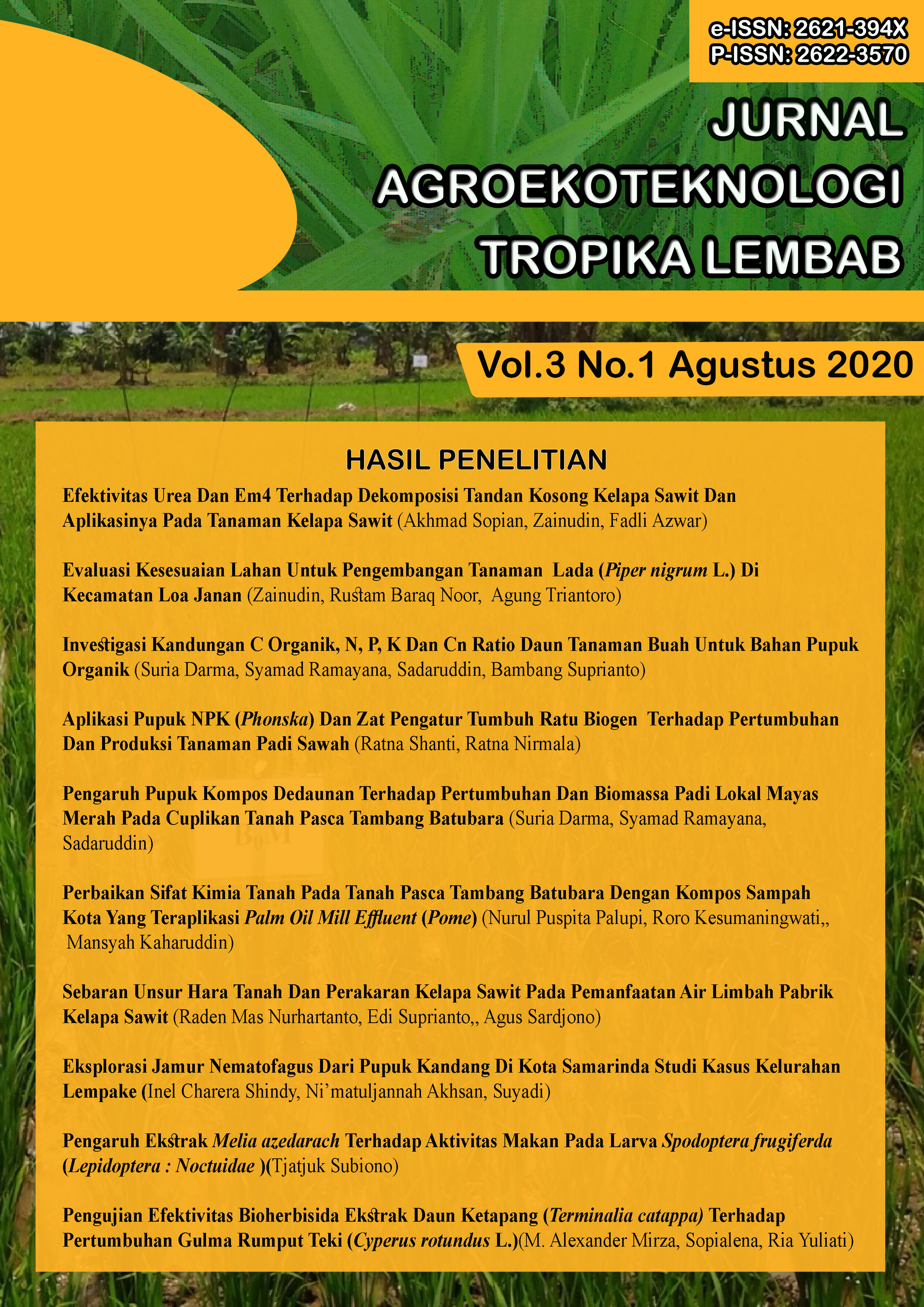
Pengaruh Ekstrak Melia azedarach Terhadap Aktivitas Makan pada Larva Spodoptera frugiferda (Lepidoptera: Noctuidae)
DOI:
https://doi.org/10.35941/jatl.3.1.2020.3865.61-65Keywords:
Aktivitas antifeedant, Indeks nutrisi, Melia azedarachAbstract
Abstrak. Senyawa kimia tanaman yang berpotensi sebagai bahan insektisidal, dan memiliki aktivitas anti feeding adalah Melia
azedarach L. Pada ekstrak daun dan buahnya. Konsentrasi ekstrak (2%, 5% dan 10%) diamati pada larva Spodoptera frugiferda
(Lepidoptera: Noctuidae). Spesies polifagus ini dianggap hama penting pada banyak tanaman pangan. Konsumsi makanan dinilai dan
indeks antifeedant dihitung melalui tes pilihan, konsumsi makanan, Umumnya larva tidak mencapai tahap kepompong saat konsentrasi
ekstrak daun atau buah pada konsentrasi tinggi yang diujikan. Aktivitas antifeedant dibandingkan dengan indeks nutrisi, yang juga
menggambarkan efek negatif dari ekstrak pada konsumsi relatif, tingkat pertumbuhan dan efisiensi dalam pemanfaatan simplisia uji
yang dicerna dan mencerna makanan, meskipun daya cerna tidak terpengaruh.
Downloads
References
Carpinella, M. C., M. T. Defagó, G. Valladares, & S. M. Palacios. 2013. Antifeedant and insecticide properties of a limonoid from Melia azedarach
(Meliaceae) with potential use for pest management. J. Agric. Food Chem. 51: 369-374.
Champagne, D. E., M. B. Isman& G. H. N. Towers. 2009. Insecticidal activity of phytochemicals and extracts of the Meliaceae. En: rnason, J. T., R. J.
R. Philogène & P. Morand (eds.), Insecticides of Plant Origin, ACS Symposium Series 387, Washington, pp. 95-109.
Chiu, S. F. 1989. Recent advances in research on botanical insecticides in China. En: Arnason, J. T., R. J. R. Philogène & P. Morand (eds.), Insecticides
of plant origin, ACS Symposium Series 387, Washington, pp. 69-77.
Dilawari, V. K., K. Singh& G. S. Dhaliwal. 2004. Effects of Melia azedarach L. on oviposition and feeding of Pluteolla xylostella L. Insect Sci. Appl.
: 203-205.
Hassanali, A. & M. D. Bentley. 1987. Comparison of the insect antifeedant activities of some limonoids. En: Schmutterer, H. & K. S. Ascher (eds.),
Natural pesticides from the Neem tree and other tropical plants, GTZ, Germany, pp. 683-689.
Pungitore, C. R., M. García, J. C. Gianello, C. E. Tonn& M. E. Sosa. 2005. Letal and sublethal effects of triterpenes from Junellia aspera (Vervenaceae)
on the grain storage insect Tribolium castaneum (Coleoptera: Tenebrionidae). Rev. Soc. Entomol. Argent. 64 (1-2): 45-51.
Saxena, R. C. 1989. Insecticides from Neem. En:Arnason, J. T., R. J. R. Philogène, & P. Morand (eds.), Insecticides of plant origin, ACS Symposium
Series 387, Washington pp. 111-119.
Schmidt, G. H., A. I. Ahmed & M. Breuer.2007. Effect of Melia azedarach extract on larlal development and reproduction parameters of Spodoptera
littoralis (B.) and Agrotis ipsilon (H.) (Lep. Noctuidae). Phytoparasitica 26 (4): 164-172.
Valladares, G., M. T. Defagó, S. M. Palacios & M. C. Carpinella. 2007. Laboratory evaluation of Melia azedarach (Meliaceae) extracts
Wheeler, D. A. & M. B. Isman. 2001. Antifeedant and toxic activity of Trichillia americana extract against the larvae of Spodoptera litura. Entomol.
Exp. Appl. 98: 9-16
Downloads
Published
Issue
Section
License
Authors retain the copyright of articles published in Jurnal Agroekoteknologi Tropika Lembab (JATL) and grant the journal the right of first publication.
Published articles are licensed under the Creative Commons Attribution-ShareAlike 4.0 International License (CC BY-SA 4.0), available at https://creativecommons.org/licenses/by-sa/4.0/.
Under this license, users may copy, redistribute, remix, transform, and build upon the published material for any purpose, including commercial purposes, provided that appropriate credit is given to the author(s) and JATL, a link to the license is provided, and any changes are clearly indicated.
If the material is remixed, transformed, or built upon, the resulting work must be distributed under the same license as the original. Users may not apply additional legal or technological restrictions that limit uses permitted by the license.
Authors may enter into separate arrangements for the non-exclusive distribution of the journal’s published version of the article, provided that its initial publication in JATL is acknowledged.
JATL does not require authors to transfer copyright to the journal.