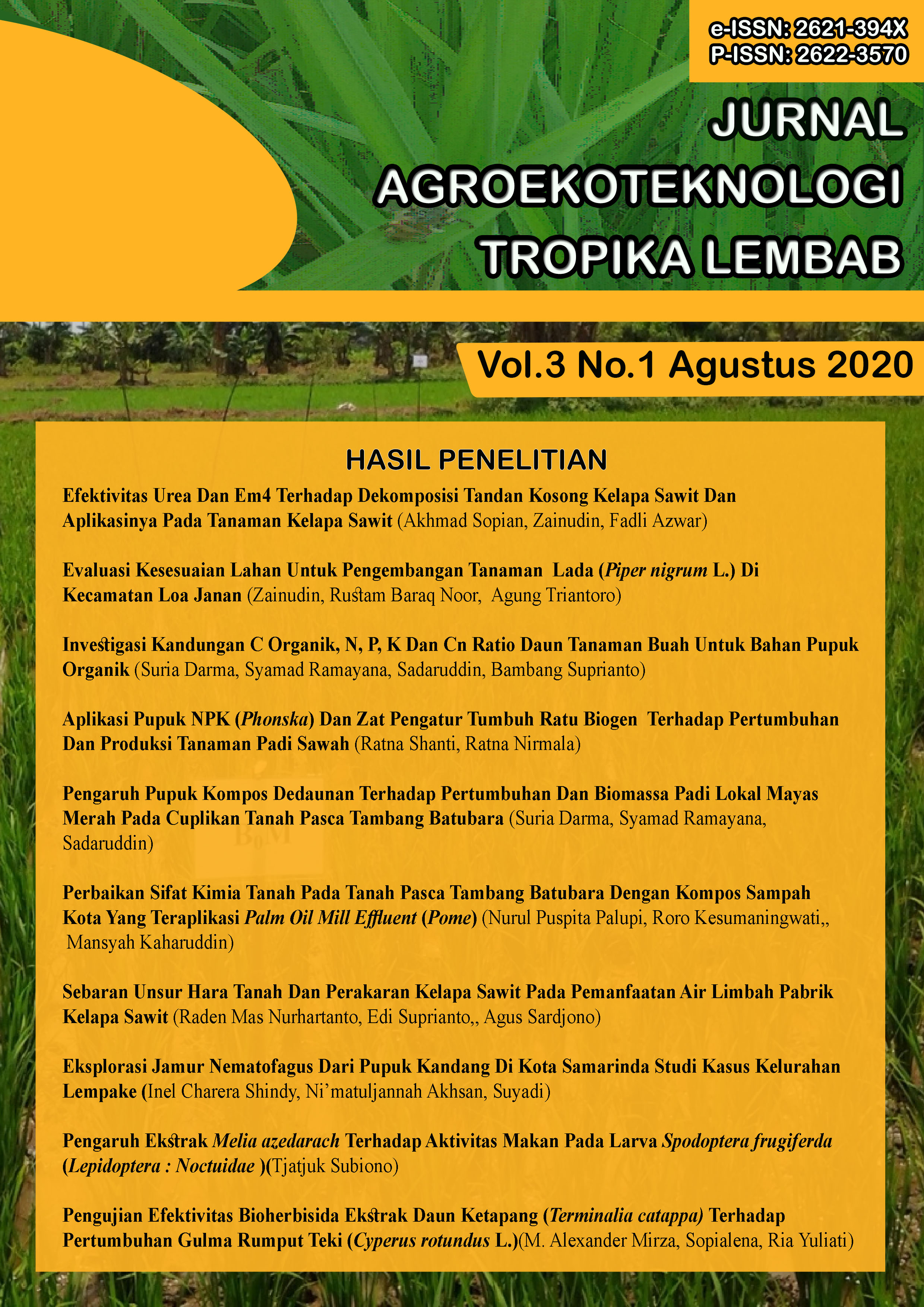
Eksplorasi Jamur Nematofagus dari Pupuk Kandang di Kota Samarinda: Studi Kasus Kelurahan Lempake
DOI:
https://doi.org/10.35941/jatl.3.1.2020.3864.55-60Keywords:
Jamur Nematofagus, Nematoda, Pupuk kandangAbstract
Abstrak. Nematoda parasit adalah hama dan penyakit yang dapat berdampak pada penurunan kuantitas dan kualitas tanaman.
Kalimantan Timur telah mengendalikan nematoda parasit, tetapi tidak menjadi perhatian konselor pertanian dan petani hanya
menggunakan pestisida umum yang dapat mempengaruhi pengendalian nematoda parasit. Penelitian ini didasarkan pada deskriptif
dan eksploratif untuk mengetahui keberadaan jamur nematoda pada pupuk kandang. Eksplorasi jamur nematoda menggunakan media
larutan pupuk kandang yang telah diencerkan 10-3 dan telah ditambahkan oleh ± 50 jamur nematoda. Hasil penelitian ini ditemukan
sembilan genera jamur. Delapan genus jamur dipastikan sebagai nematofag dan satu jamur (Circinella sp) belum diperoleh. Jamur
sebagai nematofag adalah Dactylella sp .; Arthrobotrys sp .; Gliocladium sp .; Trichoderma sp .; Verticillium sp .; Sarocladium sp.;
Aspergillus sp. dan Monacrosporium sp.
Downloads
References
Ahmad R. 2001. Isolasi dan Seleksi Cendawan Nematofagus untuk Pengendalian Haemonchosis pada Domba.
Tesis. Program Pascasarjana Institut Pertanian Bogor, Bogor.
Ahmad R. 2018. Medium tapioka untuk preservasi kapang yang bermanfaat untuk veteriner. Jurnal Mikologi Indonesia 2 (1): 1-6.
Al-Hazmi AS dan Tariq Javeed M. 2016. Effects of different inoculum densities of Trichoderma harzianum and
Trichoderma viride against Meloidogyne javanica on tomato. Saudi J Biol Sci 23 (2): 288-92.
Alexopoulos CJ., Mims CW dan Blackwell M. 1996. Introductory Mycology. John Wiley & Sons. Singapore.
Ashraf MS dan Khan TA. 2017. Efficacy of Gliocladium virens and Talaromyces flavus with and without organic amendments against
Meloidogyne javanica infecting eggplant. Asian Journal of Plant Pathology 1 (1): 18-21.
Barnett HL dan Hunter BB. 1998. Illustrated Genera of Imperfect Fungi (edisi keempat). APS Press, New Zealand.
Brands, Sheila. 2004. The Taxonomicon. www.taxonomy.nl. 17 April 2019.
Chaverri P, Samuels GJ dan Stewart EL. 2001. Hypocrea virens, the teleomorph of Trichoderma virens.
Mycologia 93: 1113-1124.
Chen J., Ling-Ling, Xu, Bin, Liul dan Xing-Zhong, Liu. 2007. Taxonomy of Dactylella complex and Vermispora. II. The genus Dactylella. Fungal
Diversity. Vol 26(1): 85-126.
Corley DG, Miller M dan Durley RC 1994. Isolation and structure of harzianum: a new trichothecene from
Trichoderma harzianum. J Nat Prod 57 (3): 422–425.
Dong YJ, He HP, Shen Y dan Zhang KQ. 2005. Nematicidal epipolysulfanyldioxopiperazines from Gliocladium roseum. Journal of Natural Products
(10): 1510-1513.
Goswami J, Kumar PR dan Tewari JP. 2008. Management of root knot nematode of tomato through application of fungal antagonists, Acremonium
strictum and Trichoderma harzianum. Journal of Environmental Science and Health 43 (3): 237–240.
Harman GE., Charles RH., Viterbo A., Chet I. dan Lorito M. 2004. Trichoderma species opportunistic, avirulent plant symbionts. Journal Nature.
Vol 2:43-54.
Howard DH. 2002. Pathogenic Fungi in Humans and Animals (edisi kedua). Marcel Dekker Inc, New York.
Huang X, Zhao N dan Zhang K. 2004. Extracellular enzymes serving as virulence factors in nematophagous fungi involved in infection of the host.
Res Microbiol 155: 811–816.
Hussain M, Zouhar M dan Rysanek P. 2017. Effects of nematophagous fungi on viability of eggs and juveniles of Meloidogyne incognita. The
Journal of Animal & Plant Sciences 27 (1): 252-258.
Jinkui Y, Wang L, Ji X dan Feng Y. 2011. Genomic and proteomic analyses of the fungus Arthrobotrys oligospora provide insights into nematodetrap
formation. Plos pathogens 7 (2): 1-12.
Junwei W, Qinglng M, Jun Q, dkk. 2013. The recombinant serine protease XAoz1 of Arthrobotrys oligospora exhibits potent nematicidal activity
against Caenorhabditis elegans and Haemonchus contortus. FEMS Microbiol Lett 344 (1): 53-59.
Kasim AA dan Dragh M. 2016. Identification of nematode trapping fungus Monacrosporium eudermatum based on genetic diversity using RAPD
technique. American Journal of Microbiological Research 4 (6): 178- 180.
Kubicek CP dan Harman GE. 1998. Trichoderma dan Gliocladium (edisi pertama). Taylor & Francis Ltd, UK.
Kunjadia A, Darji N, Patel B dan Pandit R. 2018. Exploring the industrially important extracellular enzymes from different nematode-trapping fungi.
Int J of Life Sciences 6 (1):434-440.
Liu CYM, Shimizu KM dan Hasumi. 2007. Activation of prothrombin by two subtilisinlike serine proteases from Acremonium sp. Biochemical and
Biophysical Research Communications 358 (1): 356-362.
Makmur AHA, 2014. Cendawan Anamorf (Cendawan Nematofagus, Aquatik, Aero-aquatik).
academia.edu/11750298/Anamorfic_Fungi. 17 April 2019.
Manjunath B, Devaraja, Srinivasappa KN, dkk. 2017. Assessment on management of late blight in potato incited by Phytophthora infestans.
International Journal of Plant Protection 10 (2): 410-414.
Mascarin GM, Junior MFB, Filho JV. 2012. Trichoderma harzianum reduces population of Meloidogyne incognita in cucumber plants under
greenhouse conditions. J Entomol Nematol 4: 54–57.
Mycobank. 2017. Search on: Mycobank Names. www.mycobank.org. 4 April 2019.
Nguyen TTT dan Lee HB. 2018. Isolation and characterization of three zygomycetous fungi in Korea: Backusellacircina, Circinellamuscae, and Mucor
ramosissimus. Mycobiology 46 (4): 317-327.
Noweer EMA. 2017. Occurrence and the morphological identity of some antagonistic fungi isolated from soils infested with root-knot nematode.
Communications in agricultural and applied biological sciences 82 (3): 261-275.
Pandit R, Kunjadia P, Mukhopadhyaya P dan Kunjadia A. 2014. Inorganic phosphate solubilizing potential of Arthrobotrys Conoides and
Duddingtonia Flagrans, a nematode trapping fungi a potential biocontrol agent. International Journal of Agricultural Technology 10 (3):
-570.
Pereira EO, Tsang A, McAllister TA dan Menassa R. 2013. The production and characterization of a new active lipase from Acremonium alcalophilum
using a plant bioreactor. Biotechnology for Biofuels 6: 111.
Sahebani N dan Hadavi N. 2008. Biological control of the root-knot nematode Meloidogyne javanica by
Trichoderma harzianum. Soil Biol. Biochem 40: 2016–2020.
Sen L, Wu Xia, Cao Jun-zheng dan Feng-Long W. 2013. Biocontrol potential of chitinase-producing nematophagous fungus Acremonium implicatum
against Meloidogyne incognita. Acta Phytopathologica Sinica 43 (5): 509-517.
Singh S dan Mathur N. 2010. In vitro studies of antagonistic fungi against the root knot nematode, Meloidogyne incognita. Biocon Sci Technol 20 (8):
-285.
Sudiro W. 1993. Mikrobiologi Umum. Erlangga. Jakarta.
Summerbell RC., Gueidan C. dan Schroers HJ. 2011. Acremonium phylogenetic overview and revision of Gliomastix, Trichothecium and Sarocladium.
Studies in Mycology. Vol 68: 139–162.
Surono dan Soekarno BPW. 2008. Potensi fungi tanah nematofagus dalam pemeliharaan kesehatan tanah pada praktek budidaya pertanian
berkelanjutan. Dalam Prosiding Seminar Nasional Dan Dialog Sumberdaya Lahan Petanian. Institut Pertanian Bogor , Bogor, 18-20
November 2008.
Watanabe T. 2002. Pictorial Atlas of Soil And Seed Fungi Morphologies of Cultured Fungi and Key to Species (edisi kedua). CRC Press, USA.
Watanabe T. 2013. Pictorial Atlas of Soil And Seed Fungi Morphologies of Cultured Fungi and Key to Species (edisi ketiga). CRC Press, USA.
Webster J dan Weber RWS. 2007. Introduction to Fungi (edisi ketiga). Cambridge University Press, New York.
Yuantari MGC, Widianarko B dan Sunoko HR. 2015. Analisis risiko pajanan pestisida terhadap kesehatan petani. Kemas 10 (2): 239-245.
Zare R dan Gams W. 2001. A revision of Verticillium section Prostrata. VI. The genus Haptocillium. Nova Hedwigia. Vol 73:271-292.
Zheng RY, Liu XY dan Wang YN. 2017. Circinella (Mucorales, Mucoromycotina) from China. Mycotaxon 132: 43–62.
Downloads
Published
Issue
Section
License
Copyright Transfer Statement
The copyright of this article is transferred to Jurnal Agroekoteknologi Tropika Lembab and when the article is accepted for publication. the authors transfer all and all rights into and to paper including but not limited to all copyrights in the JATL. The author represents and warrants that the original is the original and that he/she is the author of this paper unless the material is clearly identified as the original source, with notification of the permission of the copyright owner if necessary. The author states that he has the authority and authority to make and carry out this task.
The author states that:
This paper has not been published in the same form elsewhere.
This will not be submitted elsewhere for publication prior to acceptance/rejection by this Journal.
A Copyright permission is obtained for material published elsewhere and who require permission for this reproduction. Furthermore, I / We hereby transfer the unlimited publication rights of the above paper to Jurnal Agroekoteknologi Tropika Lembab. Copyright transfer includes exclusive rights to reproduce and distribute articles, including reprints, translations, photographic reproductions, microforms, electronic forms (offline, online), or other similar reproductions.
The author's mark is appropriate for and accepts responsibility for releasing this material on behalf of any and all coauthor. This Agreement shall be signed by at least one author who has obtained the consent of the co-author (s) if applicable. After the submission of this agreement is signed by the author concerned, the amendment of the author or in the order of the author listed shall not be accepted.
Rights / Terms and Conditions Saved
The author keeps all proprietary rights in every process, procedure, or article creation described in Work.
The author may reproduce or permit others to reproduce the work or derivative works for the author's personal use or for the use of the company, provided that the source and the JATL copyright notice are indicated, the copy is not used in any way implying the Jurnal Agroekoteknologi Tropika Lembab (JATL) approval of the product or service from any company, and the copy itself is not offered for sale.
Although authors are permitted to reuse all or part of the Works in other works, this does not include granting third-party requests to reprint, republish, or other types of reuse.