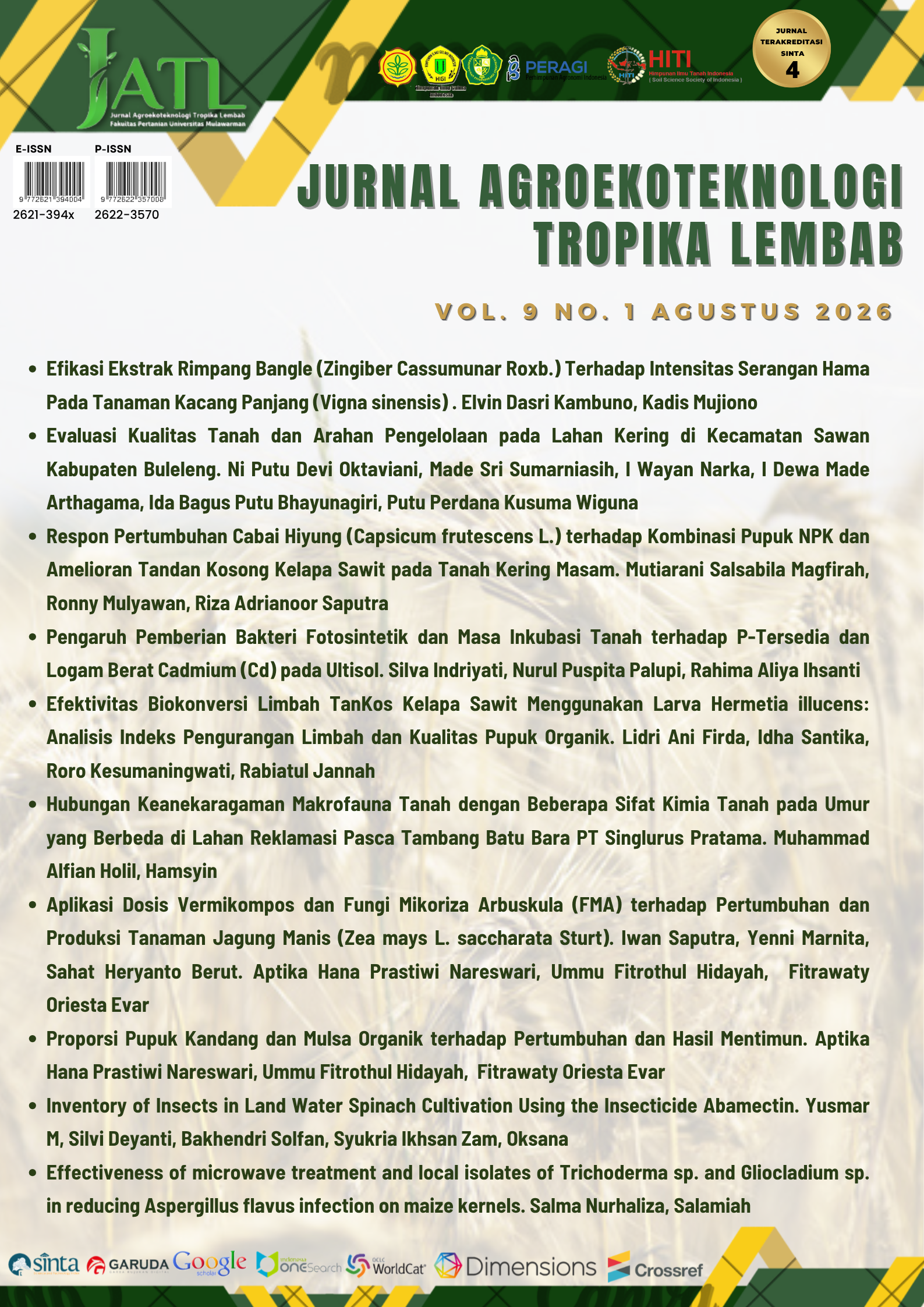
Inventory of Insects in Land Water Spinach Cultivation Using the Insecticide Abamectin
DOI:
https://doi.org/10.30872/jatl.9.1.2026.27436.91-98Keywords:
abamectin, climate, land kale, pest attacks, predatorAbstract
Land kale in a cultivated has an obstacle, namely the presence of insects. Based on their there are beneficial and harmful insects. To deal with harmful insects, insecticides are used which contain the active ingredient abamectin which causes insect skin irritation and eliminates appetite. The aim of this research was to see the presence of insects in the use of abamectin in land kale plantings in West Sidomulyo Village. This study was conducted in May and September 2024 in West Sidomulyo Village and identification was carried out at the Pathology Laboratory, Entomology, Microbiology, and Soil Science, Faculty of Agriculture and Animal Science, Sultan Syarif Kasim State Islamic University, Riau. The samplin was by catching directly using nets and yellow traps found on land kale plants. Insects are stored in collection bottles. The research results showed that there were 3 ordo, 7 family dan 8 genera of insects. There are 4 insect pests namely Anasa sp., Gonocerus sp., Bemisia sp., and Aspidimorpha sp., there are 3 predatory insect namely Verenia sp., Menochilus sp., and Paederus sp., and there 1 migrant insect namely Musca sp. The insects found have haustelata (piercin, sucking) and mandibulata (biting, chewing) mounth types. The intensity of insect pest attack increased after the application of abamectin insecticide, allegedly due to the inappropriate application time, where the application was carried out in the morning toward noon with a fairly high temperature so that evaporation occured and the effectiveness of the insecticide was reduced.Downloads
References
Aljedani, D. M. 2017. Effects of Abamectin and Deltamethrin to the Foragers Honeybee Workers of Apis Mellifer Jemenatica (Hymenoptera: Apidae) under laboratory conditions. Saudi Journal of Biological Sciences,24(5), 1007–1015.
Arfan, Anshary, A., Basri, Z., and Toana.
H. 2018. Effect Chemical Insecticide on the Arthropod Diversity in the Agroecosystem of Red Onion Crops. Asian Journal of Crop Science,107-114.
Arfan, Ratnawati, and Shahabuddin, 2016. Distribution and Population of Leaf-Feeding Pests (Liriomyza spp.) in the Red Onion Growing Area of the Palu Valley. Proceedings. PEI Palu Branch.
Pekanbaru Central Statistics Agency. 2023. Tuah Madani Subdistrict in Figures 2023. Pekanbaru City Central Statistics Agency.
Ministry of Agriculture. 2012. Development of Sustainable Food Production Areas (KRPL). Agricultural Research and Development Agency. Ministry of Agriculture.
Maulana, D. (2018). Raih Untung Dari Budidaya Kangkung. Yogyakarta: Trans Idea Publishing. 120 hal.
Downloads
Published
Issue
Section
License
Authors retain the copyright of articles published in Jurnal Agroekoteknologi Tropika Lembab (JATL) and grant the journal the right of first publication.
Published articles are licensed under the Creative Commons Attribution-ShareAlike 4.0 International License (CC BY-SA 4.0), available at https://creativecommons.org/licenses/by-sa/4.0/.
Under this license, users may copy, redistribute, remix, transform, and build upon the published material for any purpose, including commercial purposes, provided that appropriate credit is given to the author(s) and JATL, a link to the license is provided, and any changes are clearly indicated.
If the material is remixed, transformed, or built upon, the resulting work must be distributed under the same license as the original. Users may not apply additional legal or technological restrictions that limit uses permitted by the license.
Authors may enter into separate arrangements for the non-exclusive distribution of the journal’s published version of the article, provided that its initial publication in JATL is acknowledged.
JATL does not require authors to transfer copyright to the journal.