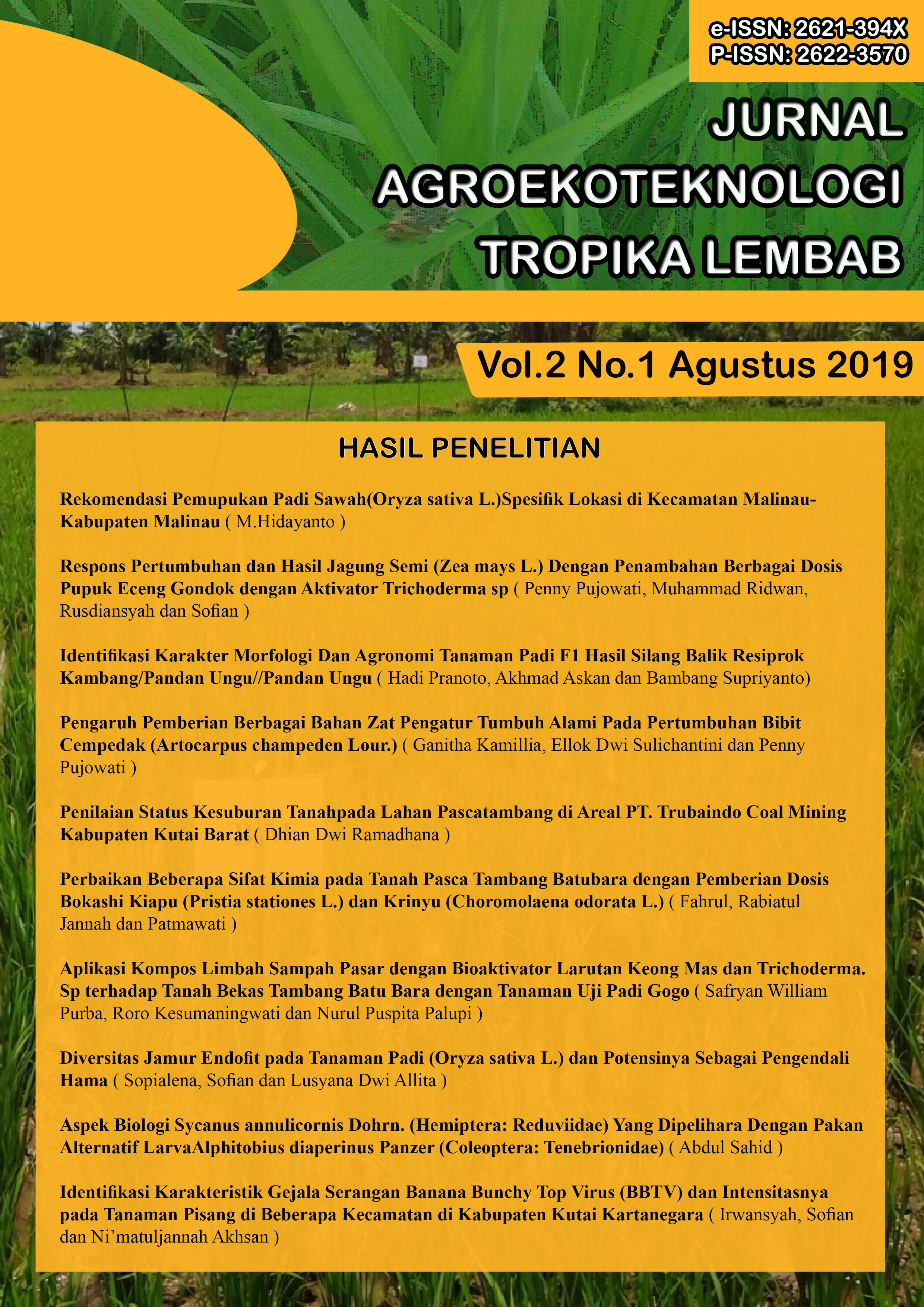
Identifikasi Karakteristik Gejala Serangan Banana Bunchy Top Virus (BBTV) dan Intensitasnya pada Tanaman Pisang di Beberapa Kecamatan di Kabupaten Kutai Kartanegara
DOI:
https://doi.org/10.35941/jatl.2.1.2019.2536.55-60Keywords:
BBTV, symptom, cropping pattern, sanitation, weed controlAbstract
Banana is one of the fruit commodities that are consumed by many people. Banana dwarf disease is an important disease in Indonesia.This study aims to identify the characteristics of BBTV attack symptoms on banana plants and the physical characteristics of banana plants which are attacked by different planting patterns, sanitation and weed control.This research was carried out in several sub-districts in Kutai Kartanegara District, namely Samboja sub-district, Muara Jawa sub-district, Loa Janan sub-district, Muara Badak sub-district, Loa Kulu sub-district. The method used is the survey method, which is direct observation in the field using a modified score based on the appearance of the sick morphology of the plant (Brooks, 1999).Data obtained from each plot was processed to determine the intensity of each-plot disease using the formula for calculating disease severity (Agrios, 1997). Disease intensity data are compared based on sampling land conditions. Based on the results of a survey conducted at several observation points spread across 5 sub-districts, it can be concluded that the symptom severity is higher in mixed-crop, uses sanitation and weed control compared to monoculture, without sanitation and weed control. The average score of the assessment is a score of 3 with characteristics: (1) the edges of the leaves turn yellow quite severe, (2) the narrowing of the leaves or twisting (3) the occurrence of distortion, dwarf and necrosis (4) found more than four infected banana stems in clump.Downloads
References
Agrios,G.W. 1997. Plant Pathology Fourth Edition. New York:Academic Pres.
Balai Pengkajian Teknologi Pertanian Kalimantan Timur. 2017. Sanitasi, Teknik Pengendalian Yang Efektif. (http://kaltim.litbang.pertanian.go.id) diakses tanggal 11 Desember 2018.
Brooks, F.E. 1999. Incidence and distribution of Banana Bunchy Top Virus in American Samoa. Journal of South Pasific Agriculture 6(1): 25-28.
Furuya,N.,Dizon,T.O., dan Natsuaki, K.T.2006. Molecular characterization of banana bunchy top virus and cucumber mosaic virus from Abaca (Musa textilis Nee).Journal of Agricultural Science, Tokyo University of Agriculture 51:92–101.
Nurhadi A., & L. Setyobudi. 2000. Status of banana and citrus viral diseases in Indonesia. Di dalam: Molina AB, Roa VN, Bay-Petersen J, Carpio At, joven JEA, editor. Managing Banana and Citrus Diseases. Proceeding of a Regional Workshop on Disease-free Planting Materials; Davao City (Philippines), 14-16 October 1998. Davao City: International Plant Genetic Resources Institute. P. 135-148.
Semangun H. 2000. Penyakit-Penyakit Tanaman Hortikultura di Indonesia. Gadjah Mada University Press. Yogyakarta.
Silalahi, U. 2015. Metode Penelitian Sosial Kuantitatif. Bandung : Refika Aditama.
Sulandari, Sri. 2006. Deteksi dan Kajian Kisaran Inang Virus Penyebab Penyakit Daun Keriting Kuning Cabai. Jurnal Hayati. Vol 13(1): 1-6
Thomas, J.E. 2008. Banana Bunchy Top Virus. In Mahy B.W.J & M.H.V. Van Regenmortel (eds.), Desk Encyclopedia of Plant and Fungal Virology. Elsevier Ltd, London.Vol (2): Hal 94-100.
Widiarta, I. N., Burhanuddin, A. A. Daradjat, dan A. Hasanuddin. 2004. Status dan program penelitian pengendalian terpadu penyakit tungro. Prosiding Seminar Nasional Status Program Penelitian Tungro Mendukung Keberlanjutan Produksi Padi Nasional. Makassar, 7-8 September 2004.
Downloads
Published
Issue
Section
License
Copyright Transfer Statement
The copyright of this article is transferred to Jurnal Agroekoteknologi Tropika Lembab and when the article is accepted for publication. the authors transfer all and all rights into and to paper including but not limited to all copyrights in the JATL. The author represents and warrants that the original is the original and that he/she is the author of this paper unless the material is clearly identified as the original source, with notification of the permission of the copyright owner if necessary. The author states that he has the authority and authority to make and carry out this task.
The author states that:
This paper has not been published in the same form elsewhere.
This will not be submitted elsewhere for publication prior to acceptance/rejection by this Journal.
A Copyright permission is obtained for material published elsewhere and who require permission for this reproduction. Furthermore, I / We hereby transfer the unlimited publication rights of the above paper to Jurnal Agroekoteknologi Tropika Lembab. Copyright transfer includes exclusive rights to reproduce and distribute articles, including reprints, translations, photographic reproductions, microforms, electronic forms (offline, online), or other similar reproductions.
The author's mark is appropriate for and accepts responsibility for releasing this material on behalf of any and all coauthor. This Agreement shall be signed by at least one author who has obtained the consent of the co-author (s) if applicable. After the submission of this agreement is signed by the author concerned, the amendment of the author or in the order of the author listed shall not be accepted.
Rights / Terms and Conditions Saved
The author keeps all proprietary rights in every process, procedure, or article creation described in Work.
The author may reproduce or permit others to reproduce the work or derivative works for the author's personal use or for the use of the company, provided that the source and the JATL copyright notice are indicated, the copy is not used in any way implying the Jurnal Agroekoteknologi Tropika Lembab (JATL) approval of the product or service from any company, and the copy itself is not offered for sale.
Although authors are permitted to reuse all or part of the Works in other works, this does not include granting third-party requests to reprint, republish, or other types of reuse.