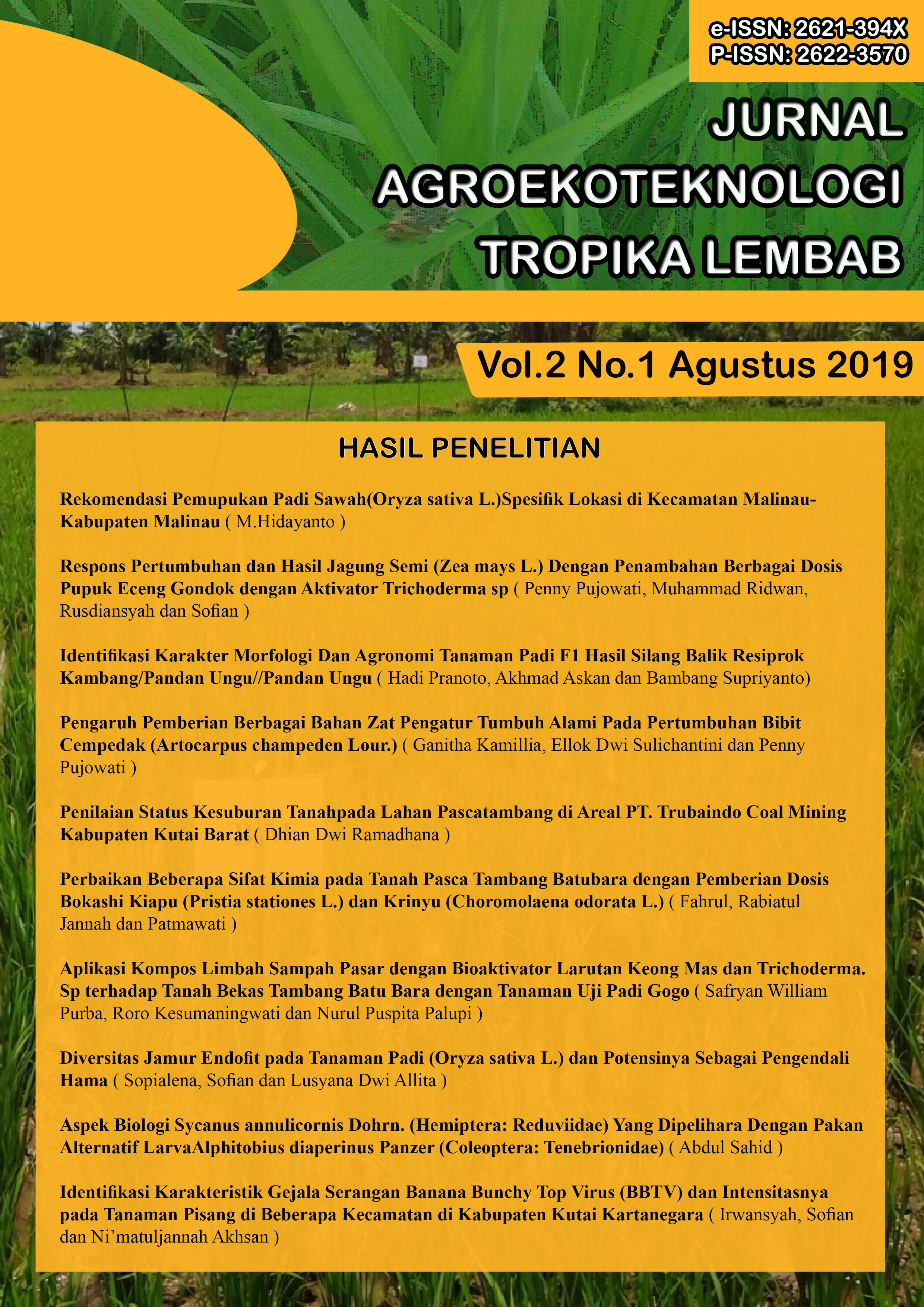
Aplikasi Kompos Limbah Sampah Pasar dengan Bioaktivator Larutan Keong Mas dan Trichoderma. Sp terhadap Tanah Bekas Tambang Batu Bara dengan Tanaman Uji Padi Gogo
DOI:
https://doi.org/10.35941/jatl.2.1.2019.2534.38-43Keywords:
Situ Bagendit rice, compost fertilizer, MOL golden snail, Trichoderma sp solution, market wasteAbstract
East Kalimantan has a fairly extensive ex-coal mining area. Continuous mining activities cause severe land damage with a dramatically reduced nutrient. The application of organic farming can be one of the solutions to improve ex-mining land. One of the plants that can be applied is Situ Bagendit Rice. Rice Bagendit varieties are dry land rice which is resistant to pests and blast disease. The use of market waste, MOL golden snail, and Trichoderma. Sp as organic material can increase productivity in Bagendit rice plants there and be able to repair damage to ex-coal mine land. The aim of this study was to compare market waste, MOL golden snail and Trichoderma sp to Bagendite rice plant growth. This study used the RAL method (Completely Randomized Design) with 9 treatments and 3 replications. B0 control (soil without additives), B1 compost market waste and Trichoderma sp with a dose of 100 g/polybag, B2 market waste waste compost and MOL golden snail with a dose of 100 g/polybag, B3 compost market waste and Trichoderma sp with 200 g/polybag, B4 market waste compost and MOL golden snail with a dose of 200 g/polybag, B5 market waste compost and Trichoderma sp with a dose of 300 g/polybag, B6 market waste compost and MOL golden snail with a dose of 300 g/polybag, B7 market waste compost and Trichoderma sp with a dose of 400 g/polybag, B8 market waste compost and MOL golden snail with a dose of 400 g/polybag. The results showed that Trichoderma sp market waste compost fertilizer and golden snail market MOL waste compost each had a significant effect on the productivity of bagendite rice plants. In addition, MOL market golden snail waste compost with the best dosage of 400 g/polybag is able to produce harvested dry grain production of around 2.8 tons/ha.Downloads
References
Departemen Pertambangan dan Energi Direktorat Jenderal Pertambangan UMUM. 1996. Pedoman Reklamasi Lahan Bekas Tambang. Jakarta
Foth, D. H., 1994. Dasar-dasar Ilmu Tanah. Gadjah Mada University Press, Yogyakarta
Gandjar, I., Robert A.S., Karin V.D., Ariyanti O., dan Iman S., 1999. Pengenalan Kapang Tropik Umum. Yayasan Obor Indonesia. Jakarta.
Hanafiah, K. A. 2005. Dasar-dasar Ilmu Tanah. Raja Grafindo Persada. Jakarta
Hardjowigeno, S. 2003. Ilmu tanah. Akademika Pressindo. Jakarta
Indriani, Y. H. 2003. Membuat Kompos Secara Kilat. Penebar Swadaya. Jakarta
Khairul, U., 2001. Pemanfaatan Bioteknologi untuk Meningkatkan Produksi Pertanian. dalam Makalah Falsafah Sains (PPS 702) Program Pasca sarjana/S3 Institut Pertanian Bogor,November 2001.
Kurnia, U., dkk., 2006. Sifat Fisik Tanah dan Metode Analisisnya. Balai Litbang Sumberdaya Lahan Pertanian
Manurung, S.O. and M. Ismunadji. 1988. Morfologi dan Fisiologi Padi. Balitan Pangan Bogor. 319 hal.
Downloads
Published
Issue
Section
License
Copyright Transfer Statement
The copyright of this article is transferred to Jurnal Agroekoteknologi Tropika Lembab and when the article is accepted for publication. the authors transfer all and all rights into and to paper including but not limited to all copyrights in the JATL. The author represents and warrants that the original is the original and that he/she is the author of this paper unless the material is clearly identified as the original source, with notification of the permission of the copyright owner if necessary. The author states that he has the authority and authority to make and carry out this task.
The author states that:
This paper has not been published in the same form elsewhere.
This will not be submitted elsewhere for publication prior to acceptance/rejection by this Journal.
A Copyright permission is obtained for material published elsewhere and who require permission for this reproduction. Furthermore, I / We hereby transfer the unlimited publication rights of the above paper to Jurnal Agroekoteknologi Tropika Lembab. Copyright transfer includes exclusive rights to reproduce and distribute articles, including reprints, translations, photographic reproductions, microforms, electronic forms (offline, online), or other similar reproductions.
The author's mark is appropriate for and accepts responsibility for releasing this material on behalf of any and all coauthor. This Agreement shall be signed by at least one author who has obtained the consent of the co-author (s) if applicable. After the submission of this agreement is signed by the author concerned, the amendment of the author or in the order of the author listed shall not be accepted.
Rights / Terms and Conditions Saved
The author keeps all proprietary rights in every process, procedure, or article creation described in Work.
The author may reproduce or permit others to reproduce the work or derivative works for the author's personal use or for the use of the company, provided that the source and the JATL copyright notice are indicated, the copy is not used in any way implying the Jurnal Agroekoteknologi Tropika Lembab (JATL) approval of the product or service from any company, and the copy itself is not offered for sale.
Although authors are permitted to reuse all or part of the Works in other works, this does not include granting third-party requests to reprint, republish, or other types of reuse.