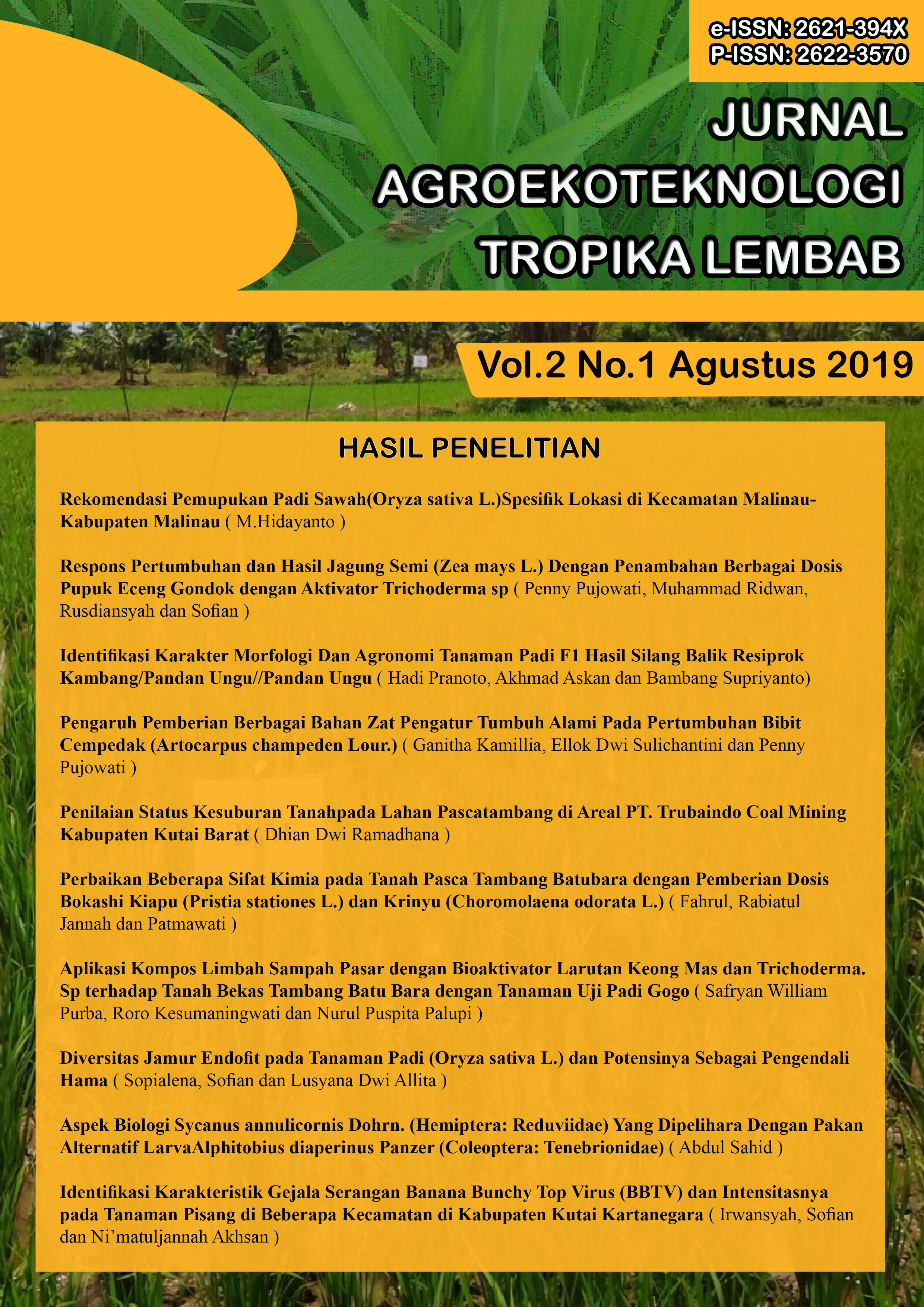
Perbaikan Beberapa Sifat Kimia pada Tanah Pasca Tambang Batubara dengan Pemberian Dosis Bokashi Kiapu (Pristia stationes L.) dan Krinyu (Choromolaena odorata L.)
DOI:
https://doi.org/10.35941/jatl.2.1.2019.2530.29-37Keywords:
Kiapu and krinyu mixed bokashi, post-coal mine soil, soil chemistryAbstract
The purpose of this study was to determine the nutrient content of bokashi fertilizers that matched the SNI compost quality standards and the best bokashi and chrysanthemum mixture dosages and the effect of increasing the best chemical status on post-coal mine soil. This research was conducted for two 2 months. The land for this research was taken from post-coal mine land in the Loa Bakung area, Samarinda. The place for conducting research is carried out on Jl. Jakarta Blok BN No 36. Loa Bakung, Samarinda. The method used in this study is descriptive and comparative. This research has 2 stages, namely the first stage of making bokashi kiapu and krinyu mixture and the second stage of the incubation process of post-coal mine soil with a treatment dose that is soil without bokashi, soil with a dose of bokashi 17.5 g polybags, 20 g polybags and 22.5 g polybags, each repeated 3 times. Then analyzed at the Soil Science Laboratory, Mulawarman University Faculty of Agriculture, with parameters pH, C/N ratio, C-organic, N, P, K. Bokashi analysis data based on 2004 SNI Compost Quality Standards and soil analysis data based on soil chemical review status which was developed by the Bogor Soil Research Center in 2009. The results of this study showed that the bokashi mixture of kiapu and krinyu had an effect on increasing soil chemical properties in post-coal mine land, the status of bokashi according to SNI, 22.5% organic C had not matched the quality standard, pH 8.87 not yet according to quality standards, N 1.86% according to quality standards, C/N 12.11 according to quality standards, P 0.98 ppm according to quality standards, and K 2.11 ppm according to quality standards. The best application is at a dose of 22.5 g polybags with a rise at week 4, namely pH 4.94 with acidic status, organic C 2.71% with moderate status, N 0.16% with low status, C/N ratio 16 , 08 with high status, P 31.85 ppm with high status, and K 120.41 ppm with very high status.Downloads
References
APNAN. 1996. Pedoman Penggunaan EM bagi Negara-negara Asia- Pasifik Nature Agricultere Network (APNAN). Departemen pertanian, badan Pendidikan dan Latihan Pertanian. Jakarta.
Arinong, R. 2013. Fosfor Tanah. http://www.stppgowa.ac.id/infor masi/artikel-ilmiah/258-fosfor- tanah.htm 5 Juli 2018
Atmojo, S. W. 2003. Peranan Bahan Organik Terhadap Kesuburan Tanah Dan Upaya Pengelolaanya. Sebelas Maret University Press. Surakarta. 36 hlm.
Cooke J. A., and Jhonson M. S. 2002. Ecological Restoration of Land With Particularreference to the Mining of Metals and Industrial Minerals : A Review of the oryand Pratice. Environmental Review 10:41-71.
Djuarmani, N . Kristian, B.S Setiawan. 2005. Cara Cepat Membuat Kompos. Agromedia Pustaka. Jakarta.
Dodd WE, Louis AO. 2003. Evaluating Reclamation Success At Three AML Sites in North Dakota in 1998 and 2003. 25 th Annual Confrence of the Associaton of Abandoned Mine Land Program. Kentucky, 28 Sept-01Oct 2003.
Edy, S. H. 2008. Pembibitan kelapa sawit. Pusat Penelitian Kelapa Sawit. Medan.
Fredy, A., Ismayana, A., Indrasti, N. S., Suprihatin, Maddu, A. 2012. Factor rasio C/n Awal dan Laju Aerasi pada Proses Co- composting Bagasse dan Blateng. Fakultas Teknologi Pertanian IPB. Bogor. Volume 22 Nomer 3. Halaman 173 -179.
Foth, Henry D 1998. Dasar-dasar Ilmu Tanah. Terjemahan Purbayanti, E. D. dkk. Gajah Mada University Press, Yogyakarta.
Hakim, N, M.Y. nyapka, a. M. Lubus, S. G. Nugroho, M. R. Saul, M. A. diha, G. B. Hong, dan H. H. Bailey. 1986. Dasar- dasar Ilmu Tanah. Universitas Lampung. Lampung.
Halvin JL, Beaton DJ, Nelson SL, dan Nelson WL, 2005, 2005. Soil Fertility and Fertilizers.An Introduction toNutrient Management.NewJersey : Pearson Prentice Hall. Dalam Munawar, Ali. 20011. Kesuburan tanah dan Nutrisi Tanaman, IPB Press. Bogor.
Hardjowigeno. 2010. Ilmu Tanah. Rajawali Press. Bogor.
Kusumanintyas, Hapsari. 2009. Limonologi Tanaman Air. http://www.scribd.com/doc/55466421/Tanaman-Air-Di-GH
Kohnke H. 1968. Soil physics. New York: McGraw-Hill Book Company.
Lingga, P. dan Marsono. 2001. Petunjuk Penggunaan Pupuk. Penebar Swadaya. Jakarta. 163 hlm.
Munawar.2011. Kesuburan Tanah dan Nutrisi Tanaman.ITB Press. Bogor.
Nadapdap, E. F. R., Rauf, A., Hanafiah, A.S. 2013. Kajian Total Biomassa dan Simpanan Karbon Rerumputan Serta Sifat Fisika Kimia Tanah Pada Lahan Rerumputan Dengan Kelas Lereng Berbeda di Daerah Tangkapan Air Danau Toba. Jurnal. Fakultas Pertanian. Universitas Sumatera Utara. Medan. Vol 2, No.1.
Lubis, S. Y. Dkk. 2010. Dasar-dasar Ilmu Tanah. Universitas Lampung. Lampung.
Paul, E.A dan F.E.Clark. 1989. Soil Microbiology and Biochemistry. Academic Press, Inc. Harcourt Brace Jovanovich, Pulb. Toronto.
Sariwahyuni. 2002. Laju Penyerapan Logam Berat Cu, Cd, Co, dan Ni dengan penambahan Bahan Organik Ganggang Coklat Pada Tanah Bekas Penambangan Nikel Pomala. Univesitas Hasanudin. Makasar
Sugeng. 2006. Tanaman Apotik Hidup. Semarang : Aneka Ilmu.
Susanto, R. 2002. Penerapan Pertanian Organik. Kanisisus. Yogyakarta.
Subroto dan Yusrani. 2005. Kesuburan dan Penataan Tanah. Bayumedia Publishing. Malang.
Soniari , N.N., Budiyani, N.K,. dan Sutari, N.W.S. (2014). Analisis Kualitas Mikroorganisme Lokal (MOL). bonggolPisang. E- Jurnal Agroekoteknologi Tropika. Vol 5 (1): Universitas Udayana. Bali.
Subowo. 2011. Penambangan Sistem Terbuka Ramah Lingkungan dan Upaya Reklamasi Pasca Tambang Untuk Memperbaiki Kualitas Sumberdaya Lahan dan Hayati Tanah.Jurnal Sumberdaya Lahan Volume.5 No.2, Desember 2011. Bogor.
Prawiradiputra, B.R. 2007. Krinyu Chromolaena Odorata (L.)R.M.King dan H. Robinson: Gulma padang rumput yang merugikan. Bulletin Ilmu Peternakan Indonesia (WARTAZOA), 17(1):124-132
Novizan, 2005, petunjuk pemupukan yang efektif. Jakarta : Agro Media Pustaka
Rosmarkam, A., dan N. W. Yuwono2002. Ilmu Kesuburan Tanah. Kanisius.Yogyakarta.
Thamrin, m., S. Asikin, Mukhlis dan A. Budiman. 2007. Potensi ekstrak flora lahan rawa sebagai pestisida nabati. Dalam Supriyo, A., M. Norr, I. Ar-Riza dan D. Nazemi (Ed). Monograf : keanekaragaman Flora dan Buah-buahan Eksotik Lahan Rawa. Balai Besar Penelitian dan Pengembanga Sumberdaya Lahan Pertanian. Hal 23-31.
Utami, N.H., 2009. Kajian Sifat Fisik, Sifat Kimia dan Sifat Biologi Tanah Paska Galian C pada Tiga Tipe Penutupan Lahan. Departeman Silvikultur, Fakultas Kehutanan, Institut Pertanian Bogor. Bogor.
Wahida dan Suryaningsih Ni Luh Sri 2012. “Analisis kandungan unsur hara pupuk Organik cair di kabupaten Marauke”. Jurnal Agricola. Vol 6. No 1. p-ISSN : 2088-1673
Winarso, S. 2005. Kesuburan Tanah dan Strategi Pengelolaannya. Edisi Pertama. Graha Ilmu. Yogyakarta.
Wirdati dan Mardhatillah 2015, penentuan konsentrasiLogam berat Pb, Cu, Zn, dan Konduktivitas Listrik Limbah Cair Industri Pabrik Karet Pekanbaru : Karya Ilmiah FMIPA Binawidya Pekanbaru.
Yuniar.2002. Biologi Tanah dan Strategi Pengelolaannya. Edisi Pertama. Graha Ilmu. Yogyakarta.
Yulipriyanto, M. 2010. Biologi Tanah dan Penerapannya. Graha Ilmu, Jakarta.
Downloads
Published
Issue
Section
License
Copyright Transfer Statement
The copyright of this article is transferred to Jurnal Agroekoteknologi Tropika Lembab and when the article is accepted for publication. the authors transfer all and all rights into and to paper including but not limited to all copyrights in the JATL. The author represents and warrants that the original is the original and that he/she is the author of this paper unless the material is clearly identified as the original source, with notification of the permission of the copyright owner if necessary. The author states that he has the authority and authority to make and carry out this task.
The author states that:
This paper has not been published in the same form elsewhere.
This will not be submitted elsewhere for publication prior to acceptance/rejection by this Journal.
A Copyright permission is obtained for material published elsewhere and who require permission for this reproduction. Furthermore, I / We hereby transfer the unlimited publication rights of the above paper to Jurnal Agroekoteknologi Tropika Lembab. Copyright transfer includes exclusive rights to reproduce and distribute articles, including reprints, translations, photographic reproductions, microforms, electronic forms (offline, online), or other similar reproductions.
The author's mark is appropriate for and accepts responsibility for releasing this material on behalf of any and all coauthor. This Agreement shall be signed by at least one author who has obtained the consent of the co-author (s) if applicable. After the submission of this agreement is signed by the author concerned, the amendment of the author or in the order of the author listed shall not be accepted.
Rights / Terms and Conditions Saved
The author keeps all proprietary rights in every process, procedure, or article creation described in Work.
The author may reproduce or permit others to reproduce the work or derivative works for the author's personal use or for the use of the company, provided that the source and the JATL copyright notice are indicated, the copy is not used in any way implying the Jurnal Agroekoteknologi Tropika Lembab (JATL) approval of the product or service from any company, and the copy itself is not offered for sale.
Although authors are permitted to reuse all or part of the Works in other works, this does not include granting third-party requests to reprint, republish, or other types of reuse.