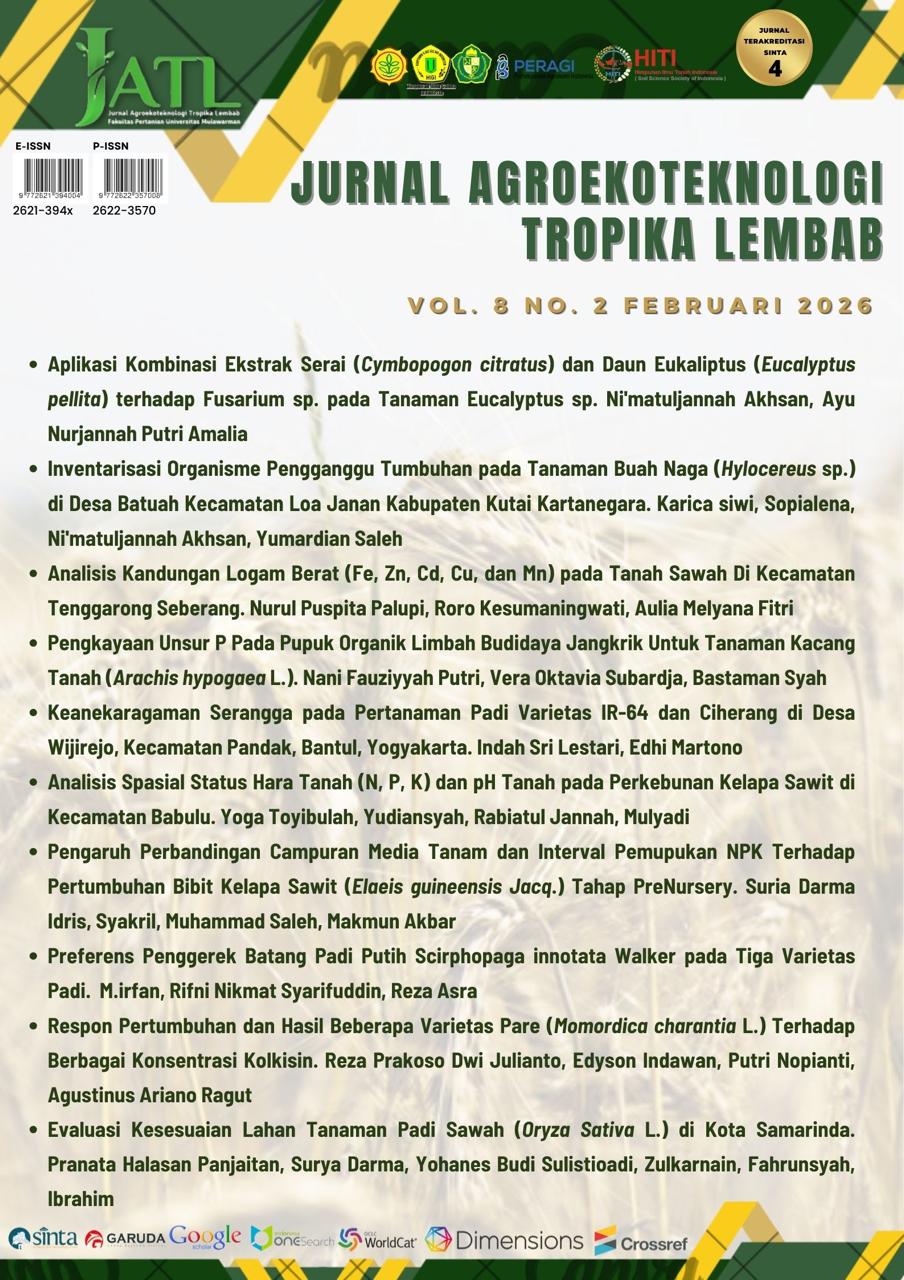
Respon Pertumbuhan dan Hasil Beberapa Varietas Pare (Momordica charantia L.) Terhadap Berbagai Konsentrasi Kolkisin
DOI:
https://doi.org/10.30872/jatl.8.2.2026.21392.69-75Keywords:
kolkisin, pare, poliploidiAbstract
Tanaman pare (Momordica charantia L.) merupakan salah satu jenis tanaman sayuran yang tergolong dalam famili cucurbitaceae, yang tumbuhnya menjalar atau merambat dan mudah untuk dibudidayakan serta tumbuhnya tidak tergantung dengan kondisi musim. Permasalahan utama tanaman pare saat ini yaitu rendahnya tingkat produktivitas hanya sekitar 11,5 ton/ha sedangkan tingkat kebutuhan buah pare terus mengalami peningkatkan seiring dengan peningkatan jumlah penduduk yang terus meningkat setiap tahunnya. Pemuliaan tanaman dengan cara penggandaan kromosom (poliploid) menggunakan kolkisin, merupakan salah satu cara yang dapat digunakan untuk mengoptimalkan pertumbuhan dan hasil tanaman pare. Poliploidi berpengaruh terhadap peningkatan ukuran nukleus, sehingga menyebabkan adanya penambahan ukuran sel dan jaringan, organ dan tanaman sehingga menyebabkan penampakan morfologis tanaman menjadi lebih besar dibandingkan tanaman diploid. Penelitian ini bertujuan untuk menguji pengaruh kolkisin terhadap pertumbuhan dan hasil tanaman pare, serta menentukan dosis kolkisin terbaik untuk peningkatan hasil dan pertumbuhan tanaman pare. Berdasarkan hasil penelitian dapat disimpulkan bahwa aplikasi kolkisin pada beberapa varietas tanaman pare (Momordica charantia L.) mampu meningkatkan hasil tanaman dan berbeda nyata dengan tanaman pare yang tidak diaplikasikan kolkisin. Aplikasi kolkisin dengan dosis 30 ppm memberikan hasil paling optimal, hal ini dapat diketahui dari parameter juppmaj buah, bobot buah, dan diameter buah. Sedangkan aplikasi kolkisin menyebabkan panjang sulur tanaman pare menjadi lebih pendek,dan meningkatkan ukuran luas daun, sehingga hal ini akan berdampak terhadap peningkatan proses fotosintesis tanaman
Downloads
References
Behera, P., Kumar, V., Sharma, S., Lenka, S., & Panda, D. (2022). Genotypic diversity and abiotic stress response profiling of short-grain aromatic landraces of rice (Oryza sativa L. Indica). Current Plant Biology, 33, 100269. https://doi.org/10.1016/j.cpb.2022.100269
Darko, C., Yeboah, S., Amoah, A., Opoku, A., & Berchie, J. N. (2020). Productivity of sweet potato (Ipomoea batatas (L) Lam) as influenced by fertilizer application in different agro-ecologies in Ghana. Scientific African, 10, e00560. https://doi.org/https://doi.org/10.1016/j.sciaf.2020.e00560
Desai, B. . (2004). Seeds Handbook Biology, Production, Processing, and Storage Second Edition. Marcel Dekker.
Kishore, K., D., Samant, H. S., Singh, & Behera., S. (2017). Studies on the Reproductive Strategies of Sapota (Manilkara zapota). J. of Environmental Biology, 38, 361–366.
Lundqvist, U., Franckowiak, J. ., & Forster, B. (2012). Mutation catagories. In Plant Mutation Breeding and Biotechnology (Shu, Q.Y., et al. Eds). Plant Breeding and Genetics Section Joint FAO/IAEA Devision of Nuclear Techniques in Food and Agriculture International Atomic Energy Agency, 47–55.
Nasrudin, N., & Wahyudhi, A. (2021). Application of Liquid Silica Nutrients to Plant Growth Analysis and Rice Productivity Affected by Salt Stress (NaCl). International Journal of Agricultural System, 9(2), 91–102.
Nursyamsi, A., Nasrudin, N., & NurhidayahS. (2023). Pengaruh Jenis Pupuk Organik Dan Penjarangan Bakal Buah Terhadap Pertumbuhan Dan Hasil Melon. Jurnal Agrotek Tropika, 11(1), 119.
Ommezine, F., Ladhari, F., Nefzi, R., Harrath, M. A., & Haoula, R. (2012). Induction and Flow Cytometry Identification of Mixoploidi Through Colchicine Treatment of Trigonella foenum-graceum L. AFRICAN JOURNAL OF BIOTECHNOLOGY, 11, 16434–16442.
Rahman, H. ., Nasrudin, N., & Saleh, I. (2022). Respon Pertumbuhan dan Hasil Tanaman Mentimun Jepang Akibat Pengurangan Dosis Pupuk Urea, SP-36, dan KCl. AGROTEKNIKA, 5(2), 107–117.
Ritongga, A., Gusmeizal, G., & Pane, E. (2020). Respon Pemberian Bokhasi Kandang Sapi Dan Berbagai Mulsa Organik terhadap Pertumbuhan dan Produksi Tanaman Pare (Momordica Charantia L.). Jurnal Ilmiah Pertanian ( JIPERTA), 2, 1–10. https://doi.org/10.31289/jiperta.v2i1.80
Rosmiati, & Dani, J. (2015). Pengaruh Konsentrasi dan Lama Perendaman Kolkisin pada Benih Semangka (Citrullus Lanatus (Thunb.) Matsum. Et Nankai) Terhadap Keragaan Tanaman. Jurnal Agrosamudra, 2(2).
Santosa, R., & Anggorowati, S. (1993). Pengaruh pemberian perlakuan colchisine terhadap pertumbuhan dan produksi buah tomat. Majalah Ilmiah Universitas Sudirman No.4 Th. XIX, 24–31.
Stern, N. (2007). The Economics of Climate Change. Stern Review. Cambridge: Cambridge University Press.
Syaifudin, A., Ratnasari, E., & Isnawati. (2013). Pengaruh Pemberian Berbagai Konsentrasi Kolkisinterhadap Pertumbuhan dan Produksi Tanaman Cabai (Capsicum annum)Varietas Lado F1. Jurnal Lentera Bio, 5(2), 167–171.
Tuyl, J. ., Van, B., Meijer, & Van, M. P. D. (1990). The Use of Oryzalin as an Alternative for Colchisine In-Vitro Chromosome Doubling of Lilium. Lily Yearbook of the Morth American Lily Soc, 43, 19–22.
Zulkarnain. (2004). The production of tetraploid Swainsona formosa By colchicines mutagenesis. Zuriat, 15(1), 60–64.
Downloads
Published
Issue
Section
License
Copyright Transfer Statement
The copyright of this article is transferred to Jurnal Agroekoteknologi Tropika Lembab and when the article is accepted for publication. the authors transfer all and all rights into and to paper including but not limited to all copyrights in the JATL. The author represents and warrants that the original is the original and that he/she is the author of this paper unless the material is clearly identified as the original source, with notification of the permission of the copyright owner if necessary. The author states that he has the authority and authority to make and carry out this task.
The author states that:
This paper has not been published in the same form elsewhere.
This will not be submitted elsewhere for publication prior to acceptance/rejection by this Journal.
A Copyright permission is obtained for material published elsewhere and who require permission for this reproduction. Furthermore, I / We hereby transfer the unlimited publication rights of the above paper to Jurnal Agroekoteknologi Tropika Lembab. Copyright transfer includes exclusive rights to reproduce and distribute articles, including reprints, translations, photographic reproductions, microforms, electronic forms (offline, online), or other similar reproductions.
The author's mark is appropriate for and accepts responsibility for releasing this material on behalf of any and all coauthor. This Agreement shall be signed by at least one author who has obtained the consent of the co-author (s) if applicable. After the submission of this agreement is signed by the author concerned, the amendment of the author or in the order of the author listed shall not be accepted.
Rights / Terms and Conditions Saved
The author keeps all proprietary rights in every process, procedure, or article creation described in Work.
The author may reproduce or permit others to reproduce the work or derivative works for the author's personal use or for the use of the company, provided that the source and the JATL copyright notice are indicated, the copy is not used in any way implying the Jurnal Agroekoteknologi Tropika Lembab (JATL) approval of the product or service from any company, and the copy itself is not offered for sale.
Although authors are permitted to reuse all or part of the Works in other works, this does not include granting third-party requests to reprint, republish, or other types of reuse.