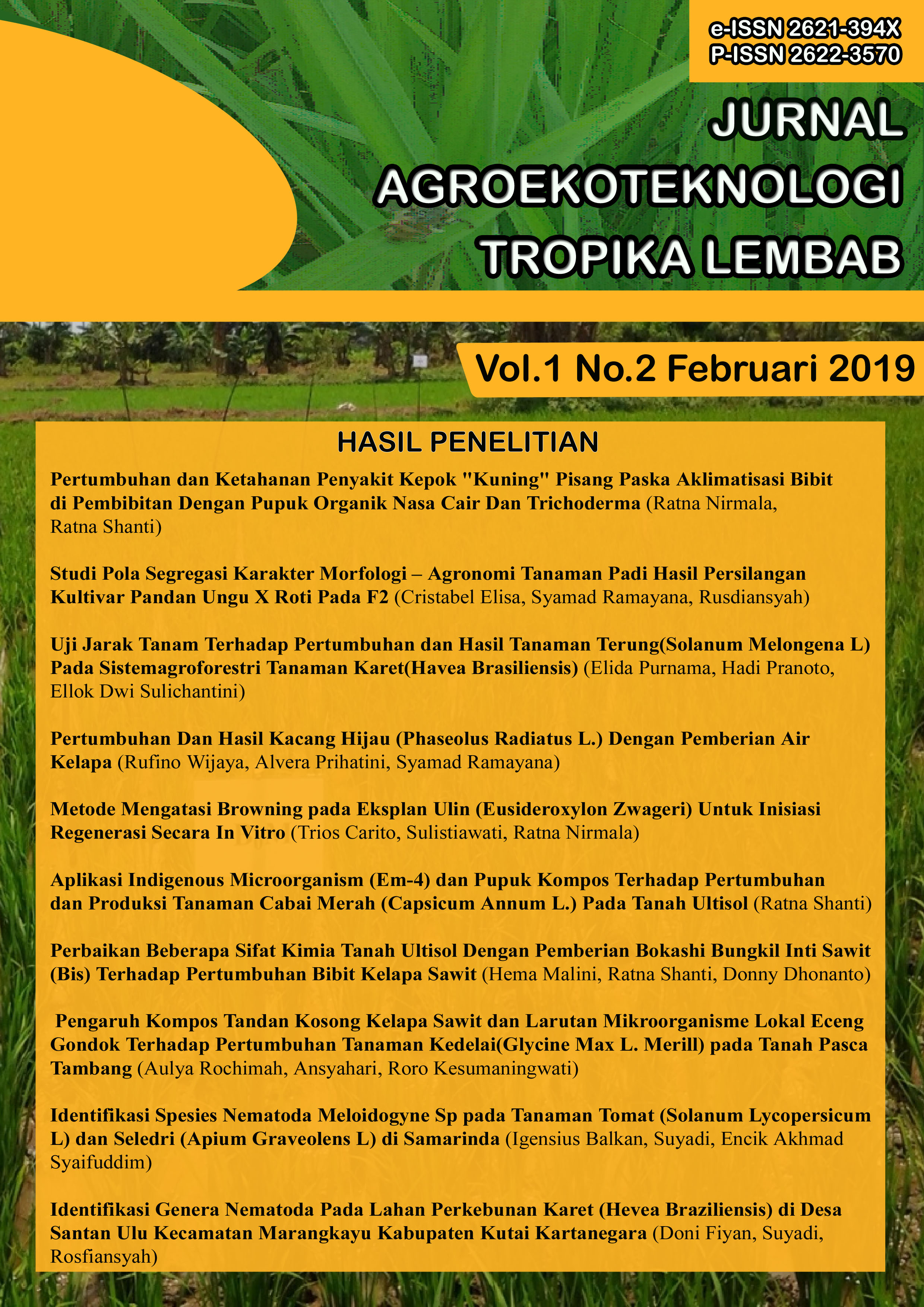
Identifikasi Genera Nematoda pada Lahan Perkebunan Karet (Hevea braziliensis) di Desa Santan Ulu Kecamatan Marangkayu Kabupaten Kutai Kartanegara
DOI:
https://doi.org/10.35941/jatl.1.2.2019.1981.144-150Keywords:
Rubber, Nematodes, IdentificationAbstract
This study aims to determine the dominant nematode genus and nematode population associated with rubber plants. Field research were carried out in Santan Ulu Village, Marangkayu District, Kutai Kartanegara Regency. The laboratory works was carried out at the Laboratory of Plant Pest and Disease Sciences, Faculty of Agriculture, Mulawarman University. The study was conducted for 3 months from October to December 2017. The method in this study is a diagonal method on nine rubber trees that have produced. The obtained nematodes were identified and calculated by the population of each genus. The results showed that there are five species of nematodes in rubber plantation areas aged 5, 7 and 10 years, namely Aphelenchulus, Dorylemus, Pratylencus, Rhabditis, and Rotylenchulus. Weeds that grow on rubber plantations, namely, Imperata cylindrica L, Mikania micranta, Melastoma offine, Chromolaena odorata, and Paspalum conjungtum.Downloads
References
Castillo. 1991. Manual in genera identification of plan nematodes. Collage Agriculture University of The Philipines. Los Banos Collage Laguna, Philipines.
Chairil Anwar,2006. Prospek Usaha Pembibitan Karet 2013. http://addeoalmubarok1.blogspot.co.id/ 2013/11/proposal-penelitian-prospektif.html diakses 15/02/2017
Chena, X,.Liua, M. Hua, F., Maoa, X., and Huixin, L. 2007.Contributions of soil micro fauna (protozoa and nematodes) to rhizosphere ecological functions.Acta Ecologica Sinica 27(8): 3132-3143.
Dropkin, V, H. 1992. Pengantar nematologi tumbuhan. Universitas Gadjah mada.Yogyakarta.
Direktorat Jendral perkebunan , 2013. Pedoman Pelaksanaan Pengelolaan DataKomoditas Perkebunan Jakarta
Dinas Perkebunan Kaltim, 2014. Data Statistik Perkebunan Kalimantan Timur. Http://disbun. Kaltimprov.go.id/statis-33-komoditi-karet.html. diakses tanggal 13/02/2017
Evans, K. 1982. Water use, calcium uptake and tolerance of cyst nematode attack in potatoes.Potato Research 25 : 71-88.
Heru&Andoko. 2011. Prospek Usaha Pembibitan Karet 2013. http://addeoalmubarok1.blogspot .co.id/2013/11/proposal-penelitian-perspektif.hlml. Diakses 15/12/2017 Litbang Deptan
Melakeberhan, H., J.W. Webster, R.C. Brook, J.M. D’Auria and M. Cacckette. 1987. Effect of Meloidogyne incognita on plant nutrient concentration and its influence on plant physiology of bean .J. of Nematology.19 : 324-330
Mubyaro dan Dewanta, S. A. 1990.Karet Kajian Sosial Ekonomi. Aditya Media.Yogyakarta.
Mustika, I. 2005. Konsepsi dan Strategi PengendalianNematoda Parasit Tanaman Perkebunan di Indonesia. Hlm. 20-25. Balai Penelitian Tanaman Rempah dan Obat. Bogor.Penebar Swadaya,2011 Budidaya Tanaman Karet Jakarta
Pracaya. 2008. Hama dan penyakit tanaman. Penebar swadaya. Jakarta
Price, T, V. 2000. Plant parasitic nematodes. Integrated pest management for smallholder estate crops project. Plant quarantine component–nematology. p. 27-34
Sagala, D. dan Sayurandi. 2010. TeknikIdentifikasidanPengenalanKlon Unggul 2010-2014.Makalah yang disampaikanpadaMagangPetugasBalai BesarPerbenihandanProteksiTanaman Perkebunan Medan padatanggal 30 Nopember – 1 Desember 2010.PusatPenelitianKaretSungeiPutih
Setiawan, H. D. dan Andoko, 2005.Petunjuk lengkap budidaya karet.Agromedia Pustaka Jakarta
Sorensen, L, I. 2009. Grazing, Distrubanceand Pland Soilin in Northern Grassland. Oulum Yliopisto.Oulu
Suhenry I, 2012.StandarMutuBahanTanam (benih) KaretUnggul. Slide yang disampaikanpadamagangpengawasbenihtanamanperkebunanpadatanggal 13-15 Februari 2012. BalaiPenelitian Sungai Putih.http://ditjenbun.pertanian.go.id/bbpptpmedan/berita-208-standar-mutu-bahan-tanam.
Tim Penulis Penebar Swadaya. 2013. Panduan lengkap Karet, Jakarta.
Downloads
Published
Issue
Section
License
Authors retain the copyright of articles published in Jurnal Agroekoteknologi Tropika Lembab (JATL) and grant the journal the right of first publication.
Published articles are licensed under the Creative Commons Attribution-ShareAlike 4.0 International License (CC BY-SA 4.0), available at https://creativecommons.org/licenses/by-sa/4.0/.
Under this license, users may copy, redistribute, remix, transform, and build upon the published material for any purpose, including commercial purposes, provided that appropriate credit is given to the author(s) and JATL, a link to the license is provided, and any changes are clearly indicated.
If the material is remixed, transformed, or built upon, the resulting work must be distributed under the same license as the original. Users may not apply additional legal or technological restrictions that limit uses permitted by the license.
Authors may enter into separate arrangements for the non-exclusive distribution of the journal’s published version of the article, provided that its initial publication in JATL is acknowledged.
JATL does not require authors to transfer copyright to the journal.