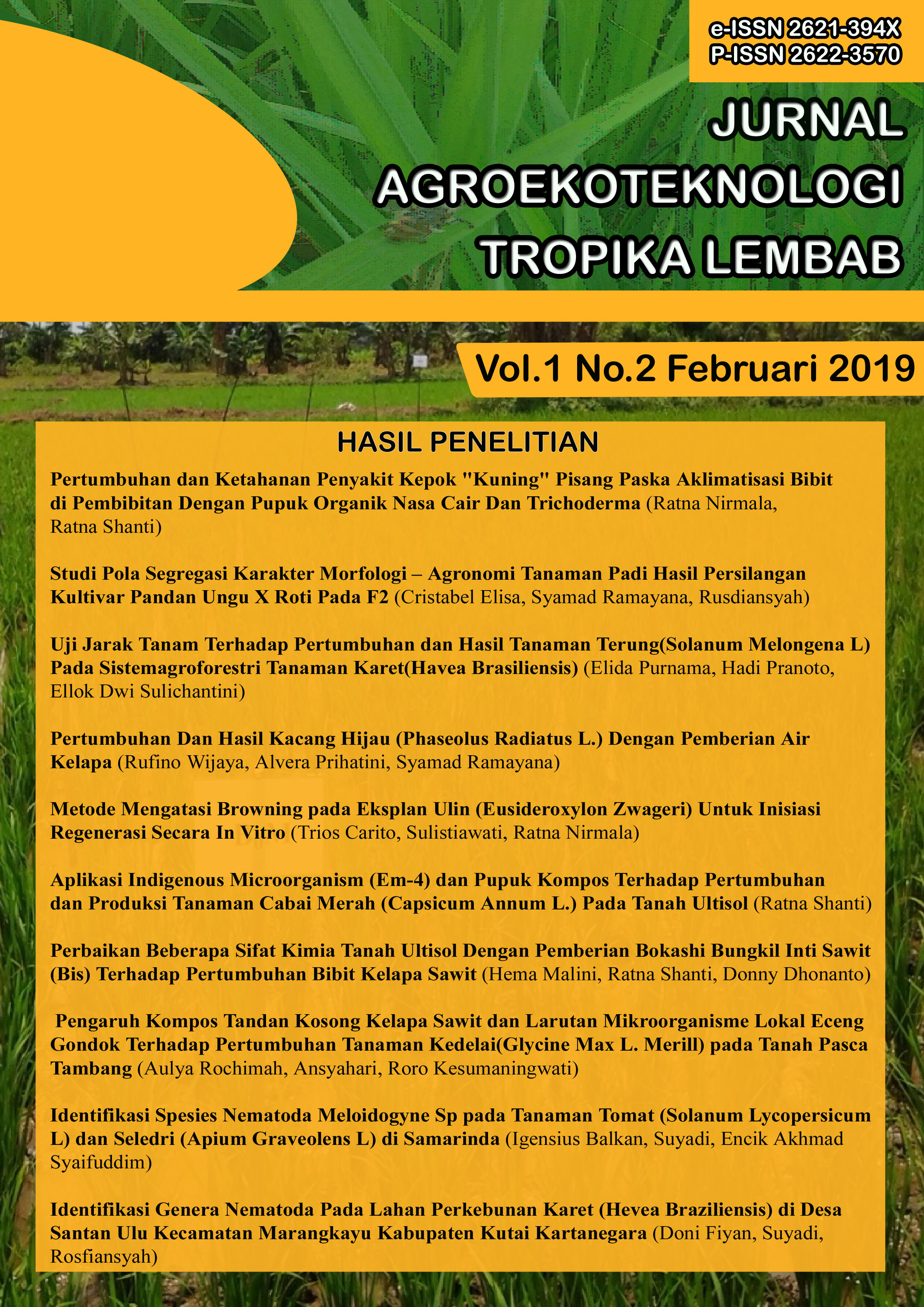
Identifikasi Spesies Nematoda Meloidogyne sp pada Tanaman Tomat (Solanum lycopersicum L) dan Seledri (Apium graveolens L) di Samarinda
DOI:
https://doi.org/10.35941/jatl.1.2.2019.1980.136-143Keywords:
Tomato, Celery, Nematodes, MeloidogynesAbstract
Nematodes are harmful organisms for tomato and celery plants. The aim of this research is to know Meloidogynespecies that attack tomato and celery plants. The locations are in Lempake and in Sambutan, Samarinda city, East
Kalimantan. Identification of nematode species is based on morphometric and perennial parten characteristics. Nematode
extract was performed by root stenning method and nematode surgery. The result showed that there was one species
(Meloidogyne javanica) of nematode at root of tomato and celery plant in Lempake, while in Sambutan showed that there
were two species of Meloidogyne, they are Meloidogyne javanica and Meloidogyne incognita. Based on this research showed
that nematodes Meloidogyne are the most enermoust nematodes on tomato and celery plants in Samarinda.
Downloads
References
Abawi, G, S and Widmer. 2000. Impact Of Soil Health Management Practices On soil Borneo Pathogens, Nematodes and Root Disease Of Vegetable Cropas. Applied Soil Ecology 15:37-47.
Agrios G. N. 2005. Plant Pathology. Edisi ke-5. New York: Academic Press.
Ambarwati, E., G. A. P. Maya, S. Trisnowati, dan R. H. Murti. 2012. Mutu buah tomat dua galur harapan keturunan ‘GM3’ dengan ‘Gondol Putih’.Proseding Seminar Nasional Hasil Penelitian Nasional.
Amin, B. 2007. Host and Temperature Preference, Male Occurrence and Morfometrics of Fungivorous Nematoda. Aphelenchus avenae Isolates from Japan. Jurnal Agripet. Vol.7.
Bernadius dan W. Wahyu. 2008. Bertanam Tomat. Jakarta: PT Agro Megia pustaka.
Bio Intellegence Service (BIS), Europe Commision. 2010. Soil Biodiversity: Functions, Threats and Toolsfor Policy Makers.Technical Reports 2010. Tersedia di: www.biois.com/soilbiodiversity/231html.
Burelle NK, Rosskopf EN. 2012. Susceptibility of several common subtropicalweeds to Meloidogyne arenaria, M incognita and M javanica. Journal Nematol. 44(2):142-147.
[CABI] Central for Agriculture and Biosciene International. 2007. Crop Protection Compendium. Wallingford (US): CAB International.
Cahyono, B. 1998. Tomat Budidaya dan Analisis Usaha Tani. Kanisius, Yogyakarta.
Castillo, M. B. 1991. Manual in genera Identification of Plant nematodes. College Agriculture University of The Philipines. Los Baros College. Laguna. Philipines.
Castillo, P., Vovlas, N., Troccoli, A. 2003. The Reniform Nematode, Rotylenchulus macrosoma, Infecting Olivebin Southern Spain. Jurnal Nematology. Vol.5 (1) : 23-29.
Disbun Kaltim. 2014. Rekapitulasi Luas Areal dan Produksi Pola Perkebunan Besar Swasta. Katalog DISBUN. Dinas Perkebunan. Samarinda. http://Dinas Perkebunan Kalimantan Timur. 17 November 2016.
Disbun Kaltim.2016. Rekapitulasi Luas Areal dan Produksi Pola Perkebunan Besar Swasta. Katalog DISBUN. Dinas Perkebunan. Samarinda. http://Dinas Perkebunan Kalimantan Timur. 17 November 2016.
Djaenudin, D., Marwan H., Subagjo H., Hidayat, A. 2003. Petunjuk Teknis Evaluasi lahan Untuk Komuditas Pertanian. Balai Penelitian Tanah Pusat dan Pengembangan Tanah dan Agroklimat Badan Penelitian dan Pengembangan Pertanian, Departemen Pertanian Bogor. 30 halaman.
Djiwati, S. R.., Supriadi. 2008. Determinasi Nematoda Parasit Aphelenchoides sp. Penyebab Penyakit Hawar Daun Sambiloto (Andrographis paniculata). Jurnal Littri. Vol.4 (2):61-66.
Dropkin. V. H. 1996. Pengantar Nematologi Tumbuhan. Gadjah Mada University Press. Yogyakarta.
Durahman, D., Tarno, H., Rahardjo, B. T. 2014. Eksplorasi Nematoda Parasit Tumbuhan pada Tanaman Nilam (Pogostemon cablin Benth) di Kecamatan Kesamben Kabupaten Blitar. Jurnal HPT. Vol. 2 (4).
Pracaya, 2007. Hama Dan Penyakit Tanaman. Penebar Swadaya, Jakarta.
Semangun, Haryono. 2001. Pengantar Ilmu Penyakit Tumbuhan. Yogyakarta : Gajah Mada University Press.
Shurtleff, M.C., and Averre, C.W. 2000. Diagnosing Plant Diseases Caused by nematodes and their distribution in Fiji. Weed Tech. 24(4);607-612.
Triharso. 2004. Dasar-dasar Perlindungan Tanaman. Yogyakarta: Gajah Mada University Press.
Downloads
Published
Issue
Section
License
Copyright Transfer Statement
The copyright of this article is transferred to Jurnal Agroekoteknologi Tropika Lembab and when the article is accepted for publication. the authors transfer all and all rights into and to paper including but not limited to all copyrights in the JATL. The author represents and warrants that the original is the original and that he/she is the author of this paper unless the material is clearly identified as the original source, with notification of the permission of the copyright owner if necessary. The author states that he has the authority and authority to make and carry out this task.
The author states that:
This paper has not been published in the same form elsewhere.
This will not be submitted elsewhere for publication prior to acceptance/rejection by this Journal.
A Copyright permission is obtained for material published elsewhere and who require permission for this reproduction. Furthermore, I / We hereby transfer the unlimited publication rights of the above paper to Jurnal Agroekoteknologi Tropika Lembab. Copyright transfer includes exclusive rights to reproduce and distribute articles, including reprints, translations, photographic reproductions, microforms, electronic forms (offline, online), or other similar reproductions.
The author's mark is appropriate for and accepts responsibility for releasing this material on behalf of any and all coauthor. This Agreement shall be signed by at least one author who has obtained the consent of the co-author (s) if applicable. After the submission of this agreement is signed by the author concerned, the amendment of the author or in the order of the author listed shall not be accepted.
Rights / Terms and Conditions Saved
The author keeps all proprietary rights in every process, procedure, or article creation described in Work.
The author may reproduce or permit others to reproduce the work or derivative works for the author's personal use or for the use of the company, provided that the source and the JATL copyright notice are indicated, the copy is not used in any way implying the Jurnal Agroekoteknologi Tropika Lembab (JATL) approval of the product or service from any company, and the copy itself is not offered for sale.
Although authors are permitted to reuse all or part of the Works in other works, this does not include granting third-party requests to reprint, republish, or other types of reuse.