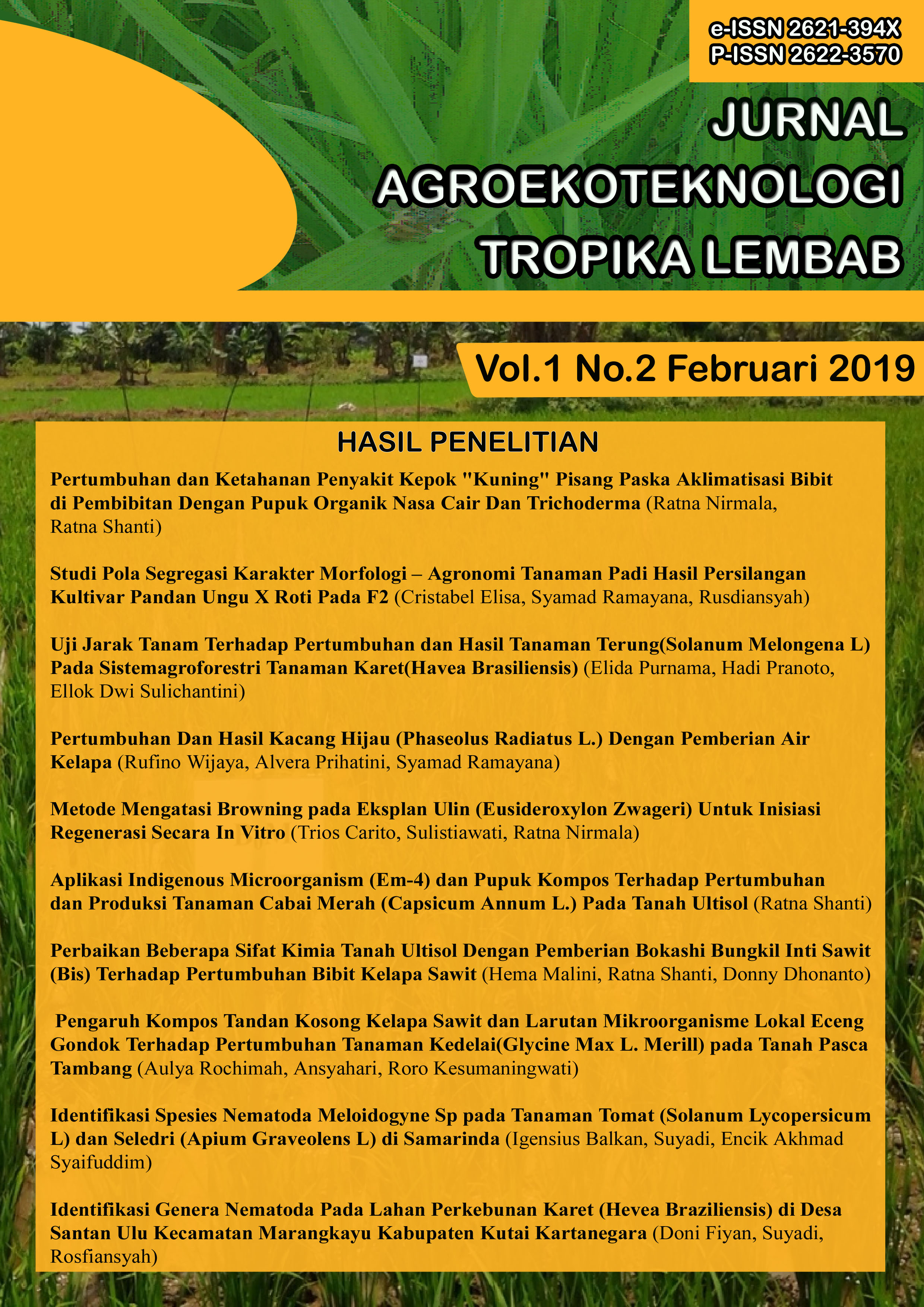
Uji Jarak Tanam Terhadap Pertumbuhan dan Hasil Tanaman Terung(Solanum melongena L)pada SistemAgroforestri Tanaman Karet(Havea brasiliensis)
DOI:
https://doi.org/10.35941/jatl.1.2.2019.1976.93-99Keywords:
rubber agroforestry, plant spacing, production, eggplantAbstract
The research was conducted to1). Optimaly planting distances analysis of eggplant in rubber agroforestry systemand 2). The research was conducted from May to September 2016 at Bunga Jadi district, Muara Kaman sub district, district
of Kutai Kartanegara.This research used a Randomized Group Design with single factor. The factor are planting distances of
eggplant with five level and five repetitions, those are 50 cm x 60 cm (j1), 60 cm x 60 cm (j2), 60 cm x 70 cm (j3), 70 cm x 70
cm (j4), 70 cm x 80 cm (j5). The results showed, the planting distances treatment were not significantly effect of height of
plant, the number of leaves, the number of teas the blooming age, the weight of the fruit on 15, 30, 45 days after planting.
And then the significantly effect on planting distances (60 cm x 70 cm) and total product of eggplant is 9.21 Mg ha1 in the
weight of the fresh fruit per plot or hectare. Optimal product with distance of 60 cm x 70 cmis 9.21 Mg ha1(total production).
The average production of eggplant in rubber agroforestry sistem is 7.82 Mg ha1 for 4 harvesting.The value of coefisient
correlation in analysis covariant of multiple regression, r = 0.3459, the value of corelation is 34.59%, its showed the
correlation value between treatment and production is low.
Downloads
References
Firmansyah, F., Tino, M., dan Akyas, A.M. 2009.Pengaruh Umur Pindah Tanam Bibit dan Populasi Tanaman terhadap Hasil dan Kualitas Sayuran Pakcoy (Brassica campestris L.) yang ditanam dalam Naungan Kasa di Datara Medium.Jurnal. Fakultas Pertanian Universitas Padjadjaran.
Gardner. 1991. Fisiologi Tanaman Budidaya. Universitas Indonesia, Jakarta.
Hardi, H. 2007. Respon Tanaman Terung (Solanum melongena L) terhadap Jarak Tanam dan Pupuk Kotoran Ayam. Skripsi. Fakultas Pertanian. Universitas Mulawarman.
Heryadi, D. 2007. Pengaruh Pemberian Dosis Pupuk Kandang Ayam dan Pupuk Fosfor terhadap Pertumbuhan dan Hasil Tanaman Terung (Solanum melongena L) Var. Virgin. Skripsi. Fakultas Pertanian. Universitas Mulawarman.
Harjadi, S.S. 1993. Pengantar Agronomi. Gramedia. Jakarta.
Monografi. 2015. Profil Desa Bunga Jadi, Kecamatan Muara Kaman. Kabupaten Kutai Kartanegara.
Prasetyo, Y.B. 2015. Produksi Tanaman Cabai Rawit (Capsicum frutescens L.) pada SistemAgroforestri Tanaman Karet (Hevea brasiliensis). Skripsi.Fakultas Pertanian. Universitas Mulawarman
Rachman, A. 2001.Uji Jarak Tanam dan Pemberian Pupuk Kandang Sapi terhadap Pertumbuhan dan Hasil Tanaman Mentimun (Cucumis sativus L.). Skripsi. Fakultas Pertanian. Universitas Mulawarman.
Rukmana, R.H. 2002. Usaha Tani Cabai Rawit. Kanisius, Yogyakarta
Setiawan, D. 2000. Atlas Tumbuhan Obat Indonesia. Trubus Agriwidya, Bogor
Swanti, E., Badrun, M.A., dan Susylowati. 2003. Pengaruh Jarak Tanam dan Unsur Nitrogen terhadap Pertumbuhan dan Hasil Tanaman Petsai (Brassica chinensis L.)Jurnal Budidaya Pertanian. Volume 9, No. 1, Samarinda.
Qamari, N. 2013. Pengaruh Varietas dan Jarak Tanam terhadap Pertumbuhan dan Hasil Tanaman Terung (Solanum melongena L.). Skripsi Fakultas Pertanian Universitas Syiah Kuala.Darussalam-Banda Aceh.http://etd.unsyiah.ac.id (12 juli 2016).
Wuryaningsih, S.R., Tejasarwan., dan Kustatang. 2001. Pertumbuhan Melati pada Beberapa Komposisi Media Tanpa Tanah.Seminar Nasional Pertanian Berkelanjutan. Bandar Lampung.
Downloads
Published
Issue
Section
License
Authors retain the copyright of articles published in Jurnal Agroekoteknologi Tropika Lembab (JATL) and grant the journal the right of first publication.
Published articles are licensed under the Creative Commons Attribution-ShareAlike 4.0 International License (CC BY-SA 4.0), available at https://creativecommons.org/licenses/by-sa/4.0/.
Under this license, users may copy, redistribute, remix, transform, and build upon the published material for any purpose, including commercial purposes, provided that appropriate credit is given to the author(s) and JATL, a link to the license is provided, and any changes are clearly indicated.
If the material is remixed, transformed, or built upon, the resulting work must be distributed under the same license as the original. Users may not apply additional legal or technological restrictions that limit uses permitted by the license.
Authors may enter into separate arrangements for the non-exclusive distribution of the journal’s published version of the article, provided that its initial publication in JATL is acknowledged.
JATL does not require authors to transfer copyright to the journal.