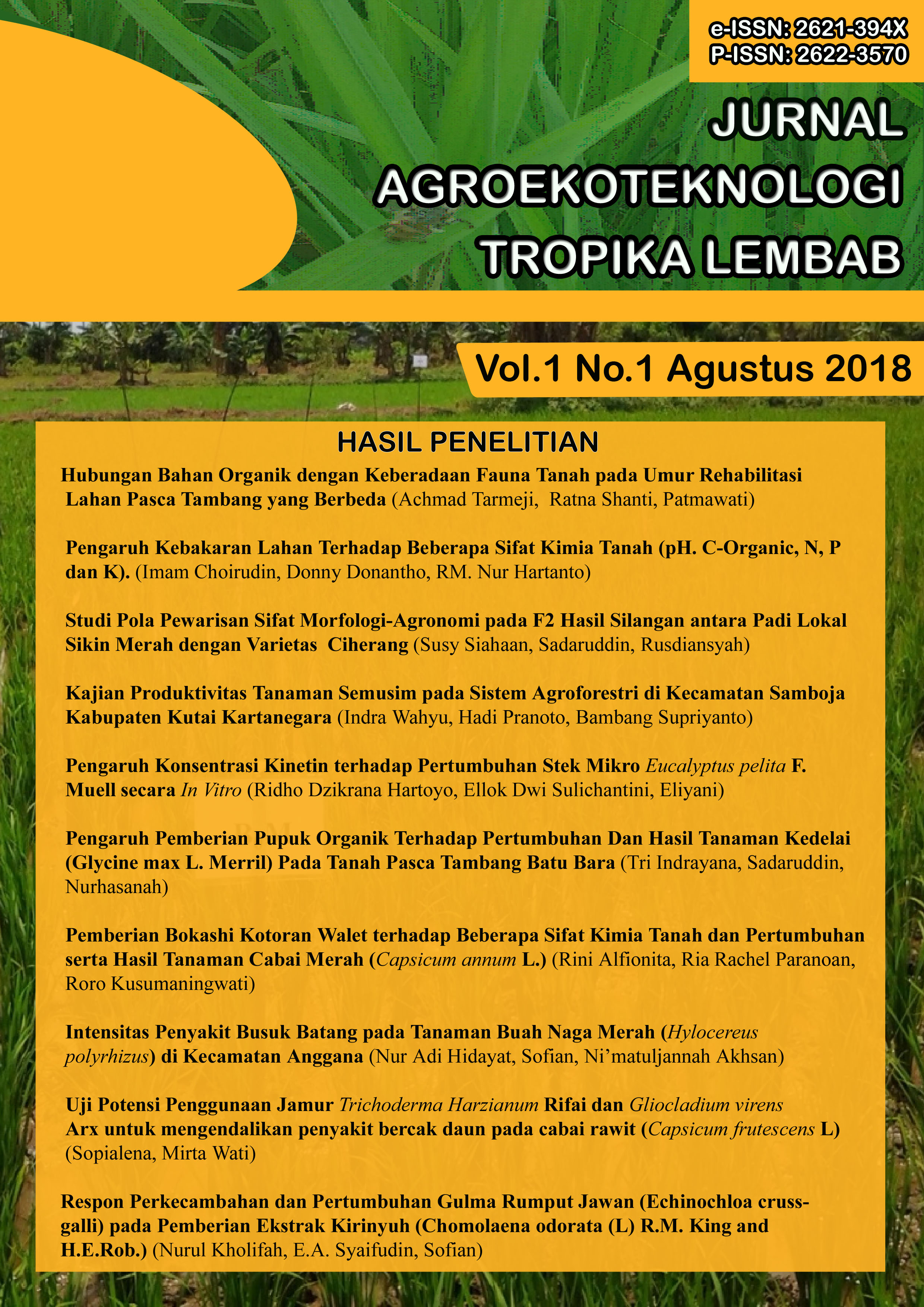
Application of Kirinyuh Extracts (Chromolaena odorata (L.) R.M. King and H.E. Rob.) to Germination and Growth of Jawan Grass Weed (Echinochloa cruss-galli)
DOI:
https://doi.org/10.35941/jatl.1.1.2018.1504.67-76Keywords:
kirinyuh extracts, Echinochloa cruss-galli, allelopathyAbstract
The objectives of this research were to know: 1) the effect of allelopathy from leaf and kirinyuh root extracts (Chromolaena odorata L.) to suppress seed germination of jawan grass weed (Echinochloa cruss-galli); 2) the influence of allelopathy from leaf and kirinyuh root extracts (C. odorata L.) to suppress the growth of jawan grass weed (E. cruss-galli). This research was conducted from August to October 2017. Sampling site was located in Bukit Raya Village, Samboja District.This study used a Completely Randomized Design consisted of two factors with five treatments and three replications. The first factor was the source of the extracts, consisted of leaves and roots of kirinyuh, while the second factor was the concentration of extracts, namely 0; 50; 100; 150; and 200 gL-1 aquadest. Data were analyzed by analysis of variance with F-test and followed by LSD test of 5% level.The results showed that: 1) kirinyuh extractswas able to inhibit the time and percentage of seed germination of jawan grass weed. The longest in germination time, was 8.54%,obtained from kirinyuh root extracts 200gL-1aquadest. , while the lowest in germination percentage obtained from 50g kirinyuh root extractsL-1, was 40.28%; 2) Leaf and kirinyuh root extractsinhibit thegrowth (height and root length), and caused high percentage of deaths of jawan grass weed. The highest percentage of weed deaths due to kirinyuh leaf extracts of concentration 100 g L- l with the death percentage was 1.76%.Downloads
References
Afolabi CA, Ibukun EO, Afor E, Obuotor EM, and Farombi EO.(2007). Phytochemical consituent and antioxidant activity of extracts from the leaves of Ocimun gratissimum. Sci. Res. Essaysm 2(5):163-166
Einhellig FA. 1996. Allelopathy: Current Status and Future Goals. In Inderjit, Dakhsini KMM, Einhellig FA (eds). Allelopathy, Organism, Processes and Applications. Washington DC: American Chemical Society.
Hadi M, Hidayat JW, dan Baskoro K. 2000. Uji potensi ekstrak daun Eupatorium odoratum sebagai bahan insektisida alternatif: Toksisitas dan efek antimakan terhadap larva Heliothis armigera hubner.
J. Sains dan Matematika. Fakultas MIPA Universitas Diponegoro, Semarang.
Januwati M dan Yusron M. 2005. Budidaya Tanaman Pegagan. Balai Penelitian dan Pengembangan Pertanian.Balai Penelitian Tanaman Obat dan Aromatika.
Kamil J. 1979. Teknologi Benih 1. Angkasa Raya, Padang.
Kurniasih B. 2002. Sifat perakaran beberapa varietas padi gogo dalam cekaman residu alelopati gulma. J. Agrivita 24(2): 47-52.
Master J. 2012. Alelopati. http://staff.unila.ac.id/janter/2012/09/10/alelopati.html. Diakses pada tanggal 2 Januari 2018.
Moenandir J. 1993. Pengantar Ilmu dan Pengendalian Gulma. Rajawali Press, Jakarta.
Pane H, Bangun P, dan Jatmiko SY. 1999. Pengelolaan gulma pada pertanaman padi gogo rancah dan walik jerami di lahan sawah tadah hujan. Hlm. 321-334.
Dalam Partohardjono S, Soejitno J, dan Hermanto (eds). Risalah Seminar Hasil Penelitian Emisi Gas Rumah Kaca dan Peningkatan Produktifitas Padi di Lahan Sawah.Pusat Penelitian dan pengembangan Tanaman Pangan, Bogor.
Salimi F. 1996. Karakteristik beberapa jenis pertumbuhan dan hasil kedelai akibat persaingan dan densitas gulma. [Skripsi].Jurusan Hama dan Penyakit Tanaman Fakultas Pertanian Universitas Syiah Kuala. Darussalam, Banda Aceh.
Soerjandono.2005. Teknik Pengendalian Gulma dengan Herbisida Persistensi Rendah pada Tanaman Padi.http:// Faperta-unswagati.com/pdf. Diakses pada tanggal 08 Maret 2017.
Downloads
Published
Issue
Section
License
Copyright Transfer Statement
The copyright of this article is transferred to Jurnal Agroekoteknologi Tropika Lembab and when the article is accepted for publication. the authors transfer all and all rights into and to paper including but not limited to all copyrights in the JATL. The author represents and warrants that the original is the original and that he/she is the author of this paper unless the material is clearly identified as the original source, with notification of the permission of the copyright owner if necessary. The author states that he has the authority and authority to make and carry out this task.
The author states that:
This paper has not been published in the same form elsewhere.
This will not be submitted elsewhere for publication prior to acceptance/rejection by this Journal.
A Copyright permission is obtained for material published elsewhere and who require permission for this reproduction. Furthermore, I / We hereby transfer the unlimited publication rights of the above paper to Jurnal Agroekoteknologi Tropika Lembab. Copyright transfer includes exclusive rights to reproduce and distribute articles, including reprints, translations, photographic reproductions, microforms, electronic forms (offline, online), or other similar reproductions.
The author's mark is appropriate for and accepts responsibility for releasing this material on behalf of any and all coauthor. This Agreement shall be signed by at least one author who has obtained the consent of the co-author (s) if applicable. After the submission of this agreement is signed by the author concerned, the amendment of the author or in the order of the author listed shall not be accepted.
Rights / Terms and Conditions Saved
The author keeps all proprietary rights in every process, procedure, or article creation described in Work.
The author may reproduce or permit others to reproduce the work or derivative works for the author's personal use or for the use of the company, provided that the source and the JATL copyright notice are indicated, the copy is not used in any way implying the Jurnal Agroekoteknologi Tropika Lembab (JATL) approval of the product or service from any company, and the copy itself is not offered for sale.
Although authors are permitted to reuse all or part of the Works in other works, this does not include granting third-party requests to reprint, republish, or other types of reuse.