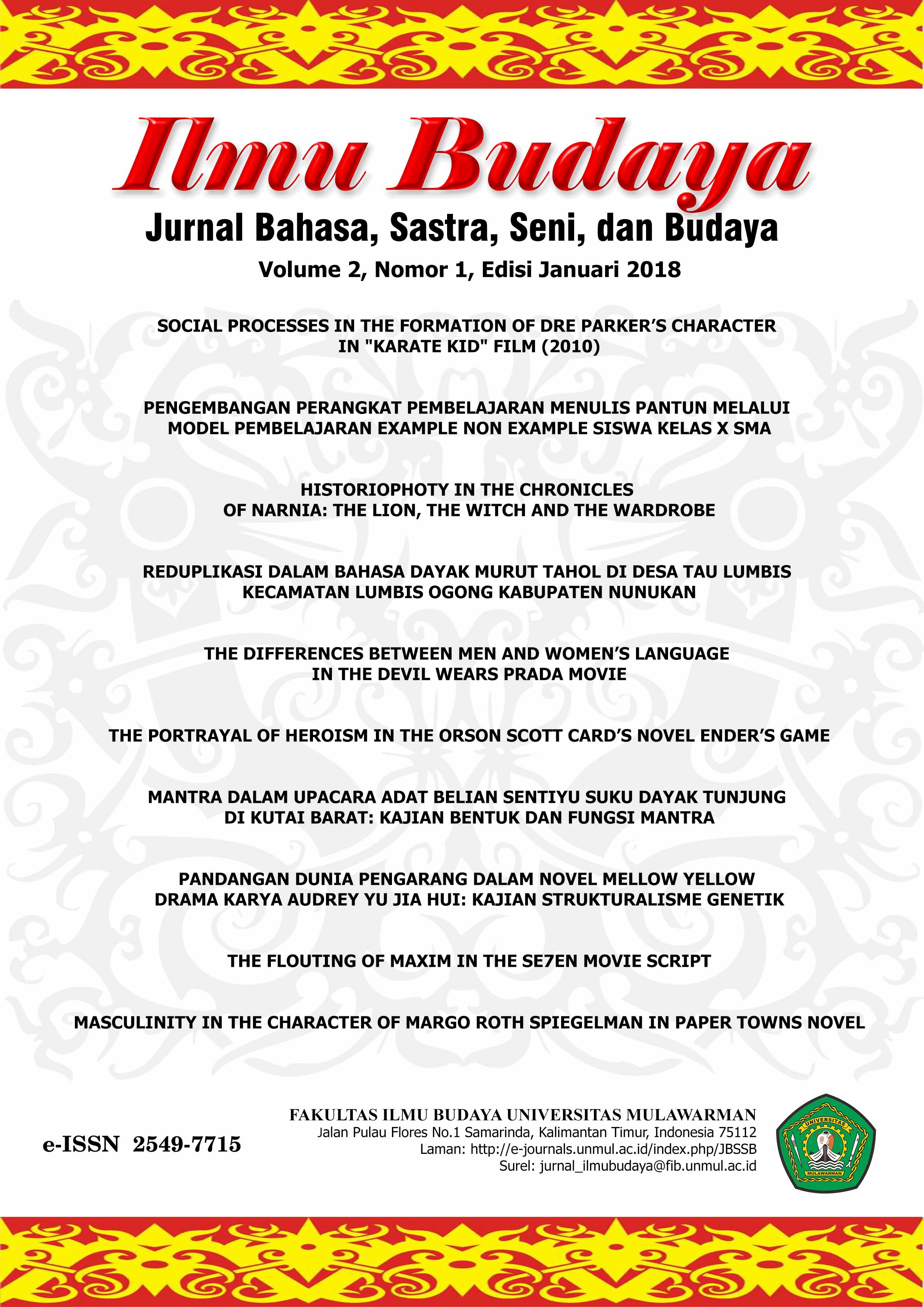
MANTRA DALAM UPACARA ADAT BELIAN SENTIYU SUKU DAYAK TUNJUNG DI KUTAI BARAT: KAJIAN BENTUK DAN FUNGSI MANTRA
DOI:
https://doi.org/10.30872/jbssb.v2i1.898Abstract
ABSTRACT
Belian Sentiyu’s traditional ceremony is a series of human efforts aimed at preventing the occurrence of a calamity to humans and the environment, or free themselves from the shackles of disease that always ends in a way abstain. The ceremony has existed since ancient times before the arrival of any religion to the village Sekolaq Joleq. Belian Sentiyu traditional ceremony held at the residence of patients suffering from a disease and intend to be healed through the ceremony of Belian Sentiyu. Belian Sentiyu traditional ceremony led by a Pememang. The purpose of this research is to describe the form and function of spell contained in traditional ceremony of Belian Sentiyu of Dayak Tunjung tribe in Kutai West. The type of research used in this study is descriptive (qualitative). Researchers try to describe and explain about the shape, and function of spell in traditional ceremony of Belian Sentiyu Dayak Tunjung tribe in Kutai West. Data collection techniques used in this study are observation techniques, interviews and notes, summarizes, translations, and instruments. Then, the data obtained from this study is associated with the theory of spell shape, and the spell function. The results of this study show that the form of spell in traditional ceremony Belian Sentiyu can be seen from the form of lines, the temple form, and from the choice of language there are three languages in the traditional ceremony spell Belian Sentiyu, namely Indonesian, Kutai language, and Tunjung Dayak language. Furthermore, the spell function that is found in the spell in Belian Sentiyu traditional ceremony is, as a social controller, as a reminder, as tolerance, and as a means to pray.
Keywords: spell, traditional ceremony of Belian Sentiyu, form, function
ABSTRAK
Upacara Adat Belian Sentiyu merupakan serangkaian usaha manusia yang bertujuan untuk mencegah terjadinya suatu musibah terhadap manusia dan lingkungan, atau membebaskan diri dari belenggu penyakit yang selalu di akhiri dengan cara berpantang. Upacara adat tersebut telah ada sejak zaman dahulu sebelum datangnya agama apa pun ke Desa Sekolaq Joleq. Upacara adat Belian Sentiyu diadakan di kediaman pasien yang menderita suatu penyakit dan bermaksud ingin disembuhkan melalui upacara adat Belian Sentiyu tersebut. Upacara adat Belian Sentiyu dipimpin oleh seorang Pememang. Tujuan penelitian ini adalah untuk mendeskripsikan bentuk, dan fungsi mantra yang terdapat dalam upacara adat Belian Sentiyu suku Dayak Tunjung di Kutai Barat. Jenis penelitian yang digunakan dalam penelitian ini adalah deskriptif (kualitatif). Peneliti berusaha menggambarkan dan menjelaskan tentang bentuk, dan fungsi mantra dalam upacara adat Belian Sentiyu suku Dayak Tunjung di Kutai Barat. Teknik pengumpulan data yang digunakan dalam penelitian ini yaitu teknik observasi, wawancara dan mencatat, merangkum, penerjemahan, dan instrumen. Kemudian, data-data yang diperoleh dari penelitian ini dikaitkan dengan teori bentuk mantra, dan fungsi mantra. Hasil penelitian ini memperlihatkan bahwa bentuk mantra dalam upacara adat Belian Sentiyu dapat dilihat dari bentuk baris, bentuk bait, dan dari pilihan bahasa terdapat tiga bahasa pada mantra upacara adat Belian Sentiyu, yaitu bahasa Indonesia, bahasa Kutai, dan bahasa Dayak Tunjung. Selanjutnya yaitu fungsi mantra yang terdapat pada mantra dalam upacara adat Belian Sentiyu yaitu, sebagai pengendali sosial, sebagai pengingat, sebagai toleransi, dan sebagai sarana untuk berdoa.
Kata kunci: mantra, upacara adat Belian Sentiyu, bentuk, fungsi
Downloads
References
Adi. 2011. “Sejarah Mantra”. http://mantaram.hindu.bali.blogspot.co.id (diakses pada 3 Oktober 2016 pukul 14.10 Wita)
Alfiansyah, Muhammad 2011. “Pengertian-ciri-ciri-jenis-jenis-dan” http://www.sentra-edukasi.com (diakses pada 31 Agustus 2017 pukul 15.00 Wita)
Bake, Nariati. 2012. “Jurnal Makna Kaago-Ago Dalam Bahasa Muna” http://duniajurnalistiknariati.blogspot.co.id (diakses pada 1 Agustus 2017 pukul 12.00 Wita)
Danandjaja, James. 2007. Folklor Indonesia Ilmu Gosip, Dongeng, dan lain-lain. Jakarta: PT Pustaka Utama Grafiti.
Dwija, Sapthadi. 2012. “Mantra Adalah”. http://sastra-sekura.blogspot.com (diakses pada 3 Oktober 2016 pukul 17:00 Wita).
Irpan, Istian, Y. Hudiyono, & A. Rokhmansyah. 2017. “Bentuk, Fungsi, dan Nilai Tuturan dalam Upacara Adat Biduk Bebandung Suku Bulungan: Kajian Folklor” dalam Jurnal Ilmu Budaya, Volume 1 Nomor 4 Oktober 2017. http://e-journals.unmul.ac.id/index.php/JBSSB/article/view/710 (Diunduh 17 November 2017).
Junaedi, Usman. 2010. Materi Penting Mata Pelajaran Bahasa Indonesia. Ciamis: Mekar Mandiri
Koetjarangningrat. 1980. Sejarah Teori Antropologi. Jakarta: Rineka Cipta
Moleong, Lexy J. 2014. Metode Penelitian Kualitatif. Bandung: Remaja Rosdakarya.
Riyono, Ahdi. 2009. “Mantra Kedudukan dan Fungsinya”. http://googleweblight.com (diakses pada 19 Februari 2017 pukul 18.00 Wita)
Rokhmansyah, Alfian. 2014. Studi dan Pengkajian Sastra: Perkenalan Awal terhadap Ilmu Sastra. Yogyakarta: Graha Ilmu.
Shadily, Hassan. 1983. Ensiklopedi Indonesia Jilid 4 . Jakarta: Gramedia Printing Division.
Sudjiman, Panuti. 1984. Kamus Istilah sastra. Jakarta: Gramedia.
Sugiyono, Dandi dkk. 2005. Kamus Besar Bahasa Indonesia. Jakarta: Balai Pustaka.
Waluyo, Herman J. 1987. Teori dan Apresiasi Puisi. Jakarta: Erlangga.
Downloads
Published
Issue
Section
License

Every work in Ilmu Budaya: Jurnal Bahasa, Sastra, Seni, dan Budaya is licensed under a Creative Commons Attribution-ShareAlike 4.0 International License.
Under the following terms:
Attribution — You must give appropriate credit, provide a link to the license, and indicate if changes were made. You may do so in any reasonable manner, but not in any way that suggests the licensor endorses you or your use.
ShareAlike — If you remix, transform, or build upon the material, you must distribute your contributions under the same license as the original.
Authors who publish with this journal agree to the following terms:
- Authors retain copyright and grant the journal right of first publication with the work simultaneously licensed under a Creative Commons Attribution License that allows others to share the work with an acknowledgement of the work's authorship and initial publication in this journal.
- Authors can enter into separate, additional contractual arrangements for the non-exclusive distribution of the journal's published version of the work (e.g., post it to an institutional repository or publish it in a book), with an acknowledgement of its initial publication in this journal.
- Authors are permitted and encouraged to post their work online (e.g., in institutional repositories or on their website) prior to and during the submission process, as it can lead to productive exchanges, as well as earlier and greater citation of published work (See The Effect of Open Access).