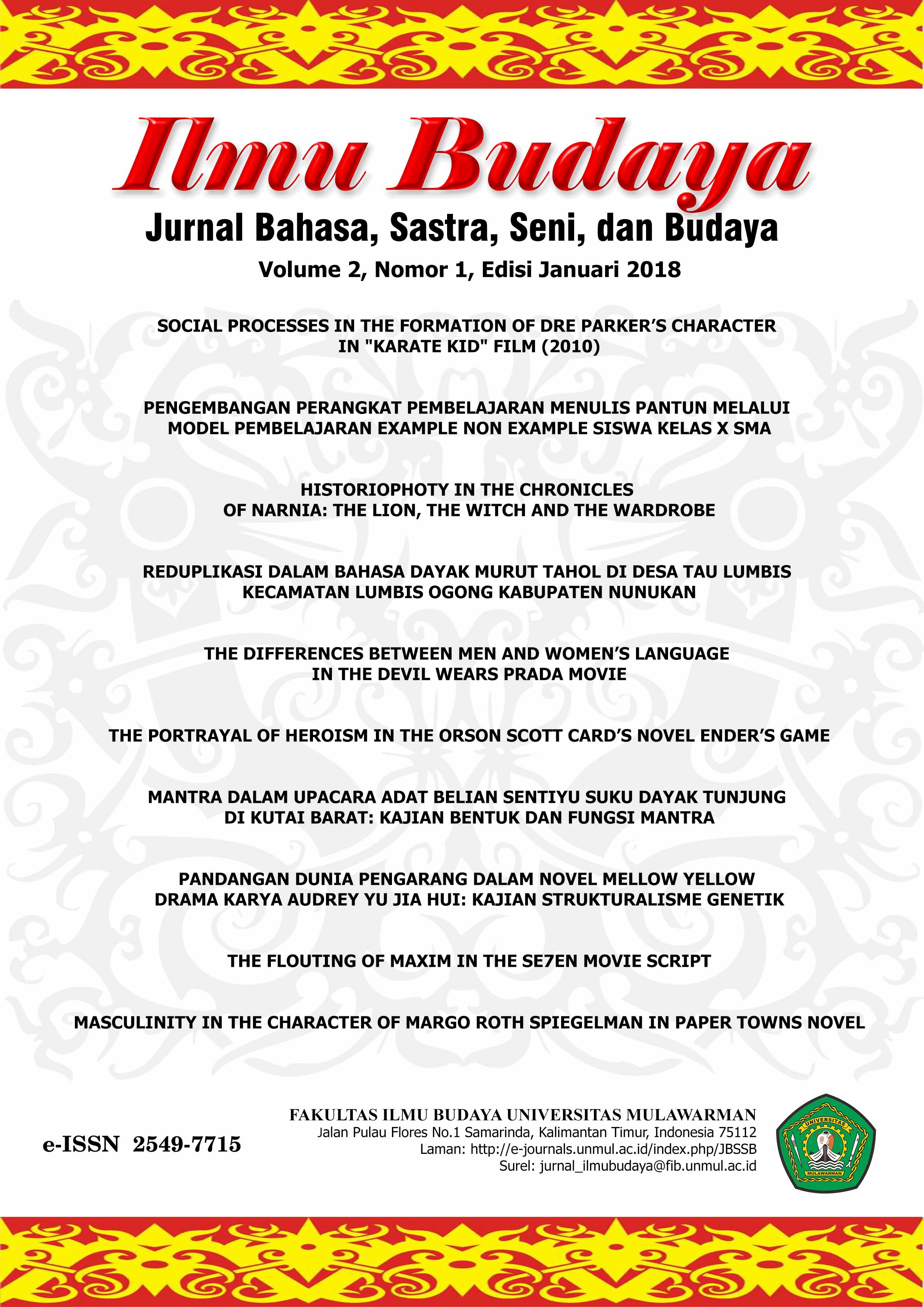
MASCULINITY IN THE CHARACTER OF MARGO ROTH SPIEGELMAN IN PAPER TOWNS NOVEL
DOI:
https://doi.org/10.30872/jbssb.v2i1.1017Abstract
ABSTRACT
Woman and her position toward man in society are always interesting to be discussed. Woman is now labeled by femininity for years and often be associated with several characteristics such as gentle, caring, loving and inferior from man because of the gender stereotype formed by society. By this research, the researcher aimed to analyze the masculine traits of the female character, Margo Roth Spiegelman in Paper Towns novel. This research was a qualitative research and used content analysis as the data analysis technique. This research used Sandra L Bem’s Sex Role Inventory as the indicator of masculinity in Margo’s character in Paper Towns novel. The result of this research showed that Margo has masculine traits even though she is a woman and they appeared through three aspects of her character: physical, emotional, and behavioral.
Keywords: gender, gender stereotypes, masculinity, Paper Towns novel
ABSTRAK
Wanita dan posisinya terhadap pria di masyarakat selalu menjadi topik menarik untuk dibahas. Wanita saat ini lekat dengan label kewanitaan yang telah melekat selama bertahun-tahun dan sering dikaitkan dengan beberapa karakteristik khusus seperti lembut, perhatian, penyayang dan lebih rendah daripada pria dikarenakan stereotip yang melekat di masyarakat berdasarkan gender. Dalam penelitian ini, peneliti bermaksud untuk menganalisis sifat maskulin yang ada pada karakter wanita pada novel Paper Towns yaitu Margo Roth Spiegelman. Penelitian ini merupakan penelitian kualitatif dan menggunakan teknik konten analisis sebagai teknik analisis data. Penelitian ini menggunakan teori dari Sandra L. Bem, Sex Role Inventory sebagai indikator dari sifat-sifat maskulin pada karakter Margo di novel Paper Towns. Hasil penelitian menunjukkan bahwa Margo memiliki sifat-sifat maskulin meskipun ia terlahir sebagai wanita dan sifat-sifat tersebut muncul melalui tiga aspek yaitu secara fisik, secara emosi, dan secara tingkah laku.
Kata kunci: gender, stereotip gender, maskulinitas, novel Paper Towns
Downloads
References
“Aggressive.” Gale Encyclopedia of Psychology. 2nd ed. 2001. Web. 8 March 2017.
Barsukova, Oksana V. “Psychological Characteristic of Ambitious Person.” (JPMNT) Journal of Process Management – New Technologies, International 4 No. 2 (2016): 79-80. Web. 5 August 2017.
Beauvoir, Simone de. The Second Sex. Trans. Constance Borde and Sheila Malovany-Chevallier. New York: Vintage Books, 2011. Web. 8 February 2017.
Bertens, Hans. Literary Theories: The Basics. London: Routledge, 2014. Print.
Bem, Sandra L. “The Measurement of Psychological Androgyny.” Journal of Consulting and Clinical Psychology 42 (1974): 155-162. Web. 10 February 2017.
Beynon, John. Masculinities and Culture. Philadelpia: Open University Press, 2002. Web. 9 February 2017.
Brannon, Linda. Gender: Psychological Perspectives. 2004. Web. 8 February 2017.
Connel, Raewyn. “Gender, Men, and Masculinities.” Quality of Human Resources: Gender and Indigenous People (2001): n. page. Web. 9 February 2017.
Dowd, Nancy E. “Masculinities and Feminist Legal Theory.” The Man Question: Feminist Jurisprudence, Masculinities and Law. New York: New York University Press, 2008: n. page. Web. 9 February 2017.
Elo, Satu and Helvi Kyungas. “The Qualitative Content Analysis Process.” Journal of Advanced Nursing 62 (2008): 107-115. Web. 25 February 2017.
Givray S. Henry. 12 Distinguish Qualities to Define True Leaders. Smith Bucklin Corporation, 2012. Web. 7 August 2017.
Green, John. Paper Towns. London: Bloomsburry, 2008. Print.
Miller, Anna M. “8 Signs You are Made to be an Athlete.” US News: 2016. Web. 9 August 2017.
Patton, Michael Quinn and Michael Cochran. A Guide to Using Qualitative Research Methodology. Medecins Sans Frontierers (2002). Web. 25 February 2017.
Wallen, Norman E and Jack. R. Fraenkel. How to Design and Evaluate Research in Education. New York: McGraw-Hill, 2009. Web. 7 April 2017.
Zhang, Yan and Barbara M. Wildemuth. “Qualitative Analysis of Content”. Web. 26 February 2017.
Downloads
Published
Issue
Section
License

Every work in Ilmu Budaya: Jurnal Bahasa, Sastra, Seni, dan Budaya is licensed under a Creative Commons Attribution-ShareAlike 4.0 International License.
Under the following terms:
Attribution — You must give appropriate credit, provide a link to the license, and indicate if changes were made. You may do so in any reasonable manner, but not in any way that suggests the licensor endorses you or your use.
ShareAlike — If you remix, transform, or build upon the material, you must distribute your contributions under the same license as the original.
Authors who publish with this journal agree to the following terms:
- Authors retain copyright and grant the journal right of first publication with the work simultaneously licensed under a Creative Commons Attribution License that allows others to share the work with an acknowledgement of the work's authorship and initial publication in this journal.
- Authors can enter into separate, additional contractual arrangements for the non-exclusive distribution of the journal's published version of the work (e.g., post it to an institutional repository or publish it in a book), with an acknowledgement of its initial publication in this journal.
- Authors are permitted and encouraged to post their work online (e.g., in institutional repositories or on their website) prior to and during the submission process, as it can lead to productive exchanges, as well as earlier and greater citation of published work (See The Effect of Open Access).