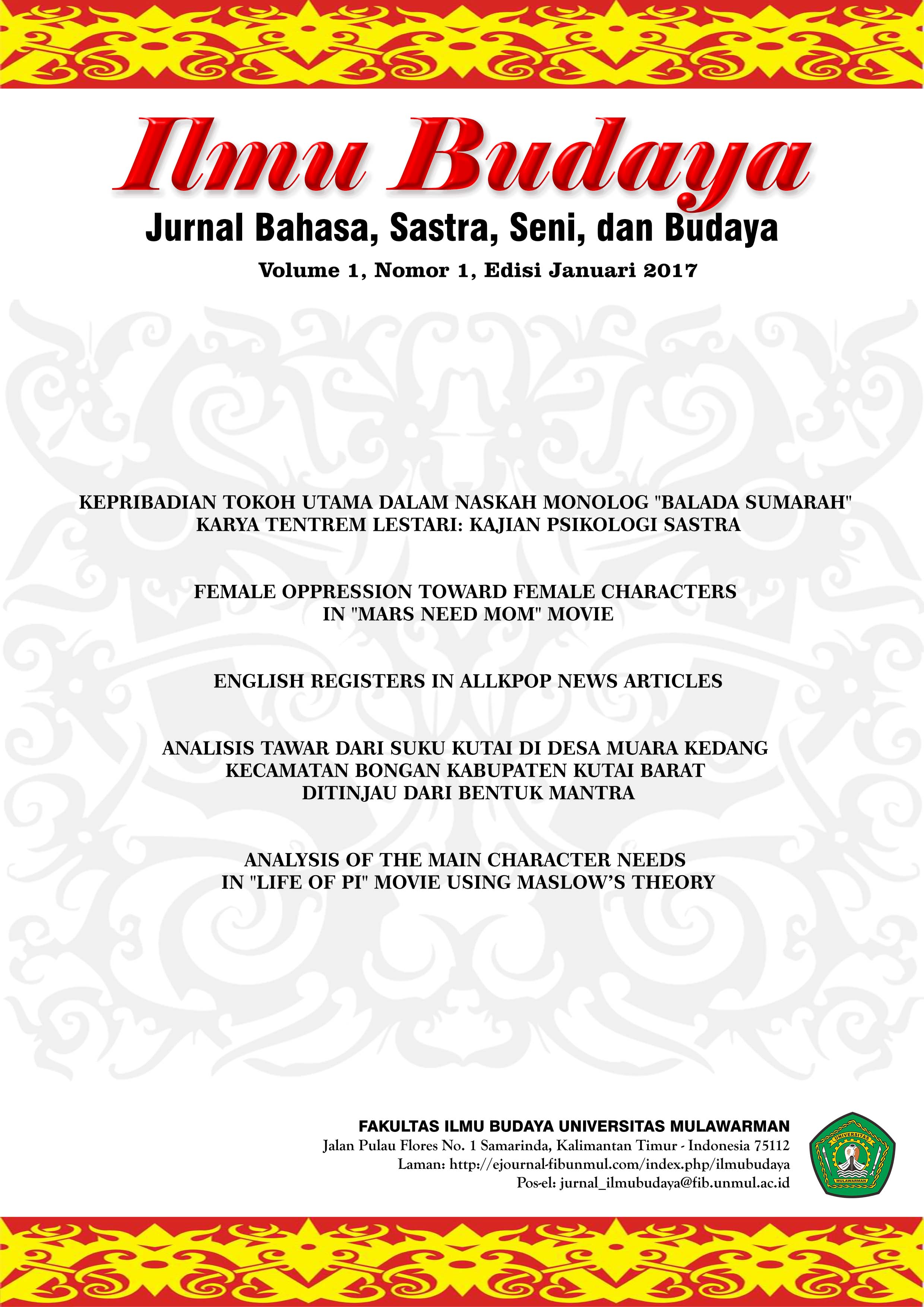
ANALYSIS OF THE MAIN CHARACTER NEEDS IN LIFE OF PI MOVIE USING MASLOW’S THEORY
DOI:
https://doi.org/10.30872/jbssb.v1i1.669Abstract
This research focuses on analyzing the Hierarchy of Needs manifested in the main character. Two questions were designed to discuss this topic. The first question is about the Needs manifested by the main character in the movie. The second question is about the desire of the main character in fulfilling his Needs. This research used descriptive qualitative method to explain and describe the data carefully in answering the questions. The data in this research were in written form taken from the dialogue and narration of the movie. This research uses Maslow’s theory. it is appropriate theory to this research. This research examines the elements of the hierarchy of needs through the main character.
Keywords: Life of Pi, Maslow, hierarchy of need.
Downloads
References
Andro, Norbertus Riko Juni. "Florentino Ariza's Lonelines Which Leads into Self-Actualization in Love in the Time of Cholera Movie." 2013. Print.
Baldick, Chris. The Concise Oxford Dictionary of Literary Term. Oxford: Oxford Paperback Reference, 2001. Print.
Burleson, Winslow. ""Developing creativity, motivation, and self-actualization with learning system"." The International Journal of Human-Computer Studies 2005: 436–451. Print.
Fahrozin, Muhammad, and Kartika Nur Fathiyah. Pemahaman tingkah laku. Jakarta: PT Rineka Cipta, 2004. Print.
Hajelle, Larry, and Daniel J.Ziegler. Personality Theories. 2nd. Tokyo: McGraw-Hill,Inc, 1981. Print.
Maslow, Abraham Harold. Motivation and Personality. New York: Harper & Row, Inc., 1954. Print.
Nurgiyantoro, Burhan. Teori Pengkajian Fiksi. Yogyakarta: Gadjah Mada University Press, 2013. Print.
Petrie, Dennis, and Joseph Boggs. The Art of Watching Film. New York: McGraw-Hill, 2012. Print.
Sari, Febry Indah. "A Main Character Analysis of My Sister's Keeper Movie Using Hierarchy of Human Needs of Abraham H. Maslow Theory." Institutional Repository UIN Syarif Hidayatullah Jakarta 2012. Print.
Sarwono, Sarlito W. Pengantar Psikologi Umum. Ed. Eko A. Meinarno. 1st Edition. Jakarta: Rajawali Pers, 2013. Print.
Schultz, Duane P., and Sydney Ellen Schultz. A History of Modern Psychology. Ed. M. Rizal. Trans. Lita Hardian. 10th. Bandung: Nusa Media, 2014. Print.
Sobur, Alex. Psikologi Umum dalam Lintasan Sejarah. Bandung: CV Pustaka Setia, 2013. Print.
Sugiyono. Metode Penelitian Kuantitatif, Kualitatif Dan R & D. Bandung: Alfabeta, 2012. Print.
Wellek, Rene, and Austin Warren. Teori Kesusastraan. Trans. Melani Budianta. Jakarta: PT Gramedia Pustaka Utama, 2014. Print.
Downloads
Published
Issue
Section
License

Every work in Ilmu Budaya: Jurnal Bahasa, Sastra, Seni, dan Budaya is licensed under a Creative Commons Attribution-ShareAlike 4.0 International License.
Under the following terms:
Attribution — You must give appropriate credit, provide a link to the license, and indicate if changes were made. You may do so in any reasonable manner, but not in any way that suggests the licensor endorses you or your use.
ShareAlike — If you remix, transform, or build upon the material, you must distribute your contributions under the same license as the original.
Authors who publish with this journal agree to the following terms:
- Authors retain copyright and grant the journal right of first publication with the work simultaneously licensed under a Creative Commons Attribution License that allows others to share the work with an acknowledgement of the work's authorship and initial publication in this journal.
- Authors can enter into separate, additional contractual arrangements for the non-exclusive distribution of the journal's published version of the work (e.g., post it to an institutional repository or publish it in a book), with an acknowledgement of its initial publication in this journal.
- Authors are permitted and encouraged to post their work online (e.g., in institutional repositories or on their website) prior to and during the submission process, as it can lead to productive exchanges, as well as earlier and greater citation of published work (See The Effect of Open Access).