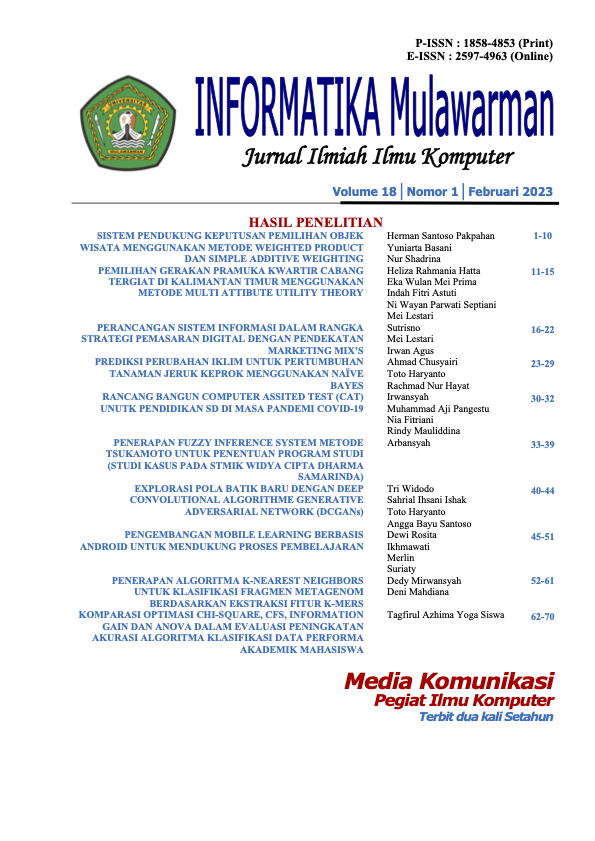
Pemilihan Gerakan Pramuka Kwartir Cabang Tergiat Di Kalimantan Timur Menggunakan Metode Multi Attribute Utility Theory
DOI:
https://doi.org/10.30872/jim.v18i1.9550Keywords:
Pemilihan, Kuartir, MAUTAbstract
Kwartir Daerah Kalimantan Timur (Kwarda Kaltim) adalah wadah nonformal kegiatan kepramukaann masyarakat Kalimantan Timur yang mengurusi dan menilai langsung 10 Kwartir Cabang dengan data potensi peserta didik Kwarda Kaltim dengan total keseluruhan 179.128 anggota Gerakan Pramuka. Penilaian kwartir cabang dilaksanakan dalam rangka pembinaan, peningkatan semangat dan kemampuan serta prestasi kerja kwartir cabang. Penilaian pada Kwarda Kaltim selama ini dilakukan secara manual menggunakan Microsoft Excel dengan memperhitungkan lima kriteria utama dan dalam setiap bidangnya memiliki beberapa cara perhitungan berbeda pada subkriterianya, sehingga memungkinkan terjadi human error pada proses perhitungan dan peserta sering melakukan pengumpulan laporan yang menyita waktu hingga batas akhir penilaian, sehingga proses selanjutnya yaitu mengkalkulasikan data menjadi terburu-buru, sehingga untuk meminimalisir terjadinya human error pada saat memasukkan rumus maupun data ke dalam Microsoft Excel oleh penilai, maka dibutuhkan suatu sistem pendukung keputusan yang dapat memudahkan penilai mendapatkan rekomendasi kwartir cabang tergiat secara terurut dengan efisien. Metode sistem pendukung keputusan yang digunakan adalah Multi Attribute Utility Theory (MAUT) menggunakan 8 alternatif dan 5 kriteria utama dengan total 58 subkriteria. Hasil dari penelitian ini akan digunakan sebegai bahan pertimbangan untuk pengambilan keputusan yang dapat digunakan penilai dalam menentukan urutan ranking pemenang kwartir cabang tergiat di Kalimantan Timur yang tepat sesuai kriteria penilaian.
References
Alfiarini, A., & Primadasa, Y. (2020). Penerapan Metode Multi Attribute Utility Theory Untuk Menganalisa Pemberian Bantuan Raskin. Techno.Com, 19(1), 76–86. https://doi.org/10.33633/tc.v19i1.3136
Fajirwan, D., Arhami, M., & Amalia, I. (2018). Sistem Pendukung Keputusan Penerimaan Bantuan Renovasi Rumah Dhuafa Menggunakan Metode Multi Attribute Utility Theory. Jurnal Infomedia:Teknik Informatika, Multimedia & Jaringan, 3(2), 49–57. https://doi.org/10.30811/JIM.V3I2.713
Hatta, H. R., Pradana, B., Khairina, D. M., Komputer, I., Teknik, F., & Mulawarman, U. (2020). Kombinasi Metode Analytical Hierarchy Process (AHP) dan Multi- Attribute Utility Theory (MAUT) Pada Lomba Balita Sehat Untuk Usia 6- 24 Bulan. Prosiding SISFOTEK, 4(1), 244–249. http://seminar.iaii.or.id/index.php/SISFOTEK/article/view/226
Jannah, R., & Lusiana, L. (2015). Aplikasi Penerimaan Karyawan dengan Metode Multi Attribute Utility Theory. SATIN - Sains Dan Teknologi Informasi, 1(2), 79–89. https://doi.org/10.33372/STN.V1I2.110
Khair, F. el, Defit, S., & Yuhandri, Y. (2021). Sistem Keputusan dengan Metode Multi Attribute Utility Theory dalam Penilaian Kinerja Pegawai. Jurnal Informasi Dan Teknologi, 215–220. https://doi.org/10.37034/JIDT.V3I4.155
Kusumawati, I. (2012). Pembentukan Karakter Siswa Melalui Pendidikan Kepramukaan. Academy of Education Journal, 3(1). https://doi.org/10.47200/AOEJ.V3I1.85
Machfud, I., & Nonggala Putra, F. (2022). Pelatihan Jurnalistik Berbasis Web bagi Pengurus Kwaran dan DKR di Lingkungan Kwarcab Gerakan Pramuka Kota Blitar. Jurnal Pengabdian Dan Pemberdayaan Nusantara (JPPNu), 4(1), 64–68. https://doi.org/10.28926/JPPNU.V4I1.47
Maharani, S., Ridwanto, H., Hatta, H. R., Khairina, D. M., & Ibrahim, M. R. (2021). Comparison of TOPSIS and MAUT methods for recipient determination home surgery. IAES International Journal of Artificial Intelligence (IJ-AI), 10(4), 930–937. https://doi.org/10.11591/IJAI.V10.I4.PP930-937
Parhusip, J. (2019). Penerapan Metode Analytical Hierarchy Process (AHP) Pada Desain Sistem Pendukung Keputusan Pemilihan Calon Penerima Bantuan Pangan Non Tunai (BPNT) Di Kota Palangka Raya. Jurnal Teknologi Informasi: Jurnal Keilmuan Dan Aplikasi Bidang Teknik Informatika, 13(2), 18–29. https://doi.org/10.47111/JTI.V13I2.251
Putra, I. N. T. A., Kartini, K. S., & Putri, N. P. H. W. (2022). Comparison Of Maut Method With Mabac In Giving Employees Salary Bonus At PT. Arta Jaya ElectriC. Telematika : Jurnal Informatika Dan Teknologi Informasi, 19(1), 133–146. https://doi.org/10.31315/TELEMATIKA.V19I1.7174
Rahma, P., Nasir, M., & Putra, A. (2019). Implementasi Metode Weighted Product dalam Sistem Pendukung Keputusan Kelayakan Pemberian Tunjangan Profesi Guru Lanjutan pada Dinas Pendidikan Kabupaten Ogan Komering Ilir (OKI). Bina Darma Conference on Computer Science (BDCCS), 1(1), 263–269. https://conference.binadarma.ac.id/index.php/BDCCS/article/view/151
Ramadhani, N., Dewi, A., & Furnamasari, Y. F. (2022). Meningkatkan Nasionalisme dalam Karakter Pendidikan Kepramukaan. Edumaspul: Jurnal Pendidikan, 6(1), 646–651. https://doi.org/10.33487/EDUMASPUL.V6I1.2534
Ramadiani, Hatta, H. R., Novita, N., & Azainil. (2018). Comparison of two methods between TOPSIS and MAUT in determining BIDIKMISI scholarship. Proceedings of the 3rd International Conference on Informatics and Computing, ICIC 2018. https://doi.org/10.1109/IAC.2018.8780455
rihastuti, siti. (2020). Penerapan Metode Multi Attribute Utility Theory dalam Pemilihan Karyawan Terbaik di STMIK Amikom Surakarta. Jurnal Ilmiah IT CIDA : Diseminasi Teknologi Informasi, 5(2). https://doi.org/10.55635/JIC.V5I2.108
Sianturi, F. A., Sinaga, B., & Hasugian, P. M. (2018). Fuzzy Multiple Attribute Decision Macking Dengan Metode Oreste Untuk Menentukan Lokasi Promosi. Journal Of Informatic Pelita Nusantara, 3(1). https://e-jurnal.pelitanusantara.ac.id/index.php/JIPN/article/view/289
Wahono, S., & Ali, H. (2021). Peranan Data Warehouse, Software Dan Brainware Terhadap Pengambilan Keputusan (Literature Review Executive Support Sistem For Business). Jurnal Ekonomi Manajemen Sistem Informasi, 3(2), 225–239. https://doi.org/10.31933/JEMSI.V3I2.781
Downloads
Published
Issue
Section
License
Copyright Transfer StatementThe copyright of this article is transferred to Informatika Mulawarman : Jurnal Ilmiah Ilmu Komputer and when the article is accepted for publication. the authors transfer all and all rights into and to paper including but not limited to all copyrights in the Informatika Mulawarman. The author represents and warrants that the original is the original and that he/she is the author of this paper unless the material is clearly identified as the original source, with notification of the permission of the copyright owner if necessary. The author states that he has the authority and authority to make and carry out this task.
The author states that:
- This paper has not been published in the same form elsewhere.
- This will not be submitted elsewhere for publication prior to acceptance/rejection by this Journal.
A Copyright permission is obtained for material published elsewhere and who require permission for this reproduction. Furthermore, I / We hereby transfer the unlimited publication rights of the above paper to Informatika Mulawarman : Jurnal Ilmiah Ilmu Komputer. Copyright transfer includes exclusive rights to reproduce and distribute articles, including reprints, translations, photographic reproductions, microforms, electronic forms (offline, online), or other similar reproductions.
The author's mark is appropriate for and accepts responsibility for releasing this material on behalf of any and all coauthor. This Agreement shall be signed by at least one author who has obtained the consent of the co-author (s) if applicable. After the submission of this agreement is signed by the author concerned, the amendment of the author or in the order of the author listed shall not be accepted.
Rights / Terms and Conditions Saved
- The author keeps all proprietary rights in every process, procedure, or article creation described in Work.
- The author may reproduce or permit others to reproduce the work or derivative works for the author's personal use or for the use of the company, provided that the source and the Informatika Mulawarman copyright notice are indicated, the copy is not used in any way implying the Journal of Informatika Mulawarman (JIM) approval of the product or service from any company, and the copy itself is not offered for sale.
- Although authors are permitted to reuse all or part of the Works in other works, this does not include granting third-party requests to reprint, republish, or other types of reuse.

Informatika Mulawarman by http://e-journals.unmul.ac.id/index.php/JIM/index is licensed under a Creative Commons Attribution-ShareAlike 4.0 International License.
under the CC BY-SA license, authors and other users are able to reprint, distribute or use the material for commercial purposes so long as they give attribution to the journal Informatika Mulawarman and license the republished material under the same license.