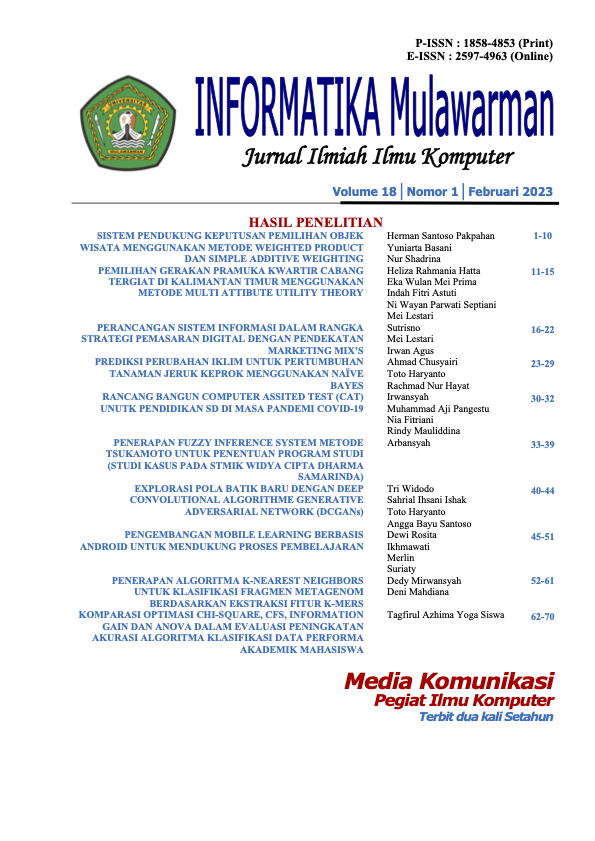
Penerapan Fuzzy Inference System Metode Tsukamoto Untuk Penentuan Program Studi (Studi Kasus Pada STMIK Widya Cipta Dharma Samarinda)
DOI:
https://doi.org/10.30872/jim.v18i1.8343Keywords:
Fuzzy Tsukamoto, Expert System, Sistem Informasi, Fuzzy LogicAbstract
Memilih program studi bukanlah hal yang mudah. Karena jika salah dalam menentukan program studi yang akan diambil maka akan berpengaruh terhadap motivasi belajar, lamanya masa studi yang melebihi dari standar yang berlaku, bahkan ada juga yang mengalami kegagalan. Dengan adanya Penentuan program studi, diharapkan setiap mahasiswa dapat lebih fokus pada minat dan kemampuan yang dimiliki. Penerapan Fuzzy Inference System (FIS) metode Tsukamoto dapat digunakan untuk pendukung keputusan dalam penentuan program studi. Untuk menghasilkan output dengan pendekatan Fuzzy Inference System (FIS) metode Tsukamoto, terdiri dari empat tahap yaitu: pembentukan himpunan fuzzy (Fuzzification), pembentukan rules (inference), aplikasi fungsi implikasi serta hasil output (defuzzification). Tujuan penelitian ini adalah menerapkan Fuzzy Inference System (FIS) metode Tsukamoto untuk penentuan program studi yang paling sesuai dengan minat dan kemampuan calon mahasiswa. Adapun variabel input nya adalah Nilai Wawancara, Nilai Teknik Informatika, Nilai Sistem Informasi dan Nilai Test Tertulis. Variabel output adalah minat dimana Teknik Informatika atau Sistem Informasi yang paling sesusai dengan minat dan kemampuan calon mahasiswa
Kata kunci : Fuzzy Inference System (FIS), Metode Tsukamoto, fuzzification, inference, defuzzification, Program Studi.
References
Arbansyah, Arbain, Dedi Rahman Nur, and Dzul Rahman. 2019. “Application of Fuzzy Multi Ttributes of Decision (Madm) in Supporting Decision to Determine Best Graduate.” International Journal of Recent Technology and Engineering 7(6):1–6.
djeari Mardapi, sri andayani &. 2012. “Sri Andayani-Makalah MCDM Semnas 2 Juni Sri Andayani PMAT UNY.” Prosiding Seminar Nasional Penelitian, Pendidikan Dan Penerapan MIPA, Fakultas MIPA, Universitas Negeri Yogyakarta,.
Irfan, Mohamad, Laras Purwati Ayuningtias, and Jumadi Jumadi. 2018. “Analisa Perbandingan Logic Fuzzy Metode Tsukamoto, Sugeno, Dan Mamdani ( Studi Kasus : Prediksi Jumlah Pendaftar Mahasiswa Baru Fakultas Sains Dan Teknologi Uin Sunan Gunung Djati Bandung).” Jurnal Teknik Informatika 10(1):9–16. doi: 10.15408/jti.v10i1.6810.
Jarti, Nanda. 2021. “Pemanfaatan Fuzzy Inference System Untuk Menentukan Dampak Covid-19 Terhadap Perekonomian Di Kota Batam.” JURTEKSI (Jurnal Teknologi Dan Sistem Informasi) 7(3):341–48. doi: 10.33330/jurteksi.v7i3.1164.
Kaswidjanti, Wilis. 2014. “Implementasi Fuzzy Inference System Metode Tsukamoto Pada Pengambilan Keputusan Pemberian Kredit Pemilikan Rumah.” Telematika 10(2). doi: 10.31315/telematika.v10i2.281.
Kusumadewi, S., & Purnomo, H. 2004. Aplikasi Logika Fuzzy Untuk Pendukung Keputusan. Yogyakarta: ta: Graha Ilmu.
Mahendra, Danang, and Noor Azizah. 2016. “Implementasi Fuzzy Inference System Tsukamoto Untuk Penentuan Topik Tugas Akhir.” Simetris : Jurnal Teknik Mesin, Elektro Dan Ilmu Komputer 7(1):337. doi: 10.24176/simet.v7i1.522.
Rohayani. 2015. “Fuzzy Inference System Dengan Metode Tsukamoto Sebagai Penunjang Keputusan Produksi (Studi Kasus : PT. Talkindo Selaksa Anugrah).” Jurnal Sistem Informasi (JSI) 7(1):2355–4614.
Rozi, A. F., & Purnomo, A. S. 2017. “Rekomendasi Pemilihan Minat Studi Menggunakan Metode Mamdani Studi Kasus.” Informatic Journal II(3):138–47.
Setiawan, A., Yanto, B., & Yasdomi, K. 2018. Logika Fuzzy Dengan Matlab. Jayapangus. Denpasar, Bali, Indonesia.
Sihaloho, T. P. 2020. “Level of Student Satisfaction on Lecturer Performance with Fuzzy Inference System (FIS) Tsukamoto Method.” IOP Conference Series: Materials Science and Engineering 1–6.
Downloads
Additional Files
Published
Issue
Section
License
Copyright Transfer StatementThe copyright of this article is transferred to Informatika Mulawarman : Jurnal Ilmiah Ilmu Komputer and when the article is accepted for publication. the authors transfer all and all rights into and to paper including but not limited to all copyrights in the Informatika Mulawarman. The author represents and warrants that the original is the original and that he/she is the author of this paper unless the material is clearly identified as the original source, with notification of the permission of the copyright owner if necessary. The author states that he has the authority and authority to make and carry out this task.
The author states that:
- This paper has not been published in the same form elsewhere.
- This will not be submitted elsewhere for publication prior to acceptance/rejection by this Journal.
A Copyright permission is obtained for material published elsewhere and who require permission for this reproduction. Furthermore, I / We hereby transfer the unlimited publication rights of the above paper to Informatika Mulawarman : Jurnal Ilmiah Ilmu Komputer. Copyright transfer includes exclusive rights to reproduce and distribute articles, including reprints, translations, photographic reproductions, microforms, electronic forms (offline, online), or other similar reproductions.
The author's mark is appropriate for and accepts responsibility for releasing this material on behalf of any and all coauthor. This Agreement shall be signed by at least one author who has obtained the consent of the co-author (s) if applicable. After the submission of this agreement is signed by the author concerned, the amendment of the author or in the order of the author listed shall not be accepted.
Rights / Terms and Conditions Saved
- The author keeps all proprietary rights in every process, procedure, or article creation described in Work.
- The author may reproduce or permit others to reproduce the work or derivative works for the author's personal use or for the use of the company, provided that the source and the Informatika Mulawarman copyright notice are indicated, the copy is not used in any way implying the Journal of Informatika Mulawarman (JIM) approval of the product or service from any company, and the copy itself is not offered for sale.
- Although authors are permitted to reuse all or part of the Works in other works, this does not include granting third-party requests to reprint, republish, or other types of reuse.

Informatika Mulawarman by http://e-journals.unmul.ac.id/index.php/JIM/index is licensed under a Creative Commons Attribution-ShareAlike 4.0 International License.
under the CC BY-SA license, authors and other users are able to reprint, distribute or use the material for commercial purposes so long as they give attribution to the journal Informatika Mulawarman and license the republished material under the same license.