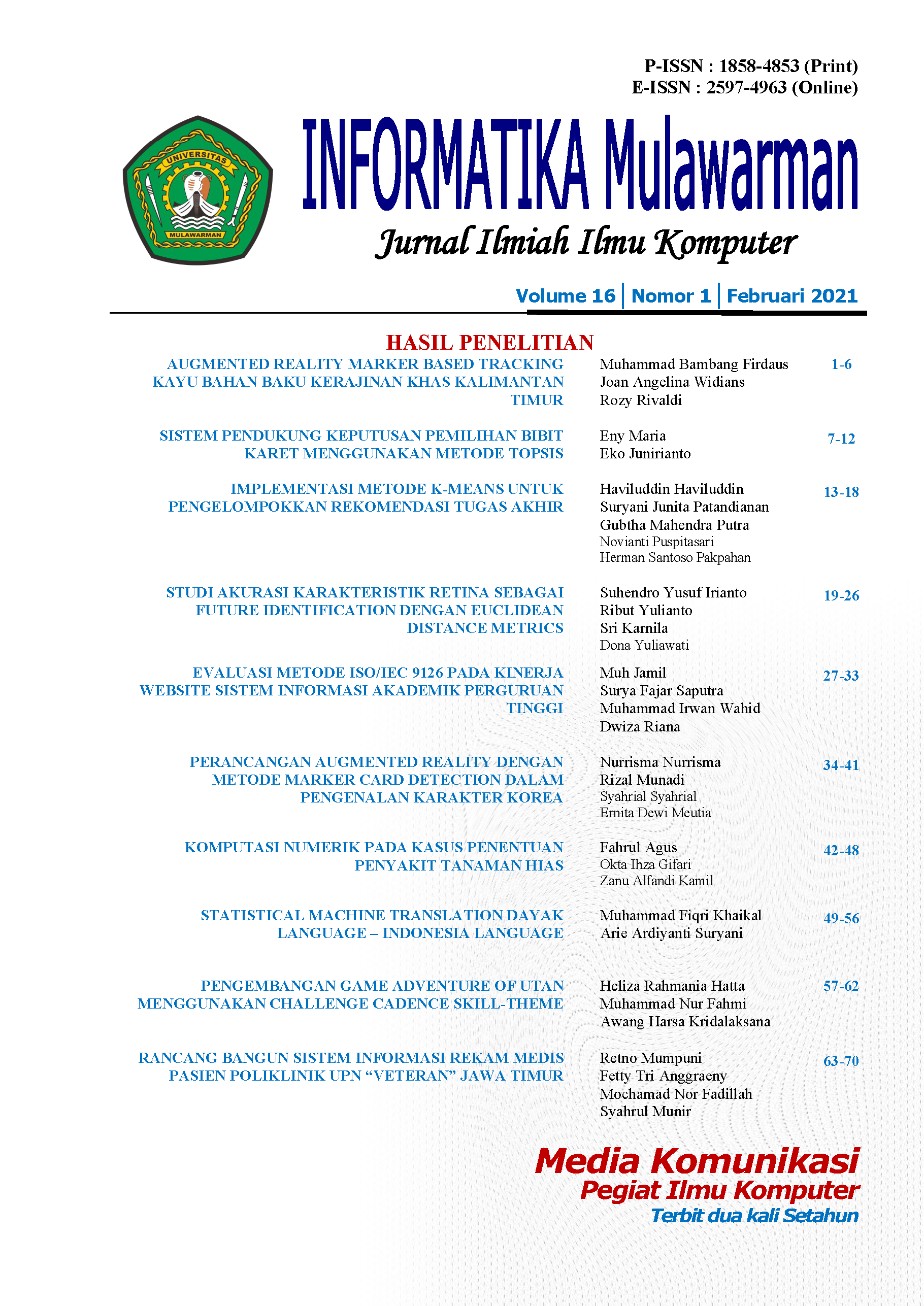
Augmented Reality Marker Based Tracking Kayu Bahan Baku Kerajinan Khas Kalimantan Timur
DOI:
https://doi.org/10.30872/jim.v16i1.4994Keywords:
Augmented Reality, Unity, Vuforia, Android, Marker Based TrackingAbstract
Kayu Kalimantan telah dikenal luas dan diperdagangan karena memiliki kayu yang berkualitas bagus, baik untuk bahan dasar bangunan maupun untuk kegunaan lain. Dari 120 jenis kayu yang telah diperdagangkan, beberapa diantaranya endemic atau asli dari Kalimantan. Beberapa jenis kayu yang endemic atau banyak berasal dari Kalimantan diantaranya adalah kayu sengon, kayu jati, kayu merbabu, kayu ulin, kayu mentibu, kayu meranti, kayu putat, dan kayu cempaka. Penelitian ini bertujuan untuk menciptakan sebuah aplikasi untuk memberikan informasi atau sosialisasi mengenai bidang kehutanan yang berfokus pada penggolongan dan pemanfaatan kayu khas Kalimantan Timur. Tujuan penelitian tersebut dapat dicapai melalui penggabungan teknologi Augmented Reality (AR) yang dapat menambahkan objek virtual kedalam lingkungan nyata dan teknologi mobile Android yang dimiliki hampir setiap lapisan masyarakat. Metode AR yang digunakan adalah Marker Based Tracking dikarenakan metode ini tidak memerlukan spesifikasi dan performa yang tinggi dari perangkat Android milik pengguna. Hasil pengujian perangkat menunjukan aplikasi yang dibuat dapat berjalan lancar dan cocok digunakan pada versi Android 6.0 keatas dengan aspek rasio layar 16:9. Sementara Hasil pengujian marker menunjukan kualitas marker yang dibuat tergolong baik karena dapat tetap terbaca walaupun marker tersebut terlipat, basah dan di-print dengan ukuran kertas A4 dan F4.
References
S. among P. Abdurahim Martawijaya, Iding Kartasujana, Kosasi Kadir, “Atlas_Kayu_Jilid_I_Final-Compres.pdf.” 2005.
R. Effendi, “Kayu Ulin di Kalimantan: Potensi, Manfaat, Permasalahan dan Kebijakan yang Diperlukan untuk Pelestariannya,” J. Anal. Kebijak. Kehutan., vol. 6, no. 3, pp. 161–168, 2009.
OECD, Tourism and Creative Economy: OECD Studies on Tourism. 2014.
S. T. Wu and B. W. Lee, “An innovative way of guided tour: A virtual experience of dark tourism,” Proc. 2017 IEEE Int. Conf. Information, Commun. Eng. Inf. Innov. Mod. Technol. ICICE 2017, pp. 208–210, 2018, doi: 10.1109/ICICE.2017.8479267.
P. Sommerauer and O. Müller, “Augmented reality in informal learning environments: A field experiment in a mathematics exhibition,” Comput. Educ., vol. 79, no. 2014, pp. 59–68, 2014, doi: 10.1016/j.compedu.2014.07.013.
B. Cahyono, M. B. Firdaus, E. Budiman, and M. Wati, “Augmented Reality Applied to Geometry Education,” 2018 2nd East Indones. Conf. Comput. Inf. Technol., vol. 2, no. 2, pp. 299–303, 2018.
N. Dengen, H. S. Pakpahan, G. F. Putra, M. B. Firdaus, R. Wardhana, and A. Tejawati, “An Augmented Reality Model Physical Transformation Learning,” ICEEIE 2019 - Int. Conf. Electr. Electron. Inf. Eng. Emerg. Innov. Technol. Sustain. Futur., pp. 255–259, 2019, doi: 10.1109/ICEEIE47180.2019.8981444.
C. Koch, M. Neges, M. König, and M. Abramovici, “Natural markers for augmented reality-based indoor navigation and facility maintenance,” Autom. Constr., vol. 48, pp. 18–30, 2014, doi: 10.1016/j.autcon.2014.08.009.
M. B. Firdaus, J. A. Widians, and J. Y. Padant, “Augmented reality for interactive promotion media at Faculty of Computer Science and Information Technology Mulawarman University,” J. Phys. Conf. Ser., vol. 1341, no. 4, 2019, doi: 10.1088/1742-6596/1341/4/042017.
M. B. Firdaus, E. Budiman, joan angelina Widians, novel maringan Sinaga, S. Fadli, and F. Alameka, “Augmented Reality for Office and Basic Programming Laboratory Peripheral,” 2018 2nd East Indones. Conf. Comput. Inf. Technol., vol. 2, no. 2, pp. 41–45, 2018.
U. M. W. Wahyudi, H. Wibawanto, and W. Hardyanto, “Pengembangan Media Edukatif Berbasis Augmented Reality untuk Desain Interior dan Eksterior,” Innov. J. Curric. Educ. Technol., vol. 6, no. 2, pp. 98–107, 2017, doi: 10.15294/ijcet.v6i2.19337.
A. Suhendar and A. Fernando, “Aplikasi Virtual tour Berbasis Multimedia Interaktif Menggunakan Autodesk 3Ds Max,” ProTekInfo, vol. 3, no. 1, pp. 30–35, 2016.
Dedynggego, Mohammad, and Moh.Affan, “Perancangan Media Pembelajaran Interaktif 3D Tata Surya Menggunakan Teknologi Augmented Reality Untuk Siswa Kelas 6 Sekolah Dasar Sangira,” J. Elektron. Sist. Inf. Dan Komput., vol. 1, no. 2, pp. 45–60, 2015.
J. Kascak, M. Teliskova, J. Torok, P. Baron, J. Zajac, and J. Husar, “Implementation of Augmented Reality into the Training and Educational Process in Order to Support Spatial Perception in Technical Documentation,” 2019 IEEE 6th Int. Conf. Ind. Eng. Appl. ICIEA 2019, pp. 583–587, 2019, doi: 10.1109/IEA.2019.8715120.
N. S. Podzharaya and A. S. Sochenkova, “The virtual museum development with the use of intelligent and 3d technologies on the basis of the Maritime museum in Kotor,” 2018 23rd Int. Sci. Conf. Inf. Technol. IT 2018, vol. 2018-Janua, pp. 1–4, 2018, doi: 10.1109/SPIT.2018.8350845.
Downloads
Published
Issue
Section
License
Copyright Transfer StatementThe copyright of this article is transferred to Informatika Mulawarman : Jurnal Ilmiah Ilmu Komputer and when the article is accepted for publication. the authors transfer all and all rights into and to paper including but not limited to all copyrights in the Informatika Mulawarman. The author represents and warrants that the original is the original and that he/she is the author of this paper unless the material is clearly identified as the original source, with notification of the permission of the copyright owner if necessary. The author states that he has the authority and authority to make and carry out this task.
The author states that:
- This paper has not been published in the same form elsewhere.
- This will not be submitted elsewhere for publication prior to acceptance/rejection by this Journal.
A Copyright permission is obtained for material published elsewhere and who require permission for this reproduction. Furthermore, I / We hereby transfer the unlimited publication rights of the above paper to Informatika Mulawarman : Jurnal Ilmiah Ilmu Komputer. Copyright transfer includes exclusive rights to reproduce and distribute articles, including reprints, translations, photographic reproductions, microforms, electronic forms (offline, online), or other similar reproductions.
The author's mark is appropriate for and accepts responsibility for releasing this material on behalf of any and all coauthor. This Agreement shall be signed by at least one author who has obtained the consent of the co-author (s) if applicable. After the submission of this agreement is signed by the author concerned, the amendment of the author or in the order of the author listed shall not be accepted.
Rights / Terms and Conditions Saved
- The author keeps all proprietary rights in every process, procedure, or article creation described in Work.
- The author may reproduce or permit others to reproduce the work or derivative works for the author's personal use or for the use of the company, provided that the source and the Informatika Mulawarman copyright notice are indicated, the copy is not used in any way implying the Journal of Informatika Mulawarman (JIM) approval of the product or service from any company, and the copy itself is not offered for sale.
- Although authors are permitted to reuse all or part of the Works in other works, this does not include granting third-party requests to reprint, republish, or other types of reuse.

Informatika Mulawarman by http://e-journals.unmul.ac.id/index.php/JIM/index is licensed under a Creative Commons Attribution-ShareAlike 4.0 International License.
under the CC BY-SA license, authors and other users are able to reprint, distribute or use the material for commercial purposes so long as they give attribution to the journal Informatika Mulawarman and license the republished material under the same license.