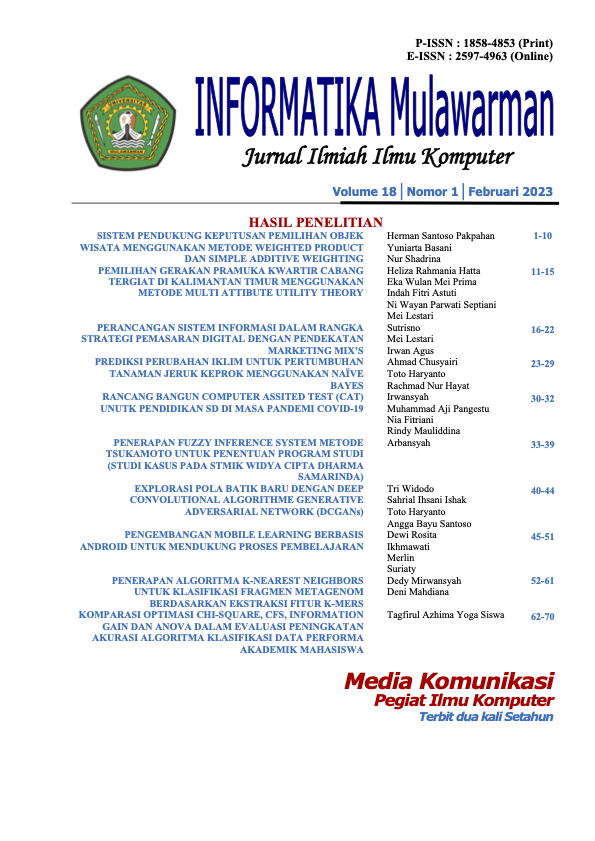
Pengembangan Mobile Learning Berbasis Android Untuk Mendukung Proses Pembelajaran
DOI:
https://doi.org/10.30872/jim.v18i1.11702Keywords:
Mobile Learning, AndroidAbstract
Penggunaan smartphone bisa dijadikan kontribusi dalam melakukan inovasi dalam proses pembelajaran. Inovasi tersebut adalah mengembangan media pembelajaran interaktif berbasis mobile learning. Terkait dengan hal tersebut, penulis mengembangkan media pembelajaran interaktif berbasis mobile learning dalam upaya menjadikan kegiatan pembelajaran lebih menyenangkan khusunya pada mata pelajaran Peniddikan Agama Islam pada Sekolah Menegah Atas. Penelitian ini menggunakan pendekatan HTLL dengan tema Teknologi Ramah Lingkungan, dimana Memuat perlunya teknologi tepat guna atau ramah lingkungan di dalam eksplorasi, pemanfaatan dan penggunaan teknologi di lingkungan/wilayah hutan hujan tropis Tujuan dalam penelitian ini adalah 1) bagaimana mengembangkan mobile learning berbasis Android menggunakan microsoft powerpoint add-ins i-spring suite untuk mendukung proses pembelajaran 2) implementasi untuk menguji kelayakan mobile learning berbasis Android menggunakan microsoft powerpoint add-ins i-spring suite untuk mendukung proses pembelajaran. Pengembangan mobile learning berbasis Android ini menggunakan model 4D yaitu 1) Define; 2) Design; 3) Development; 4) Disseminate. Kelayakan media ini oleh para validator yang terdiri dari validasi materi, media dan uji coba ke siswa. Hasil penilaian oleh ahli media mendapatkan total jumlah skor 110 dengan persentase kelayakan 88% sehingga termasuk dalam kategori “Sangat Layak”. Sedangkan penilaian oleh ahli materi mendapatkan total jumlah skor 72 dengan persentase kelayakan 96% sehingga termasuk dalam kategori “Sangat Layak”. Kemudian berdasarkan hasil uji coba ke siswa diperoleh total jumlah skor 827 dengan persentase kelayakan 87% sehingga termasuk dalam kategori “Sangat Layak”. Sehingga dapat disimpulkan bahwa mobile learning berbasis android mata pelajaran pendidikan agama islam materi asuransi syariah “sangat layak” digunakan sebagai media pembelajaran.
References
Ernawati, Iis dan Sukardiyono, T. (2017). "Uji Kelayakan Media Pembelajaran Interaktif Pada Mata Pelajaran Administrasi Server". Electronics, Informatics, and Vocational Education.Vol.2 No.2, pp.204-210.
Hermawan, Hendrik. (2016). Powerpoint untuk APK. Salatiga: Tisara Grafika.
Holzinger, Andreas, Alexander Nischelwitzer, dan Matthias Meisenberger.
(2005). Mobile Phones as a Challenge for m-Learning:Experiences with the Mobile Learning Engine (MLE) using Mobile Interactive Learning Objects(MILOs).
Mair, Zaid Romegar. (2018). Teori dan Praktek Sistem Operasi. Yogyakarta: Deepublish.
Safaat H, Nazruddin, (2015), Rancang Bangun Aplikasi Multiplatform, Informatika, Bandung
Sarrab, Elgamel, dan Aldabbas .(2012). Mobile Learning (M-Learning And Educational Environments International Journal of Distributed and Parallel System (IJDPS).
Sugiyono, (2013) Metodelogi Penelitian Kuantitatif, Kualitatif Dan R&D. Bandung: Alfabeta.
Sugiyono. (2019). Metode Penelitian dan Pengembangan. Bandung: Alfabeta.
Sutopo, Ariesto Hadi. (2012). Teknologi Informasi dan Komunikasi Dalam Pendidikan. Yogyakarta : Graha Ilmu
Thiagarajan,Sivasailam, dkk. (1974). “Instructional Development for Training Teachers of Exceptional Children: A Sourcebook.” Indiana Univ., Bloomington. Center for Innovation In. (Mc).
Downloads
Published
Issue
Section
License
Copyright Transfer StatementThe copyright of this article is transferred to Informatika Mulawarman : Jurnal Ilmiah Ilmu Komputer and when the article is accepted for publication. the authors transfer all and all rights into and to paper including but not limited to all copyrights in the Informatika Mulawarman. The author represents and warrants that the original is the original and that he/she is the author of this paper unless the material is clearly identified as the original source, with notification of the permission of the copyright owner if necessary. The author states that he has the authority and authority to make and carry out this task.
The author states that:
- This paper has not been published in the same form elsewhere.
- This will not be submitted elsewhere for publication prior to acceptance/rejection by this Journal.
A Copyright permission is obtained for material published elsewhere and who require permission for this reproduction. Furthermore, I / We hereby transfer the unlimited publication rights of the above paper to Informatika Mulawarman : Jurnal Ilmiah Ilmu Komputer. Copyright transfer includes exclusive rights to reproduce and distribute articles, including reprints, translations, photographic reproductions, microforms, electronic forms (offline, online), or other similar reproductions.
The author's mark is appropriate for and accepts responsibility for releasing this material on behalf of any and all coauthor. This Agreement shall be signed by at least one author who has obtained the consent of the co-author (s) if applicable. After the submission of this agreement is signed by the author concerned, the amendment of the author or in the order of the author listed shall not be accepted.
Rights / Terms and Conditions Saved
- The author keeps all proprietary rights in every process, procedure, or article creation described in Work.
- The author may reproduce or permit others to reproduce the work or derivative works for the author's personal use or for the use of the company, provided that the source and the Informatika Mulawarman copyright notice are indicated, the copy is not used in any way implying the Journal of Informatika Mulawarman (JIM) approval of the product or service from any company, and the copy itself is not offered for sale.
- Although authors are permitted to reuse all or part of the Works in other works, this does not include granting third-party requests to reprint, republish, or other types of reuse.

Informatika Mulawarman by http://e-journals.unmul.ac.id/index.php/JIM/index is licensed under a Creative Commons Attribution-ShareAlike 4.0 International License.
under the CC BY-SA license, authors and other users are able to reprint, distribute or use the material for commercial purposes so long as they give attribution to the journal Informatika Mulawarman and license the republished material under the same license.