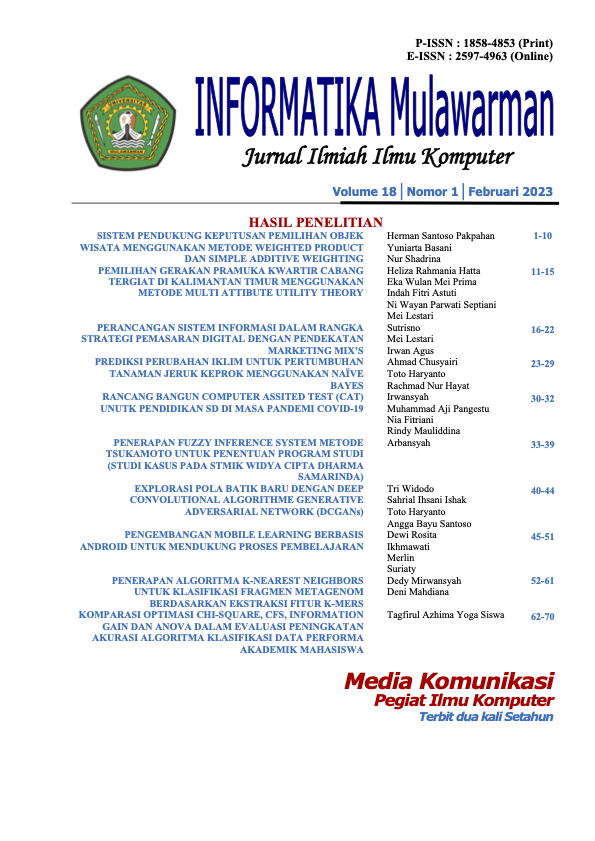
Komparasi Optimasi Chi-Square, CFS, Information Gain dan ANOVA dalam Evaluasi Peningkatan Akurasi Algoritma Klasifikasi Data Performa Akademik Mahasiswa
DOI:
https://doi.org/10.30872/jim.v18i1.11330Keywords:
klasifikasi, c4.5, naïve bayes, random forest, logistic regression, optimasi, chisquare, cfs, information gain, anova,Abstract
Telah banyak penelitian implementasi data mining pada perfoma akademik mahasiswa yang dilakukan untuk mencari kinerja terbaik dari algoritma klasifikasi, namun penelitian yang menguji hubungan atribut-atribut dengan dimensi data yang tinggi pada pemodelan terhadap label data yang digunakan masih rendah. Penelitian ini bertujuan untuk mengkomparasi peningkatan akurasi algoritma klasifikasi yakni Naive Bayes, C4.5, Random Forest, dan Logistic Regression yang telah dioptimasi dengan beberapa algoritma seleksi fitur seperti Chi-Square, CFS, Information Gain dan ANOVA. Dataset yang digunakan berjumlah 2663 record, dengan membagi data menggunakan metode 5-fold cross validation kemudian dilakukan evaluasi kinerja algoritma menggunakan confusion matrix. Hasil penelitian yang diperoleh adalah optimasi Chi-square memiliki nilai tertinggi dalam meningkatkan akurasi pemodelan algoritma klasifikasi, dengan rata-rata peningkatan akurasi sebesar 2.45%. Sementara, hasil perbandingan algoritma klasifikasi dalam menangani data prediksi performa mahasiswa menghasilkan algoritma Random Forest sebagai algoritma klasifikasi tertinggi dengan persentase accuracy sebesar 94.5%, precision 95%, recall 94, f1-score 94%.
References
Abubakar, Y., & Ahmad, N. B. H. (2017). Prediction of Students Performance in ELearning Environment Using Random Forest. International Journal of Innovative Computing, 7(2).
Annisa, R., & Sasongko, A. (2020). Prediksi Nilai Akademik Mahasiswa Menggunakan Algoritma NaÔve Bayes. Jurnal Sains & Teknologi. Vol. 9 (1)
Breiman, L. (2001). Random forests. Machine learning, 45(1), 5-32. Springer.
Daqiqil Id, I. (2021). Machine Learning: Teori, Studi Kasus dan Implementasi Menggunakan Python. Riau: UR PRESS
Hall, M. A. (1999). Correlation-based feature selection for machine learning
Hermawati, F.A. (2013). Data Mining. Yogyakarta: Penerbit Andi
Hastuti, K. (2012). Analisis komparasi algoritma klasifikasi data mining untuk prediksi mahasiswa non aktif. Semantik, 2(1).
Jensen, R., & Shen, Q. (2008). Computational Intelligence and Feature Selection - Rough and Fuzzy Approaches. IEEE Press series on computational intelligence.Johnson, K. J., & Synovec, R. E. (2002).
Pattern recognition of jet fuels: comprehensive GC◊ GC with ANOVA-based feature selection and principal component analysis. Chemometrics and Intelligent Laboratory Systems, 60(1-2), 225-237.
Jassim, M. A., & Abdulwahid, S. N. (2021). Data Mining preparation: Process, Techniques and Major Issues in Data Analysis. In IOP Conference Series: Materials Science and Engineering (Vol. 1090, No. 1, p. 012053). IOP Publishing.
Khaire, U. M., & Dhanalakshmi, R. (2022). Stability of feature selection algorithm: A review. Journal of King Saud University-Computer and Information Sciences, 34(4), 1060-1073.
Kurniawan, D., Pengenalan Machine Learning Python. Jakarta: PT Alex Media Komputindo, 2020.
KPAI. 2021. Survei Pelaksanaan Pembelajaran Jarak Jauh (PJJ) dan Sistem Penilaian Jarak Jauh Berbasis Pengaduan KPAI [pdf] Komisi Perlindungan Anak Indonesia. Tersedia di: https://bankdata.kpai.go.id/files /2021/02/ Paparan-Survei-PJJ-KPAI-29042020_Final-update.pdf [Diakses 10 Februari 2022]
Lin, H., & Ding, H. (2011). Predicting ion channels and their types by the dipeptide mode of pseudo amino acid composition. Journal of theoretical biology, 269(1), 64-69.
Ling, J., Kencana, I. P. E. N., & Oka, T. B. (2014). Analisis Sentimen Menggunakan Metode NaÔve Bayes Classifier Dengan Seleksi Fitur Chi Square. E-Jurnal Matematika, 3(3), 92-99.
Liparas, D., Ha, Cohen-Kerner, Y., Moumtzidou, A., Vrochidis, S., & Kompatsiaris, I. (2014). News articles classification using random forests and weighted multimodal features. In Information Retrieval Facility Conference (pp. 63-75). Springer, Cham.
Nurhayati, Soekarno, I., Hadihardaja, I. K., & Cahyono, M. (2015). IEEE. A study of hold-out and k-fold cross validation for accuracy of groundwater modelling in tidal lowland reclamation using extreme learning machine. 10.1109/TIME-E.2014.7011623.
Nofriansyah, D., & Nurcahyo, G. (2015). Algoritma Data Mining dan Pengujian. Yogyakarta: DEEPUBLISH.
Pulungan, A. F. (2019). Analisis Kinerja Bray Curtis Distance, Canberra Distance dan Euclidean Distance pada Algoritma K-Nearest Neighbour. Tersedia di: https://repositori.usu.ac.id/handle/123456789/15051 [Diakses 28 Januari 2022]
Sugiyono. (2010). Statistika untuk Penelitian. Bandung: CV Alfabeta.
Sokolova, M., & Lapalme, G. (2009). A systematic analysis of performance measures for classification tasks. Information processing & management, 45(4), 427-437.
Usman, H., & Akbar, S. R. Purnomo (2000), Pengantar Statistika, PT. Bumi Aksara, Jakarta
Primartha, R. (2021). Algoritma Machine Learning. Bandung: Informatika Bandung.
Santoso, B., & Umam, A. (2018). Data Mining dan Big Data Analytics. Yogyakarta: Penebar Media Pustaka.
Sihombing, I. A., Hartama, D., Parlina, I., Gunawan, I., & Kirana, I. O. (2021). Analisis Keberhasilan Pembelajaran Daring pada Masa Pandemi Covid-19 menggunakan Algoritma C4 . 5 dan Naive Bayes. Jurnal Komputer dan Informatika, 3(November), 89ñ96.
Wibawa, A. P. (2018). Metode-metode Klasifikasi. In Prosiding SAKTI (Seminar Ilmu Komputer dan Teknologi Informasi) (Vol. 3, No. 1, pp. 134-138).
Willcox, M. del R. (2011). Factores de riesgo y protecciÛn para el rendimiento acadÈmico: Un estudio descriptivo en estudiantes de PsicologÌa de una universidad privada. Ibero-American Journal of Education, 55(1), 1-9. Recuperado de http://www.rieoei.org/deloslectores/3878Wilcox.pdf
Downloads
Published
Issue
Section
License
Copyright Transfer StatementThe copyright of this article is transferred to Informatika Mulawarman : Jurnal Ilmiah Ilmu Komputer and when the article is accepted for publication. the authors transfer all and all rights into and to paper including but not limited to all copyrights in the Informatika Mulawarman. The author represents and warrants that the original is the original and that he/she is the author of this paper unless the material is clearly identified as the original source, with notification of the permission of the copyright owner if necessary. The author states that he has the authority and authority to make and carry out this task.
The author states that:
- This paper has not been published in the same form elsewhere.
- This will not be submitted elsewhere for publication prior to acceptance/rejection by this Journal.
A Copyright permission is obtained for material published elsewhere and who require permission for this reproduction. Furthermore, I / We hereby transfer the unlimited publication rights of the above paper to Informatika Mulawarman : Jurnal Ilmiah Ilmu Komputer. Copyright transfer includes exclusive rights to reproduce and distribute articles, including reprints, translations, photographic reproductions, microforms, electronic forms (offline, online), or other similar reproductions.
The author's mark is appropriate for and accepts responsibility for releasing this material on behalf of any and all coauthor. This Agreement shall be signed by at least one author who has obtained the consent of the co-author (s) if applicable. After the submission of this agreement is signed by the author concerned, the amendment of the author or in the order of the author listed shall not be accepted.
Rights / Terms and Conditions Saved
- The author keeps all proprietary rights in every process, procedure, or article creation described in Work.
- The author may reproduce or permit others to reproduce the work or derivative works for the author's personal use or for the use of the company, provided that the source and the Informatika Mulawarman copyright notice are indicated, the copy is not used in any way implying the Journal of Informatika Mulawarman (JIM) approval of the product or service from any company, and the copy itself is not offered for sale.
- Although authors are permitted to reuse all or part of the Works in other works, this does not include granting third-party requests to reprint, republish, or other types of reuse.

Informatika Mulawarman by http://e-journals.unmul.ac.id/index.php/JIM/index is licensed under a Creative Commons Attribution-ShareAlike 4.0 International License.
under the CC BY-SA license, authors and other users are able to reprint, distribute or use the material for commercial purposes so long as they give attribution to the journal Informatika Mulawarman and license the republished material under the same license.