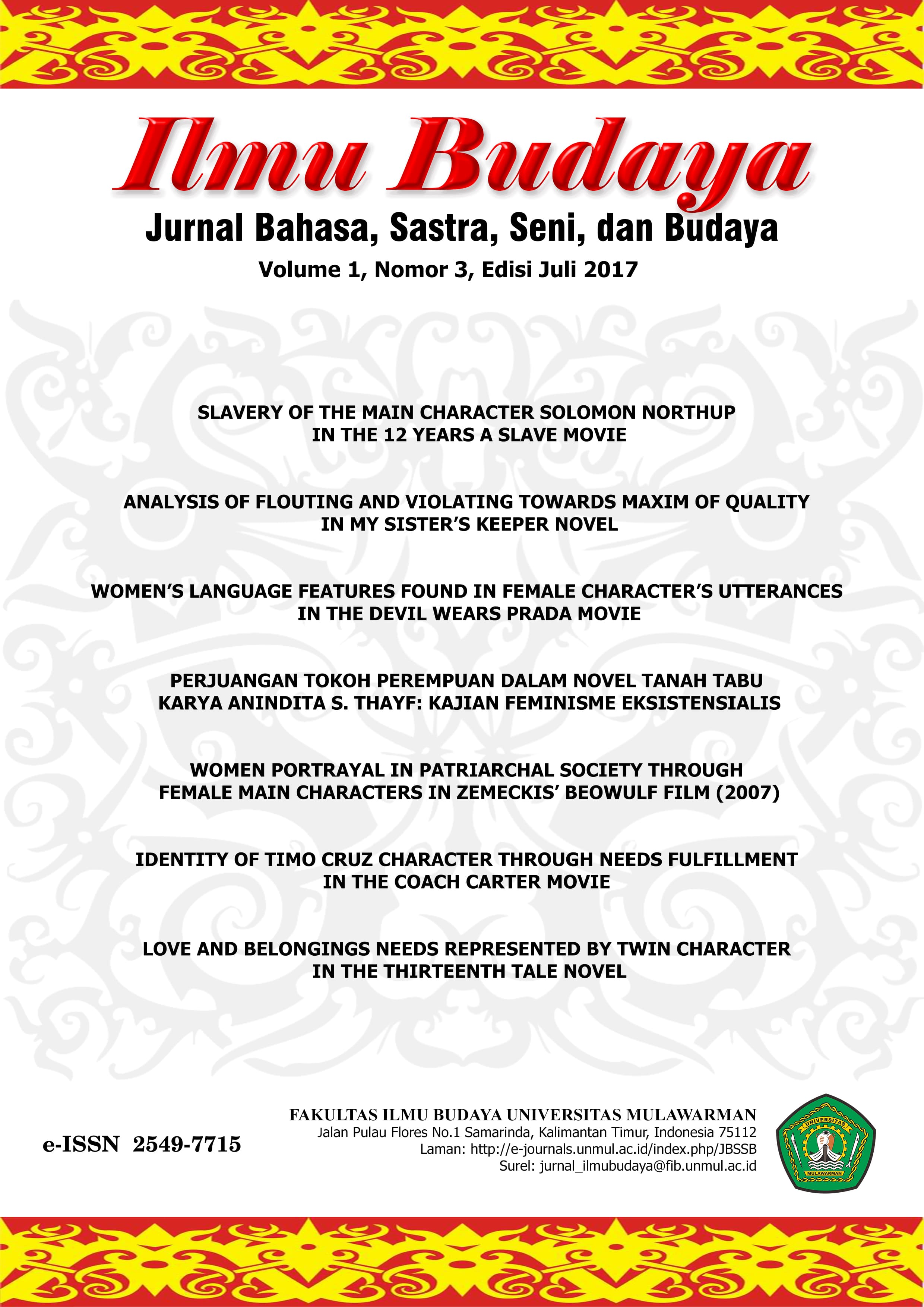
WOMEN’S LANGUAGE FEATURES FOUND IN FEMALE CHARACTER’S UTTERANCES IN THE DEVIL WEARS PRADA MOVIE
DOI:
https://doi.org/10.30872/jbssb.v1i3.672Abstract
ABSTRACT
The research entitled women’s language features found in female character’s utterances in The Devil Wears Prada Movie, aims to identify the women’s language features based on Lakoff’s theory and also to identify language functions served by women’s language features found in The Devil Wears Prada movie based on Jakobsen’s theory. This research was conducted by using descriptive qualitative method, while for collecting the data were watching the movie several times, reading script movie and underlining female character’s utterances containing the women’s language features. From ten features of women’s language, the researcher found nine features used by the female character in The Devil Wears Prada Movie. They are lexical hedges or fillers (7), tag question (3), rising intonation on declarative (2), empty adjectives (3), precious color term (1), intensifiers (10), super polite form (4), hypercorrect grammar (0), avoidance of strong swear words (3) and emphatic stress (3). Intensifiers are the most frequent women’s language features used by female characters in The Devil Wears Prada movie because they want to emphasize or strengthen their utterances deeply to attract addressee’s attention using intensifiers. Meanwhile, hypercorrect grammar did not occur in this research because the female characters mostly used informal language in their dialogue to shorten the gap among the characters. Then, there are language functions served by women’s language found in female character’s utterances in The Devil Wears Prada movie. They are expressive function, directive function and metalinguistic function.
Key words: women’s language, women’s language features, The Devil Wears Prada
ABSTRAK
Penelitian ini bertujuan untuk mengidentifikasi fitur-fitur bahasa wanita berdasarkan teori Lakoff dan juga untuk mengidentifikasi fungsi bahasa yang disajikan oleh fitur bahasa wanita yang terdapat dalam film The Devil Wears Prada berdasarkan teori Jakobsen. Penelitian ini dilakukan dengan menggunakan metode deskriptif kualitatif, sedangkan untuk mengumpulkan data adalah menonton film, membaca naskah film dan menggari bawahi ucapan karakter perempuan yang mengandung fitur-fitur bahasa wanita. Dari sepuluh fitur bahasa wanita, peneliti menemukan sembilan fitur yang digunakan oleh karakter wanita dalam The Devil Wears Prada Movie, lexical hedges atau filler7), tag question (3), rising intonation on declarative (2), empty adjectives (3), precise color term (1), intensifiers (10), super polite form (4), hypercorrect grammar (0), avoidance of strong swear word (3) dan emphatic stress (3). Intensifiers adalah fitur bahasa wanita yang paling sering digunakan oleh karakter wanita dalam film The Devil Wears Prada karena mereka ingin menekankan atau memperkuat ucapan mereka secara mendalam untuk menarik perhatian penerima dengan menggunakan intensifiers. Sementara itu, tata bahasa hypercorrect tidak terjadi dalam penelitian ini karena karakter wanita kebanyakan menggunakan bahasa informal dalam dialog mereka untuk memperpendek jarak antar karakter. Kemudian, ada fungsi bahasa yang disajikan oleh bahasa wanita yang ditemukan dalam ujaran karakter wanita dalam film The Devil Wears Prada. Mereka adalah fungsi ekspresif, fungsi direktif dan fungsi metalinguistik.
Kata kunci: bahasa wanita, fitur-fitur bahasa wanita, The Devil Wears Prada
Downloads
References
Annum, G. (2015). Research Instrument for Data Collection. KNUST GH http://campus.educadium.com/newmediart/file.php/1/giilmadstore/UgradResear h/ThesisWrit4all/files/notes/resInstr.pdf
Cameron, D. (1990). The Feminist Critique of Language. USA: Routledge
Eckert, P. (2003). Language and Gender. UK: Cambridge University Press
Eckert, P., & Ginet, S. (2013). Language and Gender. United State: Cambridge
Finerman, W. (Producer), & Frankel, David. (Director). (2006). The Devil Wears Prada [Motion Picture]. United State: Fox 200 pictures
Holmes, J. (1995). Women, Men and Politeness. London: Longman.
Jakobson, R. (1960). Style in Language. Cambridge: MIT Press
Lakoff, R. (1975). Language and Woman’s Place. New York: Cambridge
Littlejhon, S. W. (2011). Theory of Human Communication, Edision 10. USA:Waveland Press, Inc
Miles, M.B., & Huberman, A.M. (1994). Qualitative Data Analysis (2rd ed). United States: Sage Publication
Mu’minin, F. M. (2011). An Analysis Women's Language Used by The Main Character of Thirteen Movie. Retrieved February 22, 2016, from http://ebook7education.blogspot.co.id/2011/12/06320013-analysis-on-womens language.html
Nazir, M. (1988). Metode Penelitian. Jakarta: Ghalia Indonesia
Pebrianti, A. A. (2013). An analysis Women’s Language Features Used by Indonesian Female Bloggers. Retrieved February 26, 2016, from http://ejournal.upi.edu/index.php/psg/article/.../418
Talbot. ( 1995). Qualitative Inquiri an Research Design. Tousand oaks CA.
Downloads
Published
Issue
Section
License

Every work in Ilmu Budaya: Jurnal Bahasa, Sastra, Seni, dan Budaya is licensed under a Creative Commons Attribution-ShareAlike 4.0 International License.
Under the following terms:
Attribution — You must give appropriate credit, provide a link to the license, and indicate if changes were made. You may do so in any reasonable manner, but not in any way that suggests the licensor endorses you or your use.
ShareAlike — If you remix, transform, or build upon the material, you must distribute your contributions under the same license as the original.
Authors who publish with this journal agree to the following terms:
- Authors retain copyright and grant the journal right of first publication with the work simultaneously licensed under a Creative Commons Attribution License that allows others to share the work with an acknowledgement of the work's authorship and initial publication in this journal.
- Authors can enter into separate, additional contractual arrangements for the non-exclusive distribution of the journal's published version of the work (e.g., post it to an institutional repository or publish it in a book), with an acknowledgement of its initial publication in this journal.
- Authors are permitted and encouraged to post their work online (e.g., in institutional repositories or on their website) prior to and during the submission process, as it can lead to productive exchanges, as well as earlier and greater citation of published work (See The Effect of Open Access).