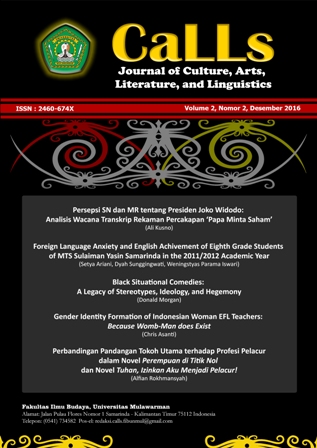
FOREIGN LANGUAGE ANXIETY AND ENGLISH ACHIVEMENT OF EIGHTH GRADE STUDENTS OF MTS SULAIMAN YASIN SAMARINDA IN THE 2011/2012 ACADEMIC YEAR
DOI:
https://doi.org/10.30872/calls.v2i2.694Abstract
Anxiety is considered having negative effects for most students in learning foreign language, especially English. It has attracted researchers’ attention to do the investigation on foreign language anxiety as a factor which inhibits students to learn the target language successfully. Concerning with this issue, this correlational research was emphasized on investigating the relationship between foreign language anxiety and students’ English achievement. Fifty-five eighth grade students of MTS Sulaiman Yasin Samarinda were asked to fill out 33 items of Foreign Language Classroom Anxiety Scale (FLCAS). The Pearson Product Moment Correlation showed that anxiety had significant negative correlation with students’ English achievement (r = -.258, p<.01).
Key words: anxiety, achievement, Pearson Product Moment
References
Aida, Y. 1994. “Examination of Horwitz, Horwitz and Cope’s Construct of Foreign Language Anxiety: The Case of Students of Japanese.” The Modern Language Journal, Vol. 78, pp. 155−167.
Atef-Vahid,S & Alireza, F.K. 2011. “The Effect of English Learning Anxiety on Iranian High-School Students’ English Language Achievement.” BRAIN (Broad Research in Artificial Intelligence and Neuroscience). Vol 3(3), pp. 29−44.
Brown, D. H. 2000. Principles of Language Learning and Teaching (4th Edition). New York: Addison Wesley Longman, Inc.
Cheng, J. 2005. The Relationship to Foreign Language Anxiety of Oral Performance Achievement, Teacher Characteristics and In-Class Activities. Master Thesis. Taiwan: Ming Chuan University.
Cubukcu, F. 2007. “Foreign Language Anxiety.” Iranian Journal of Language Studies (IJLS), Vol. 1(2), 133 – 142.
Gardner, R. C., & MacIntyre, P. D. 1993. “A Student’s Contributions to Second-Language Learning. Part II: Affective Variables.” Language Teaching, 26, pp. 1−11.
Horwitz, E. K. & Young, D. J. 1991. Language Anxiety: From Theory and Research to Classroom Implications. Englewood Cliffs, New Jersey: Prentice Hall.
Horwitz, E.K. 2001. “Language Anxiety and Achievement.” Annual Review of Applied Linguistics, Vol.21 (pp. 112−126). USA: Cambridge University Press.
Huang, Y. 2009. “Listening to their voices: An in-depth study of language anxiety and cultural adjustment among Taiwanese graduate students in the United States.” Doctoral Dissertation. Pennsylvania: Indiana University. [Online] http://dspace.lib.iup.edu:8080/.../Yi-Wen+Huang+Corrected.pdf (retrieved on June 18, 2011).
Kondo, D.S., & Ying-Ling, Y. 2004. “Strategies for Coping with Language Anxiety: The Case of Students of English in Japan.” ELT Journal, 58(3), pp. 258−265.
Kothari, C.R. 2004. Research Methodology: Methods and Techniques (Second Revised Edition). New Delhi: New Age International.
MacIntyre, P., & Gardner, R. C. 1991. “Investigating Language Class Anxiety Using the Focused Essay Technique.” The Modern Language Journal, Vol. 75(3), pp. 296−304
Ortega, L. 2009. Understanding Second Language Acquisition. London: Hodder Education.
Philips, E. M. 1992. “The Effects of Language Anxiety on Student Test Oral Performance”, The Modern Language Journal, 76, pp. 14−26.
Salkind, N.J. 2007. Encyclopedia of Measurement and Statistics (Volume 1). USA: Sage Publications, Inc.
Scovel, T. 1978. “The Effect of Affect on Foreign Language Learning: A Review of the Anxiety Research.” Language Learning, 28, pp. 129–142.
Sila. 2010. “Young Adolescent Students' Foreign Language Anxiety in Relation to Language Skills at Different Levels.” The Journal of International Social Research, Vol 3 (11), pp. 83–91.
Tanveer, M. 2007. “Investigation of the Factors that Cause Language Anxiety for ESL/EFL Students in Learning Speaking Skills and the Influence It Casts on Communication in the Target Language.” Doctoral Dissertation. University of Glasgow. [Online] www.asian-efl-journal.com/thesis_M_Tanveer.pdf (retrieved on June 19,2011).
Worku, M.F. 2008. A study of high School Students English Learning Anxiety and English Achievement: With Particular Reference to Grade 11 at Dembecha Preparatory School, in West Gojjam. Master Thesis. Addis Ababa University.
Downloads
Published
Issue
Section
License

Every works in CaLLs is licensed under a Creative Commons Attribution-ShareAlike 4.0 International License.
Authors who publish with this journal agree to the following terms:
- Authors retain copyright and grant the journal right of first publication with the work simultaneously licensed under a Creative Commons Attribution License that allows others to share the work with an acknowledgment of the work's authorship and initial publication in this journal.
- Authors are able to enter into separate, additional contractual arrangements for the non-exclusive distribution of the journal's published version of the work (e.g., post it to an institutional repository or publish it in a book), with an acknowledgment of its initial publication in this journal.
- Authors are permitted and encouraged to post their work online (e.g., in institutional repositories or on their website) prior to and during the submission process, as it can lead to productive exchanges, as well as earlier and greater citation of published work (See The Effect of Open Access).
