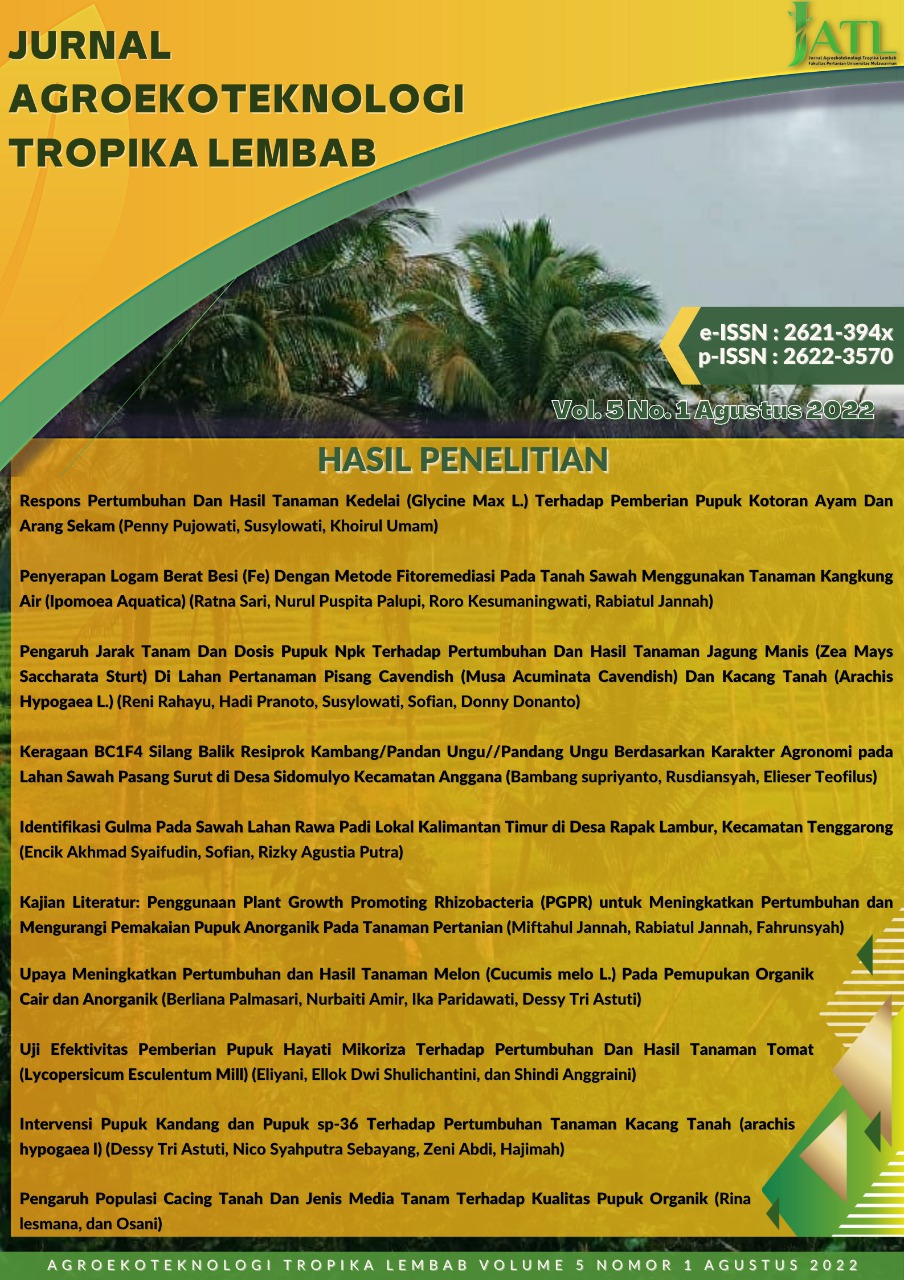
Intervensi Pupuk Kandang dan Pupuk SP-36 terhadap Pertumbuhan Tanaman Kacang Tanah (Arachis hypogaea L)
DOI:
https://doi.org/10.35941/jatl.5.1.2022.8019.65-71Keywords:
Kacang Tanah, Pupuk Kandang dan Pupuk SP-36Abstract
Tujuan penelitian ini adalah untuk mengetahui pengaruh dosis pupuk kandang dan pupuk SP-36 terhadap pertumbuhan 32 tanaman kacang tanah, serta nyata tidaknya antara interaksi kedua faktor tersebut. Penelitian ini dilaksanakan di Desa Lawe Sumur 33 Kecamatan Lawe Sumur Kabupaten Aceh Tenggara dengan ketinggian tempat ± 250 meter diatas permukaan laut, penelitian ini 34 akan di mulai pada bulan Nopember 2020 sampai bulan Desember 2020. Penelitian ini menggunakan Rancangan Acak Kelompok 35 (RAK) Faktorial dengan 9 kombinasi perlakuan dan 3 ulangan. Faktor pertama Dosis Pupuk Kandang terdiri dari 3 taraf sebagai yaitu : 36 K1 (2,5 kg/plot); K2 (3,8 kg/plo); dan K3 (4,8 kg/plot). Faktor Kedua Dosis Pupuk SP-36 yaitu : S1 (15 gr/plot); S2 (18 gr/plot); dan 37 S3 (21 gr/plot). Hasil penelitian menunjukkan perlakuan pupuk kandang (K) menunjukan pengaruh yang tidak nyata pada parameter 38 tinggi tanaman, pada K1 yaitu 16,39 cm dan terendah pada K2 yaitu 20,00 cm, jumlah cabang terbanyak pada K2 yaitu 16,48 cabang 39 dan terendah pada K3 yaitu 16,04, umur berbunga yang tercepat terdapat pada K1 yaitu 27,33 HST dan yang terlama K3 yaiut 40 28,00 HST.Perlakuan pupuk SP-36 belum menunjukan beda nyata pada semua parameter yang diamati. Interaksi antara Pupuk 41 Kandang (K) dan Pupuk SP-36 tidak menunjukan pengaruh yang nyata pada semua parameter yang diamati.Downloads
References
Aby Condro A, Supriyono. 2018. “Pengaruh Pupuk Petrobio Dan Sp36 Terhadap Pertumbuhan Dan Produksi Tanaman 293 Tomat (Licopersicum Esculentum Mill) Varietas Servo.” Jurnal Ilmiah Hijau Cendekia 3(2014). 294
Anggraini, Puput Dian et al. 2018. “Pengaruh Pemberian Senyawa Kno3 (Kalium Nitrat) Terhadap Pertumbuhan 295 Kecambah Sorgum (Sorghum Bicolor (l.) Moench).” Biologi Eksperimen dan Keanekaragaman Hayati 5(1): 37–42. 296
Asri, B, Rahmawati Arma, and & Riski. 2019. “Respon Pertumbuhan Dan Produksi Varietas Bawang Merah (Allium Cepa 297 L.) Terhadap Pemberian Pupuk Kandang.” Jurnal Agrominansia 4(2): 167–75. 298
Bayu Saputra, Denah Suswati, dan Rini Hazriani. 2018. “Kadar Hara Npk Tanaman Kelapa Sawit Pada Berbagai Tingkat 299 Peniti Sungai Purun Kabupaten Mempawah Nutrient Levels of Oil Palm Npk at Different Stages Peat Soil 300 Decomposition in Oil Palm Plantations Pt . Peniti Sungai Purun.” Perkebunan dan Lahan Tropika 8(1): 34–39. 301
Franyoto, Yuvianti Dwi, Mutmainnah, and Lia Kusmita. 2019. “Uji Aktivitas Antioksidan Dan Formulasi Sediaan Krim 302 Ekstrak Kulit Kacang Tanah (Arachis Hypogaea L.).” Jurnal Ilmiah Cendekia Eksakta 4(1). 303
Ginting, Eko Noviandi, Atang Sutandi, Budi Nugroho, and Lilik Tri Indriyati. 2013. “Rasio Dan Kejenuhan Hara k, ca, 304 Mg Di Dalam Tanah Untuk Tanaman Kelapa Sawit (Elaeis Guineensis Jacq).” Jurnal Ilmu Tanah dan Lingkungan 305 15(2). 306
HARTOYO, BUDI et al. 2020. “KEANEKARAGAMAN FUNGI MIKORIZA ARBUSKULA (FMA) PADA RIZOSFER 307 TANAMAN PEGAGAN (Centella Asiatica (L.) Urban).” Jurnal Penelitian Tanaman Industri 17(1). 308
Hidayat, Benny, Nurul Annisa Lubis, and T. Sabrina. 2021. “PENGARUH PENGGUNAAN BIOCHAR BIOMASSA 309 KELAPA SAWIT TERHADAP AKTIVITAS MIKROORGANISME PADA TANAH ULTISOL.” Jurnal Agro 310 Estate 5(1). 311
Malabar, Widia, Ruslan A Zaenuddin, and Ismail Djamaluddin. 2021. “Strategi Peningkatan Produksi Kacang Tanah DiDesa Tinangkung, Banggai Kepulauan.” CELEBES Agricultural 1(2). 313
Nurcholis, Jati, Andi Vira, Buhaerah Buhaerah, and Syaifuddin Syaifuddin. 2021. “Pemanfaatan Pupuk Organik Cair (Poc) 314 Kulit Pisang Kepok Terhadap Pertumbuhan Dan Produksi Tanaman Sawi Hijau (Brassica Rapa Var. Parachinensis 315 L.).” Composite: Jurnal Ilmu Pertanian 3(01): 25–33. 316
Oktavianti, L D, and K Koesriharti. 2019. “Pengaruh Pupuk Anorganik Pada Pertumbuhan Dan Hasil Tanaman Kol Bunga 317 (Brassica Oleracea L. Var. Botrytis L.).” … Produksi Tanaman. 318
Purnomo, Djoko, MTh Sri Budiastuti, Amalia Tetrani Sakya, and Anang Susanto. 2021. “Diseminasi Budidaya Padi Gogo, 319 Jagung, Dan Kacang Tanah Sistem Agroforestri Berbasis Tegakan Sengon Di KPH Blitar.” PRIMA: Journal of 320 Community Empowering and Services 5(1). 321
Riduwan, and Akdon. 2020. Alfabeta Rumus Dan Data Dalam Analisis Data Statistika. 322
Rosadi, Anang Purna, Darni Lamusu, and Lutfi Samaduri. 2019. “Pengaruh Pemberian Pupuk Kandang Sapi Terhadap 323 Pertumbuhan Jagung Bisi 2 Ada Dosis Yang Berbeda.” Babasal Agrocyc Journal 1(1). 324
Salingkat, Chitra Anggriani, and Amalia Noviyanty. 2019. “Mutu Kacang Tanah Rendah Lemak Yang Diberi Berbagai 325 Variasi Perlakuan Pupuk Kandang Dan Mulsa.” Jurnal Agroland 26(2). 326
Sinuraya, Bayu Aditya, and Maya Melati. 2019. “Pengujian Berbagai Dosis Pupuk Kandang Kambing Untuk Pertumbuhan 327 Dan Produksi Jagung Manis Organik (Zea Mays Var. Saccharata Sturt).” Buletin Agrohorti 7(1): 47–52. 328
Stevanus, Charlos Togi, Jamin Saputra, and Thomas Wijaya. 2015. “Peran Unsur Mikro Bagi Tanaman Karet.” Warta 329 Perkaretan 34(1). 330
Sudania, I Ketut, Hertasning Yatim, and Lani Pelia. 2021. “Pengaruh Pemberian Pupuk Urea Dan Pupuk Kandang Ayam 331 Terhadap Pertumbuhan Dan Produksi Jagung Hibrida (Zea Mays L).” Jurnal Ilmiah Mahasiswa Fakultas Pertanian 332 1(2): 41–45. 333
Summerfield, R. J., and E. H. Roberts. 2018. 13 Handbook of Flowering: Volume I Arachis Hypogaea. 334
Suprihatin, Agus, and Johanes Amirullah. 2020. “Pengaruh Pola Rotasi Tanaman Terhadap Perbaikan Sifat Tanah Sawah 335 Irigasi.” Jurnal Sumberdaya Lahan 12(1). 336
Wijaya, Achmad. 2018. “Rancang Bangun Sistem Monitoring Dan Kontroling Greenhouse Untuk Meningkatkan 337 Produktifitas Tanaman Dengan Implementasi.” JATI (Jurnal Mahasiswa Teknik Informatika) 2(1). 338
Ziladi, Aditya Rafi, Kus Hendarto, Yohannes C Ginting, and Agus Karyanto. 2021. “Pengaruh Jenis Pupuk Organik Dan 339 Aplikasi Pupuk Hayati Terhadap Pertumbuhan Dan Produksi Tanaman Tomat (Solanum Lycopersicum Mill) Di 340 Desa Sukabanjar Kecamatan Gedong Tataan.” Tomato plant is one of the horticultural commodities that has great 341 potential to be developed because it has quite high economic value. Tomato production in Indonesia has decreased 342 due to reduced harvested area in Indonesia in 2011 to 2015 decreased by 7. 9(1): 145–51.
Downloads
Published
Issue
Section
License
Copyright Transfer Statement
The copyright of this article is transferred to Jurnal Agroekoteknologi Tropika Lembab and when the article is accepted for publication. the authors transfer all and all rights into and to paper including but not limited to all copyrights in the JATL. The author represents and warrants that the original is the original and that he/she is the author of this paper unless the material is clearly identified as the original source, with notification of the permission of the copyright owner if necessary. The author states that he has the authority and authority to make and carry out this task.
The author states that:
This paper has not been published in the same form elsewhere.
This will not be submitted elsewhere for publication prior to acceptance/rejection by this Journal.
A Copyright permission is obtained for material published elsewhere and who require permission for this reproduction. Furthermore, I / We hereby transfer the unlimited publication rights of the above paper to Jurnal Agroekoteknologi Tropika Lembab. Copyright transfer includes exclusive rights to reproduce and distribute articles, including reprints, translations, photographic reproductions, microforms, electronic forms (offline, online), or other similar reproductions.
The author's mark is appropriate for and accepts responsibility for releasing this material on behalf of any and all coauthor. This Agreement shall be signed by at least one author who has obtained the consent of the co-author (s) if applicable. After the submission of this agreement is signed by the author concerned, the amendment of the author or in the order of the author listed shall not be accepted.
Rights / Terms and Conditions Saved
The author keeps all proprietary rights in every process, procedure, or article creation described in Work.
The author may reproduce or permit others to reproduce the work or derivative works for the author's personal use or for the use of the company, provided that the source and the JATL copyright notice are indicated, the copy is not used in any way implying the Jurnal Agroekoteknologi Tropika Lembab (JATL) approval of the product or service from any company, and the copy itself is not offered for sale.
Although authors are permitted to reuse all or part of the Works in other works, this does not include granting third-party requests to reprint, republish, or other types of reuse.