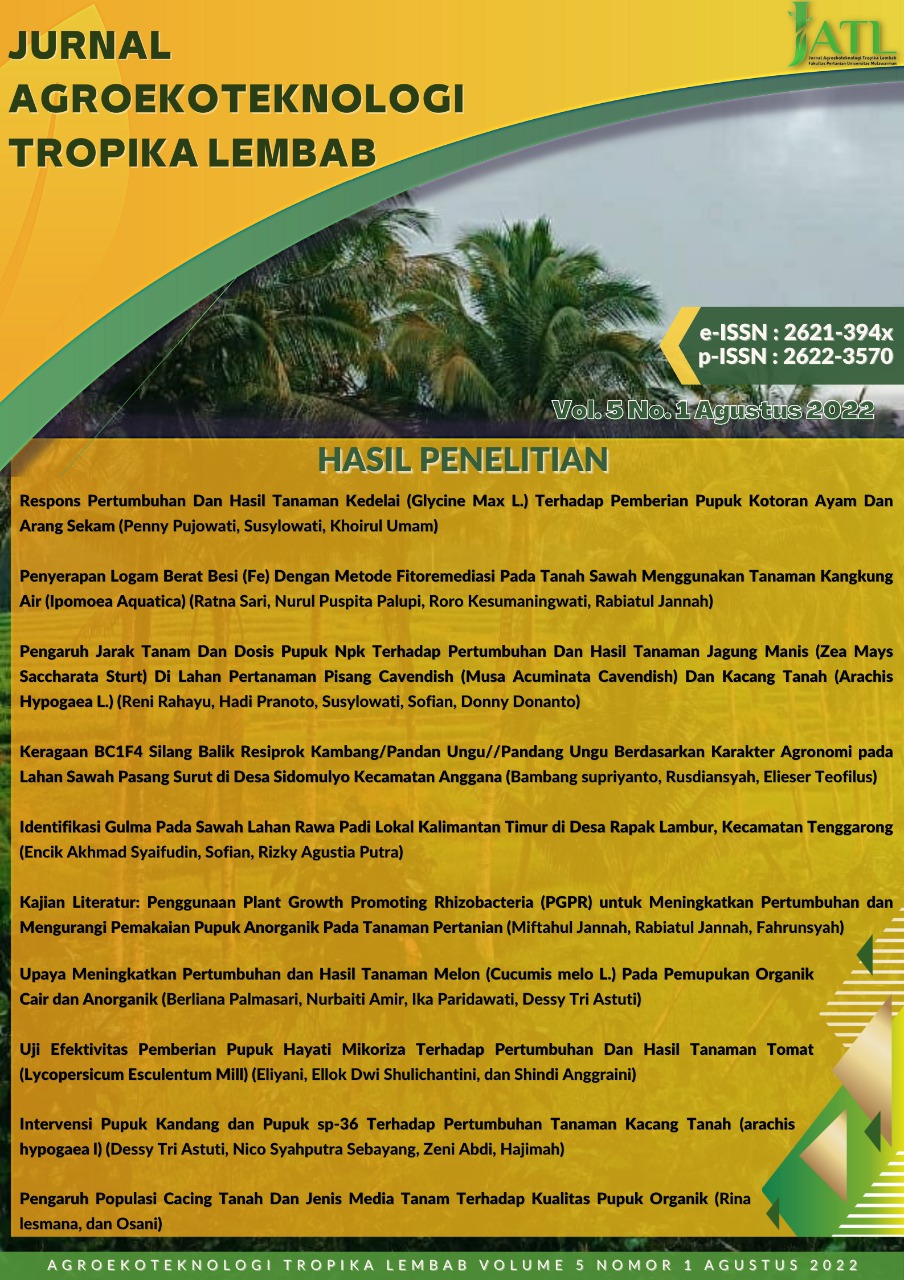
Upaya Meningkatkan Pertumbuhan dan Hasil Tanaman Melon (Cucumis melo L.) Dengan Pemupukan Organik Cair dan Anorganik
DOI:
https://doi.org/10.35941/jatl.5.1.2022.8017.50-55Keywords:
Melon (Cucumis melo L.), Pupuk Organik Cair, NPKAbstract
Melon banyak diminati masyarakat ditentukan oleh penampilan dan kualitas rasa. Kebutuhan melon tidak diimbangi denganproduksinya.Penelitian ini memiliki tujuan untuk mengetahui konsentrasi pupuk organik cair (POC) dandosis NPK bagi pertumbuhan
dan hasil tanaman melon yang optimal serta interaksi antara kedua perlakuan tersebut. Salah satu faktor keberhasilan budidaya tanaman
yaitu pemupukan yang tepat baik cara, dosis dan waktu pemberiannya. Pemupukan yang kurang dari dosis yang dibutuhkan tanaman
mengakibatkan pemenuhan akan unsur hara tidak tercapai sehingga perrumbuhan tanaman tidak optimal. Penelitian ini dilaksanakan
dari bulan Juli sampai Oktober 2020bertempat di Desa Pulau Semambu, Kecamatan Inderalaya Utara, KabupatenOganIlir, Sumatera
Selatan. Penelitian ini menggunakan desain Rancangan Acak Kelompok (RAK) Faktorial dengan 3 ulangan sehingga menghasilkan 60
petak. Faktor perlakuan adalah Pupuk Organik Cair (M), M0 = kontrol atau tanpa POC, M1 = 100 mL.L-1, M2 = 200 mL.L-1, M3 = 300
mL.L-1 dan M4 = 400 mL.L-1. Pupuk NPK (P) yaitu P0 = kontrol atau tanpa NPK, P1 = 40 g per-tanaman, P2 = 80 g per-tanaman dan P3
= 120 g per-tanaman. Variabel pengamatan pada penelitian ini yaitu Tinggi Tanaman (cm), Jumlah Daun (helai), Bobot Buah/tanaman
(kg) dan Kadar Kemanisan Buah (oBrix). Hasil penelitian menunjukkan bahwa interaksi Pupuk organik cair konsentrasi 200 mL.L-1 dan
80 g per-tanaman pupuk NPK dapat meningkatkan bobot buah per tanaman, sedangkan konsentrasi pupuk organik cair 300 mL.L-1 dan
dosis pupuk NPK 80 g per-tanaman dapat meningkatkan kadar kemanisan buah.
Downloads
References
Antarlina, S.S. 2016. Identifikasi Sifat Fisik dan Kimia Buah-Buahan Lokal Kalimantan. Buletin Plasma Nutfah 15(2): 80.
Asmawati, A and Kurnia, N. 2015. Kandungan Amonium dan Nitrat Tanah pada Budidaya Bayam Putih dengan Menggunakan Pupuk Urin Manusia. Jurnal Bionature 16(grafik rata-rata kadar amonium).
Asriyanti, SA and Hary, SB. 2017. Aplikasi Pupuk Cair MOL pada Tanaman Padi Metode Sri. Agritech 19(1): 26–34.
Badan Pusat Statistik Indonesia. 2018. BPS-Statistics Indonesia Statistik Tanaman Sayuran Dan Buah-Buahan Semusim Indonesia 2018. BPS-Statistics Indonesia. https://www.bps.go.id/publication/2019/10/07/9c5dede09c805bc38302ea1c/statistik-tanaman-sayuran-dan-buah---buahan-semusim-indonesia-2018.html.
Daryono, B.S, Purnomo, Yasir, S and Sigit, D.M. 2016. Pengembangan Sentra Budidaya Melon di Pantai Bocor Kabupaten Kebumen Melalui Implementasi Education for Sustainable Development. Bioeksperimen: Jurnal Penelitian Biologi 2(1): 44.
Ginting, AP, Barus A and Sipayung R. 2017. “Pertumbuhan Dan Produksi Melon (Cucumis melo L.) terhadap Pemberian Pupuk NPK dan Pemangkasan Buah. Jurnal Agroekoteknologi FP USU 5(4): 786–98.
Firmansyah, M.A., Nugroho, W.A dan Suparman. 2018. Pengaruh Varietas dan Paket Pemupukan pada Fase Produktif terhadap Kualitas Melon (Cucumis melo L.) di Quartzipsamments. J. Hort. Indonesia. 9(2) : 93-102
Hadi, AR. 2019. Pemanfaatan MOL (Mikroorganisme Lokal) dari Materi yang Tersedia di Sekitar Lingkungan. Agroscience (Agsci) 9(1): 93.
Milind, P and Kulwant, S. 2011. Musk Melon Is Eat-Must Melon. International Research Journal Of Pharmacy 2 : 52–57.
Nainggolan, Tiurmaida, Ramerson J Sumbayak, and Nove K Gulo, and Universitas Darma Agung. 2019. Respons Pertumbuhan dan Hasil Melon (Cucumis melo L.) terhadap Berbagai Dosis Phonska. Agrotekda 3(2): 93–102.
Sapareng, Sukriming, and Arzam, TS. 2016. Pemanfaatan Limbah Batang Pisang Sebagai Sumber Mikroorganisme Lokal (MOL) Untuk Pertumbuhan dan Produksi Cabe. Jurnal Galung Tropika 5(3).
Sondang, Y, Nelson, E and Anidarfi. 2020. Buku Ajar Praktik Fisiologi Tanaman.Bumi Aksara, Bandung.
Sudjianto, U and Krestiani, V. 2009. Studi Pemulsaan dan Dosis NPK pada Hasil Buah Melon (Cucumis melo L.). Sains dan Teknologi 2(2): 1–7.
Susilo, H.S. 2020. Budidaya Melon Golden Sistem Penyiraman Otomatis Berbasis Polybag di Desa Banjaragung Kec. Rengel Kab. Tuban. Jurnal Pengabdian Polinema Kepada Masyarakat 7(1).
Sumihar, ST. 2012. Pengaruh Pupuk Hayati dan Kompos Tandan Kosong Sawit terhadap Pertumbuhan Bibit Kelapa Sawit (Elaeis guineensis Jacq.) di Pembibitan Awal. Laporan Hasil Penelitian.
Suryanto. 2017. Pengaruh Penambahan Berbagai Jenis Mikroorganisme Lokal (MOL) Dalam Pembuatan Kompos Berbahan Baku Tandan Kosong Kelapa Sawit. Вестник Росздравнадзора 5(April).
Tiffany, F.L. 2017. Teknik Budidaya Melon (Cucumis melo L.) Secara Tabulampot, Ditaman Buah Mekarsari , Cileungsi, Jawa Barat. IPB Press : 7–10. https://www.researchgate.net/publication/315674702%0ATeknik.
Yonghua, W, Yuan, H, Minghua, X, Shasha, Y, Guozhang, K, Wei, F, Yingxin, X, Yunji, Z and Tiancai, G. 2017. Effects of the Year-Round Management Model of N , P and K Combined Application on Grain Yield and Nutrient Efficiency of Wheat-Maize Rotation System in Lime Concretion Black Soil. Scientia Agricultura Sinica 50(6): 1031–46.
Yurleni, Y. 2017. Introduksi Teknologi Komposter Berbasis MOL Pada Kelompok Wanita Tani di Desa Sebapo Kecamatan Mestong Kabupaten Muaro Jambi. Jurnal Karya Abdi Masyarakat 1(2).
Downloads
Published
Issue
Section
License
Copyright Transfer Statement
The copyright of this article is transferred to Jurnal Agroekoteknologi Tropika Lembab and when the article is accepted for publication. the authors transfer all and all rights into and to paper including but not limited to all copyrights in the JATL. The author represents and warrants that the original is the original and that he/she is the author of this paper unless the material is clearly identified as the original source, with notification of the permission of the copyright owner if necessary. The author states that he has the authority and authority to make and carry out this task.
The author states that:
This paper has not been published in the same form elsewhere.
This will not be submitted elsewhere for publication prior to acceptance/rejection by this Journal.
A Copyright permission is obtained for material published elsewhere and who require permission for this reproduction. Furthermore, I / We hereby transfer the unlimited publication rights of the above paper to Jurnal Agroekoteknologi Tropika Lembab. Copyright transfer includes exclusive rights to reproduce and distribute articles, including reprints, translations, photographic reproductions, microforms, electronic forms (offline, online), or other similar reproductions.
The author's mark is appropriate for and accepts responsibility for releasing this material on behalf of any and all coauthor. This Agreement shall be signed by at least one author who has obtained the consent of the co-author (s) if applicable. After the submission of this agreement is signed by the author concerned, the amendment of the author or in the order of the author listed shall not be accepted.
Rights / Terms and Conditions Saved
The author keeps all proprietary rights in every process, procedure, or article creation described in Work.
The author may reproduce or permit others to reproduce the work or derivative works for the author's personal use or for the use of the company, provided that the source and the JATL copyright notice are indicated, the copy is not used in any way implying the Jurnal Agroekoteknologi Tropika Lembab (JATL) approval of the product or service from any company, and the copy itself is not offered for sale.
Although authors are permitted to reuse all or part of the Works in other works, this does not include granting third-party requests to reprint, republish, or other types of reuse.