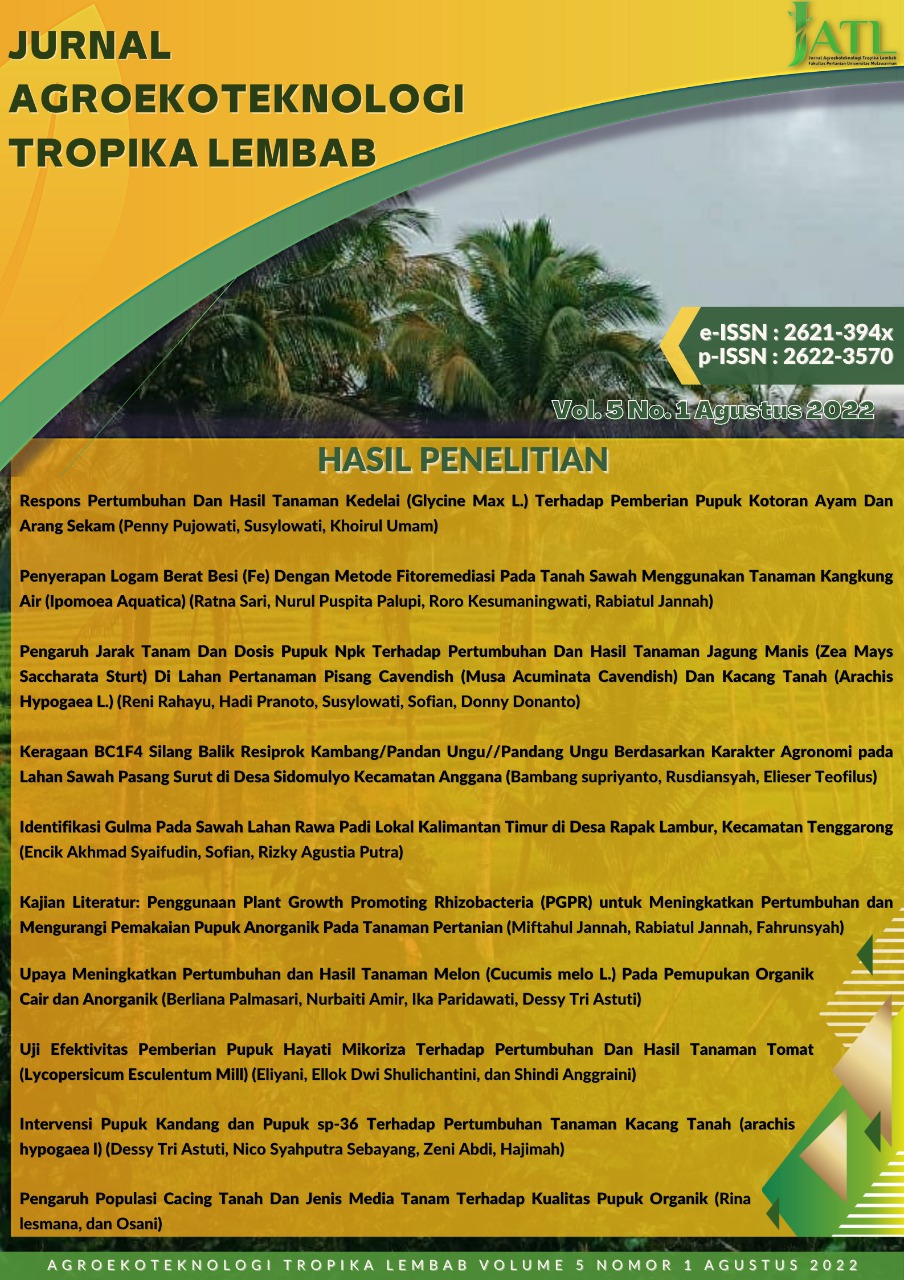
Respons Tanaman Kedelai (Glycine Max L.) Terhadap Pemberian Pupuk Kotoran Ayam dan Arang Sekam
DOI:
https://doi.org/10.35941/jatl.5.1.2022.7772.1-8Keywords:
arang sekam, Glycine max L., kedelai, pupuk organik, produksiAbstract
Abstrak. Kedelai (Glycine max L.) merupakan komoditas strategis ketiga setelah padi dan jagung. Produktivitas kedelai di Kalimantan 33 Timur cenderung menurun setiap tahun. Upaya meningkatkan produksi kedelai dapat dilakukan dengan pemupukan organik dan 34 pemberian arang sekam. Pupuk kotoran ayam merupakan pupuk organik yang dapat meningkatkan unsur hara makro dan mikro, 35 memperbaiki struktur tanah, meningkatkan kapasitas tukar kation dan memacu aktivitas mikroorganisme tanah. Penambahan arang 36 sekam dapat meningkatkan kemampuan tanah dalam menyerap air dan porositas menjadi lebih baik. Tujuan penelitian untuk 37 mengetahui: 1) interaksi antara pupuk kotoran ayam dan arang sekam, 2) dosis pupuk kotoran ayam, dan 3) dosis arang sekam terhadap 38 pertumbuhan dan hasil kedelai. Penelitian dilaksanakan pada Januari-April 2020. Lokasi penelitian di Kabupaten Kutai Kartanegara, 39 Kalimantan Timur. Penelitian disusun dalam rancangan acak kelompok dengan tiga ulangan. Faktor pertama adalah pupuk kotoran ayam (A) terdiri atas 4 taraf, yaitu a0= 0 Mg ha-1 , a1= 10 Mg ha-1 , a2= 20 Mg ha-1 , dan a3= 30 Mg ha-1 40 . Faktor kedua yaitu arang sekam padi (S) terdiri atas 3 taraf, yaitu s1= 2,50 Mg ha-1 , s2= 5,0 Mg ha-1 , s3= 7,5 Mg ha- 41 1. Data dianalisis dengan sidik ragam, dilanjutkan 42 dengan uji Beda Nyata Terkecil pada taraf 5%, serta uji Orthogonal Polinomial. Hasil penelitian menunjukkan tidak terjadi interaksi antara pupuk kotoran ayam dan arang sekam. Dosis pupuk kotoran ayam terbaik yaitu 30 Mg ha 43 -1 menghasilkan biji kering kedelai sebesar 2,14 kw ha-1 44 . Dosis arang sekam belum berpengaruh nyata terhadap hasil biji kering kedelai. Aplikasi arang sekam menghasilkan biji kering kedelai berkisar antara 1,69-1,85 kw ha-1 45 .Downloads
References
Agbede, T. M., Ojeniyi, S. O., Awodun, M. A., Giwa, R., Owo, P., State, O., & Management, P. (2008). Effect of tillage method on growth, grain yield
and nutrient content of sorghum. International Journal of Sustainable Crop Production, 3(August), 35–39.
Amrullah, A., Sopandie, D., Sugianta, S., & Junaedi, A. (2014). Peningkatan Produktivitas Tanaman Padi (Oryza sativa L.) melalui Pemberian Nano
Silika Increased Productivity of Rice Plants (Oryza sativa L.) through The Application of Nano Silica. JURNAL PANGAN.
Dutta, M. J. (2017). Innovation, Technology, and Development. 57–81. https://doi.org/10.1007/978-981-10-3051-2_3
Handayani, T. (2006). PEMBIBITAN SECARA STEK-MINI TANAMAN MELATI [Jasminum sambac (L.) Aiton]. Sains Dan Teknologi Indonesia, 8,
21–26.
Hasanah, U. (2009). Respon Tanaman Tomat (lycopersicum esculentum Mill) Pada awal Pertumbuhan Terhadap Keragaman ukuran Agregat Entisol.
J.Agroekoteknologi Tropika Lembab Umam, K. et al.
Jurnal Agroland, 16(2), 103–109.
Ismayasari, A. A., Wahyuningsih, & Paramita, O. (2014). Studi Eksperimen Pembuatan Enting-Enting Dengan Bahan Dasar Kedelai Sebagai Bahan
Pengganti Kacang Tanah. Food Science and Culinary Education Journal, 1(1), 56–64.
Mahfudz, M., Isnaini, I., & Moko, H. (2006). Pengaruh Zat Pengatur Tumbuh Dan Media Tanam Terhadap Pertumbuhan Stek Pucuk Merbau. Jurnal
Penelitian Hutan Tanaman, 3(1), 25–34. https://doi.org/10.20886/jpht.2006.3.1.25-34
Marlina, N., Aminah, R. I. S., Rosmiah, & Setel, R. L. (2015). Aplikasi Pupuk Kandang Kotoran Ayam pada Tanaman Kacang Tanah (Arachis Hypogeae
L.). Biosaintifika: Journal of Biology & Biology Education, 7(2), 136–141. https://doi.org/10.15294/biosaintifika.v7i2.3957
Meitasari, A. D., & Wicaksono, K. P. (2017). Inokulasi rhizobium dan perimbangan nitrogen pada tanaman kedelai ( Glycine max ( l ) merrill ) varietas
Wilis inoculation of rhizobium and nitrogen equalization on soybean ( Glycine max ( L ) Merrill ) varieties Wilis. PLANTROPICA Journal of
Agricultural Science, 2(1), 55–63.
Nenobesia, D., Mellab, W., & A, P. S. (2017). Pemanfaatan Limbah Padat Kompos Kotoran Ternak dalam Meningkatkan Daya Dukung Lingkungan dan
Biomassa Tanaman Kacang Hijau (Vigna radiata L.). Jurnal Pangan.
Nurul, mas’ud waqiah. (2013). Budidaya padi sawah bukaan baru. In Badan Penelitian dan Pengembangan Pertanian Kementerian pertanian (Vol. 53,
Issue 9).
Pardal, S. J. (2016). Evaluasi Galur Kedelai Transgenik Toleran Aluminium pada Fasilitas Uji Terbatas Evaluation for Tolerance of Transgenic Soybean
Lines to. Penelitian Pertanian Tanaman Pangan, 35(2), 155–162.
Rahmianna, A. A., Pratiwi, H., & Harnowo, D. (2015). Budidaya Kacang Tanah. Monograf Balitkabi, 13, 134–169.
Salam, A. K. (2020). Ilmu Tanah. In Akademika Pressindo.
Suyamto, S., Taufiq, A., & Marwoto, M. (2012). Potensi Pengembangan Tanaman Kedelai di Perkebunan Kelapa Sawit. Jurnal Penelitian Dan
Pengembangan Pertanian, 31(4), 30922.
Timur, B. P. S. K. (2019). Statistik Sayur-Sayuran dan Buah-Buahan Provinsi Kalimantan Timur 2019 1 (1st ed., Issues 1–19). Badan Pusat Statistik
Provinsi Kalimantan Timur.
Widiyaningrum, P., & Lisdiana. (2015). EFEKTIVITAS PROSES PENGOMPOSAN SAMPAH DAUN DENGAN TIGA SUMBER AKTIVATOR
BERBEDA Priyantini Widiyaningrum dan Lisdiana. Rekayasa, 13 (2)(19), 107–113.
Downloads
Published
Issue
Section
License
Copyright Transfer Statement
The copyright of this article is transferred to Jurnal Agroekoteknologi Tropika Lembab and when the article is accepted for publication. the authors transfer all and all rights into and to paper including but not limited to all copyrights in the JATL. The author represents and warrants that the original is the original and that he/she is the author of this paper unless the material is clearly identified as the original source, with notification of the permission of the copyright owner if necessary. The author states that he has the authority and authority to make and carry out this task.
The author states that:
This paper has not been published in the same form elsewhere.
This will not be submitted elsewhere for publication prior to acceptance/rejection by this Journal.
A Copyright permission is obtained for material published elsewhere and who require permission for this reproduction. Furthermore, I / We hereby transfer the unlimited publication rights of the above paper to Jurnal Agroekoteknologi Tropika Lembab. Copyright transfer includes exclusive rights to reproduce and distribute articles, including reprints, translations, photographic reproductions, microforms, electronic forms (offline, online), or other similar reproductions.
The author's mark is appropriate for and accepts responsibility for releasing this material on behalf of any and all coauthor. This Agreement shall be signed by at least one author who has obtained the consent of the co-author (s) if applicable. After the submission of this agreement is signed by the author concerned, the amendment of the author or in the order of the author listed shall not be accepted.
Rights / Terms and Conditions Saved
The author keeps all proprietary rights in every process, procedure, or article creation described in Work.
The author may reproduce or permit others to reproduce the work or derivative works for the author's personal use or for the use of the company, provided that the source and the JATL copyright notice are indicated, the copy is not used in any way implying the Jurnal Agroekoteknologi Tropika Lembab (JATL) approval of the product or service from any company, and the copy itself is not offered for sale.
Although authors are permitted to reuse all or part of the Works in other works, this does not include granting third-party requests to reprint, republish, or other types of reuse.