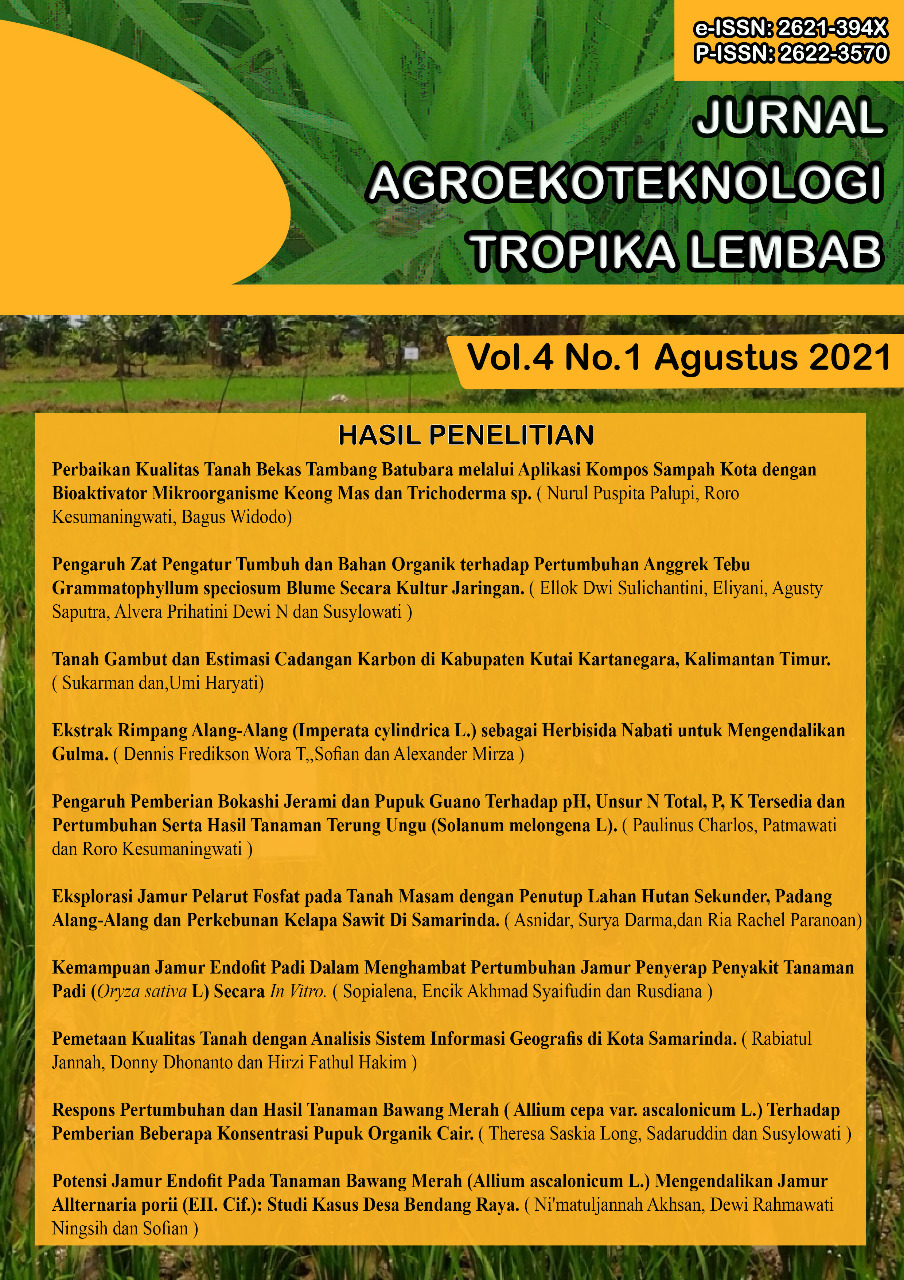
Ekstrak Rimpang Alang-Alang (Imperata cylindrica L.) sebagai Herbisida Nabati untuk Mengendalikan Gulma
DOI:
https://doi.org/10.35941/jatl.4.1.2021.5793.%25pKeywords:
Imperata cylindrica L., Ageratum conyzoides, Eleusin indica, Cyperus rotundus L, dan kematian gulma.Abstract
Ekstrak Rimpang Alang-alang (Imperata cylindrical L) Sebagai Herbisida Nabati Untuk Mengendalikan Gulma. Tujuan penelitian untuk mengetahui ekstrak rimpang alang-alang (Imperata cylindrica L.) mampu mengendalikan gulma Ageratum conyzoides, gulma Eleusin indica, dan gulma Cyperus rotundus L dan Mengetahui konsentrasi yang sesuai untuk mengendalikan gulma Ageratum conyzoides, gulma Eleusin indica, dan gulma Cyperus rotundus L. Penelitian ini dilaksanakan pada bulan Juni sampai dengan bulan Agustus 2019, menggunakan Rancangan Acak Kelompok dengan 5 perlakuan (kontrol, 20 ml, 25 ml, 30 ml dan 35ml) dan 6 ulangan. Proses pengaplikasian herbisida dilakukan setiap 3 hari sekali pada pukul 07:30 WITA dengan volume penyemprotan sebanyak 250 ml tiap polybag. Pengambilan data dilakukan setiap 3 hari sekali sampai mendapatkan 10 data pengamatan. Data yang diperoleh dianalisis dengan menggunakan sidik ragam dan jika terdapat perbedaan yang nyata maka akan dilanjutkan dengan uji Beda Nyata Terkecil (BNT) pada taraf 5%. Metode analsisnya dilanjutkan dengan menghitung persentase kematian gulma.Hasil penelitian menunjukan bahwa tingkat kematian terendah terdapat pada perlakuan t1 (20ml) dan kematian tertinggi terdapat pada perlakuan t4 (35ml).Hal ini disebabkan karena tingginya konsentrasi herbisida yang digunakan untuk mengendaliakan gulma Ageratum conyzoides, gulma Eleusin indica, dan gulma Cyperus rotundus L.Downloads
References
Barus, E. 2003. Pengendalian Gulma di Perkebunan. Yogyakarta : Kanisius.
Centre for Agriculture and Biosciences. 2018. Ageratum conyzoides (Billy Goat Weed) diakses http://www.cabi.org/isc/datasheet/28580pada tanggal 20
Maret 2018.
Dalimartha, Setiawan. 2006. Atlas Tumbuhan Obat Indonesia Jilid 2. Jakarta: Trubus Agriwidya Anggota Ikapi.
Hall, D.W., V.V. Vandiver, and J.A. Ferrell. 2009. Purple nutsedge, Cyperus rotundus L. University of Florida : SP37.
Hudzaifah,Abu,2008. Pengendalian Gulma, Hama dan Penyakit Pada Kedelai http://abumutsanna.wordpress.com/; di akses tanggal 9 April 2013.
Kamsurya, M. Y. (2014). Dampak Alelopati Ekstrak Daun Alang-alang (Imperata cylindrica) Terhadap Pertumbuhan dan Perkembangan Tanaman
Kacang Tanah (Arachis hypogaea L.). Ambon: Universitas Pattimura Ambon.
Lee, L. J. dan Ngim J. 2000. Control of Asystasia intrusa (BI) In Pineapple with Emphasis on New Techniques. Papper presented at the Seminar and
Discussion on the Weed Asystasia, West Johore Agric. Dev. Project, Pontian, 16 pp.
Martiana, F. 2018. Potensi Alelokimia Ekstrak Rimpang Alang-Alang (Imperata cylindrica L) untuk Mengendalikan Gulma Bandotan (Ageratum
conyzoidez).Skripsi.Universitas Sanata Dharma Yogyakarta.
Nasution, A. 1983. Aplikasi Beberapa Dosis Herbisida Glifosat dan Parquat pada Sistem Tanpa Olah Tanah (TOT) serta Pengaruhnya terhadap Sifat Kimia
Tanah, Karakteristik Gulma dan Hasil kedelai. Jurnal Agrista. 16 (3) : 135-145.
Plantamor. 2011. Babandotan (Ageratum conyzoides). Diakses pada tanggal 20 Maret 2019.
Rismunandar. 1986. Mendayagunakan Tanaman Rumput.Bandung : PT.Pradnya Paramita.
Sari, V. I., Nanda, S., & Sinuraya, R. (2017). Bioherbisida Pra Tumbuh Alang-alang (Imperata cylindrica) untuk Pengendalian Gulma di Perkebunan
Kelapa Sawit. Citra Widya Edukasi.
Sastroutomo, S. S. 1990. Ekologi Gulma. PT Gramedia Pustaka Utama. Jakarta.
Sembodo, D.R.J. 2010. Gulma dan Pengelolaannya.Yogyakarta (ID) : Graha Ilmu.
Sofiati, Nurul, dkk. 2011. Pengendalian Gulma pada Tanaman Kedelai (Glycinemax L.)Makalah.Diakses pada tanggal 27 April
http://cophierastafaras.blogspot.com/.diakses pada tanggal 28 Februari 2019.
Steenis,Van. 1957. Flora untuk Sekolah di Indonesia. Bandung : PT. Pradnya Paramita.
Steenis, Van. 1981. Flora. Cetakan Ketiga. Diterjemahkan oleh JUrusan Botani Universitas Gajah Mada. Jakarta: Pradnya Paramita.
Supriadi, H., & Tjahjana, B. E. (2014). Alelopati pada POla Tanam Kopi dan Teknik Pengendalian serta Prospek Pemanfaatannya.Balai Penelitian
Tanaman Industri dan Penyegar.
Titrosoepomo, G. 1985. Morfologi Tumbuhan. Yogyakarta : Gajah Mada University Press.
Tjitrosoepomo, G. 2007. Morfologi Tumbuhan.Yogyakarta : Gadjah Mada University Press.
Wijayakusuma, H. 1993. Tanaman Berkhasiat Obat di Indonesia. Jakarta : Pustaka Kartini.
Yanti, M., Indriyanto, & Duryat. (2016). Pengaruh Zat Alelopati dari Alang-Alang Terhadap Pertumbuhan Semai Tiga Spesies Akasia.
Willcox, V. D. 2012. Weed Survey-Southern States Grass Subsection. Proc South Weed Sci. Soc. 57 (3): 420-423.
Downloads
Published
Issue
Section
License
Copyright Transfer Statement
The copyright of this article is transferred to Jurnal Agroekoteknologi Tropika Lembab and when the article is accepted for publication. the authors transfer all and all rights into and to paper including but not limited to all copyrights in the JATL. The author represents and warrants that the original is the original and that he/she is the author of this paper unless the material is clearly identified as the original source, with notification of the permission of the copyright owner if necessary. The author states that he has the authority and authority to make and carry out this task.
The author states that:
This paper has not been published in the same form elsewhere.
This will not be submitted elsewhere for publication prior to acceptance/rejection by this Journal.
A Copyright permission is obtained for material published elsewhere and who require permission for this reproduction. Furthermore, I / We hereby transfer the unlimited publication rights of the above paper to Jurnal Agroekoteknologi Tropika Lembab. Copyright transfer includes exclusive rights to reproduce and distribute articles, including reprints, translations, photographic reproductions, microforms, electronic forms (offline, online), or other similar reproductions.
The author's mark is appropriate for and accepts responsibility for releasing this material on behalf of any and all coauthor. This Agreement shall be signed by at least one author who has obtained the consent of the co-author (s) if applicable. After the submission of this agreement is signed by the author concerned, the amendment of the author or in the order of the author listed shall not be accepted.
Rights / Terms and Conditions Saved
The author keeps all proprietary rights in every process, procedure, or article creation described in Work.
The author may reproduce or permit others to reproduce the work or derivative works for the author's personal use or for the use of the company, provided that the source and the JATL copyright notice are indicated, the copy is not used in any way implying the Jurnal Agroekoteknologi Tropika Lembab (JATL) approval of the product or service from any company, and the copy itself is not offered for sale.
Although authors are permitted to reuse all or part of the Works in other works, this does not include granting third-party requests to reprint, republish, or other types of reuse.