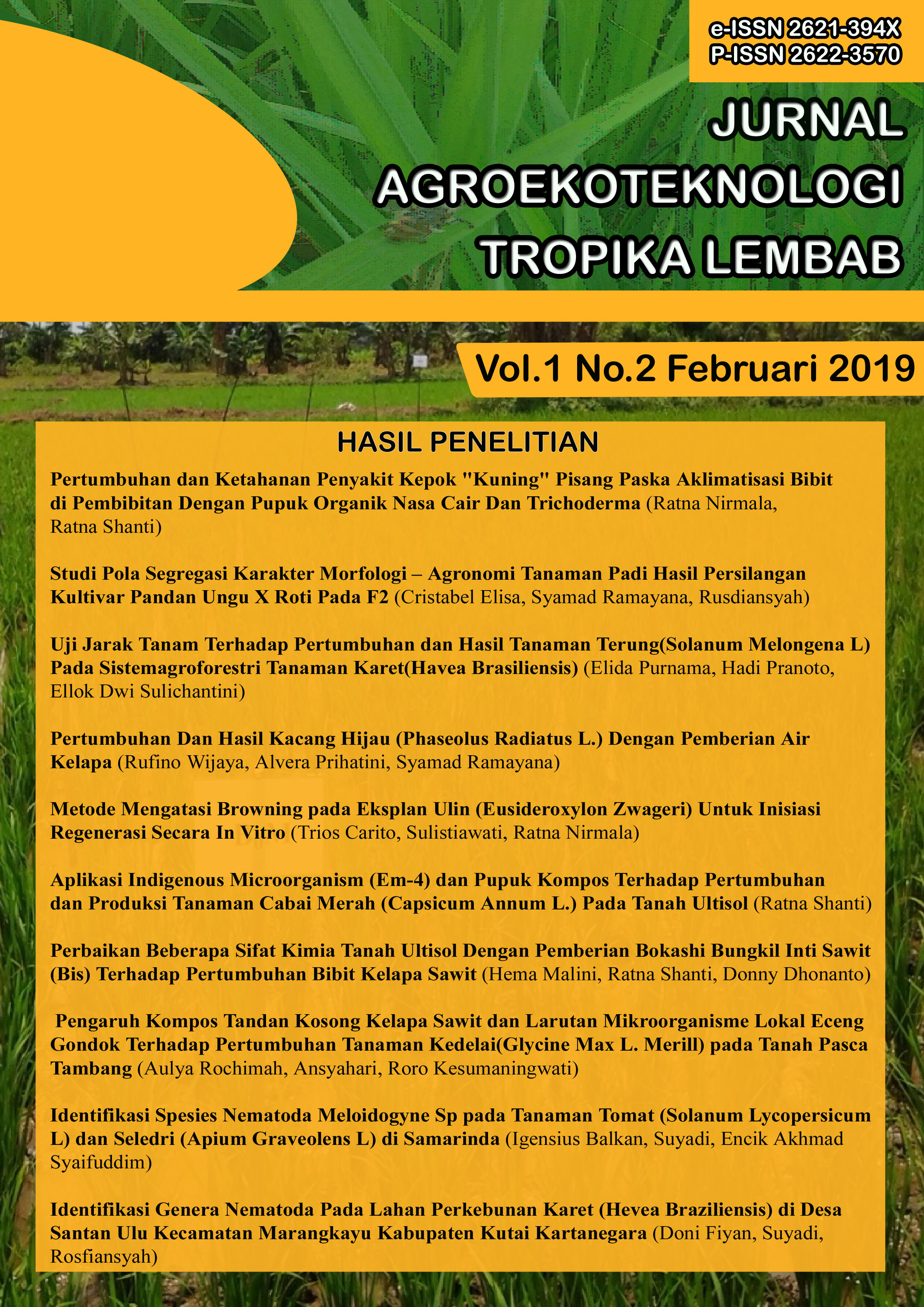
Pertumbuhan dan Ketahanan Penyakit Kepok "Kuning" Pisang Paska Aklimatisasi Bibit di Pembibitan dengan Pupuk Organik Nasa Cair dan Trichoderma
DOI:
https://doi.org/10.35941/jatl.1.2.2019.1982.77-87Keywords:
Growth Disease Resistance, Banana Post Acclimatization Seedling, Nursery, Nasa, TrichodermaAbstract
Several years ago at 2000 Kepok “Yellow” Banana plantation in East Kalimantan was attached disease, so that the production was decrease therefor in vitro propogation was a preferred a n alternative method. The aim of this study was to knew the growth and disease resistance of Kepok “Yellow” Banana post acclimatization seedling in nursery giving trichoderma as a biological control technique. This study was conducted in April until July 2018 in Samarinda. The completely randomized factorial was used as experiemental design with two factor ie: giving trichoderma (T) consist two level : with trichoderma (T1) and without trichoderma (T0), another factor ie : giving Nasa liquid organic fertilizer (N), consist four level : N0 (0 ml/l water); N1 (2 ml/l water); N2 (4 ml/l water); N3 (6 ml/l water). So that became 8 treatments, each treatment were repeated for five times.The total population were 40 polybags. Each polybags was planted 1 seedling after post acclimatization healthy and strong. The parameter observed were increase of plant hight, number of leaves, length of the longest leaves, width of the widest of leaves and diameter of stem. Observation the parameter was every two weeks, except diameter of stem, wich was only the end of observation. Polybag was filled with a mixture of top soil and goat manure with ratio 4:1. Trichoderma treatment T1 by providing trichoderma agent in mixture top soil. Treatment was done before the seedling planted in the polybag. The treatment of Nasa was done one for week. The result of research showed that the growth of banana seedling have significant different to the treatment of Nasa liquid organic fertilizer, wich was the best concentration N1 (Nasa 2 ml/liter of water. The effect of interaction giving Trichoderma and Nasa, to almost the all of growth parameter were not significant different, except in increase the length of leaves. Al trought it have tendency T1N1 the best effect to the growth of all observation. The proves that the Kepok “Yellow” Banana seedling from tissue culture were fertile growing and healthy without disease attack. Except in treatment without trichoderma on the end observation.Several years ago at 2000 Kepok “Yellow” Banana plantation in East Kalimantan was attached disease, so that the production was decrease therefor in vitro propogation was a preferred a n alternative method. The aim of this study was to knew the growth and disease resistance of Kepok “Yellow” Banana post acclimatization seedling in nursery giving trichoderma as a biological control technique. This study was conducted in April until July 2018 in Samarinda. The completely randomized factorial was used as experiemental design with two factor ie: giving trichoderma (T) consist two level : with trichoderma (T1) and without trichoderma (T0), another factor ie : giving Nasa liquid organic fertilizer (N), consist four level : N0 (0 ml/l water); N1 (2 ml/l water); N2 (4 ml/l water); N3 (6 ml/l water). So that became 8 treatments, each treatment were repeated for five times.The total population were 40 polybags. Each polybags was planted 1 seedling after post acclimatization healthy and strong. The parameter observed were increase of plant hight, number of leaves, length of the longest leaves, width of the widest of leaves and diameter of stem. Observation the parameter was every two weeks, except diameter of stem, wich was only the end of observation. Polybag was filled with a mixture of top soil and goat manure with ratio 4:1. Trichoderma treatment T1 by providing trichoderma agent in mixture top soil. Treatment was done before the seedling planted in the polybag. The treatment of Nasa was done one for week. The result of research showed that the growth of banana seedling have significant different to the treatment of Nasa liquid organic fertilizer, wich was the best concentration N1 (Nasa 2 ml/liter of water. The effect of interaction giving Trichoderma and Nasa, to almost the all of growth parameter were not significant different, except in increase the length of leaves. Al trought it have tendency T1N1 the best effect to the growth of all observation. The proves that the Kepok “Yellow” Banana seedling from tissue culture were fertile growing and healthy without disease attack. Except in treatment without trichoderma on the end observation.Downloads
References
George, EF., dan PD Sherrington. 1984. Plant Propogation by Tissue Culture In Practice, (Part I dan II). Exegetics Limited. England.
Gusnawaty, H. S., Taufik, M., Triana, L., Asniah. 2014. Karakterisasi Morfologis Trichoderma spp. Indigenus Sulawesi Tenggara. Jurnal Agroteknos, vol. 4 No. 2, Hal 87-93.
Heddy, S. 1996. Hormon Tumbuhan. Raja Grafindo Persada. Jakarta.
Shanti, R. 2015. Klasifikasi Tanah dan Sistem Lahan. Fakultas Pertanian Universitas Mulawarman. Samarinda.
Shofiyani, A dan G.P. Budi. 2013. Spesies Unggul Trichoderma spp Indegenus Rizozfir Pisang sebagai pengendali Penyakit Layu Fusarium Pada Tanaman pisang Mas Hasil Kultur In Vitro. Yurnal Agritech :Vol XV NO 2 Desember 2013 : 25 – 40.
Wareing, P. F dan I. D. J. Phillips. 1981. Growth and Differentiation In Plant. Pergamen Press. LED. England.
Wattimena, G. A. 1988. Zat Perangsang Tumbuh Tanaman. PAU-IPB. Bogor.
Downloads
Published
Issue
Section
License
Copyright Transfer Statement
The copyright of this article is transferred to Jurnal Agroekoteknologi Tropika Lembab and when the article is accepted for publication. the authors transfer all and all rights into and to paper including but not limited to all copyrights in the JATL. The author represents and warrants that the original is the original and that he/she is the author of this paper unless the material is clearly identified as the original source, with notification of the permission of the copyright owner if necessary. The author states that he has the authority and authority to make and carry out this task.
The author states that:
This paper has not been published in the same form elsewhere.
This will not be submitted elsewhere for publication prior to acceptance/rejection by this Journal.
A Copyright permission is obtained for material published elsewhere and who require permission for this reproduction. Furthermore, I / We hereby transfer the unlimited publication rights of the above paper to Jurnal Agroekoteknologi Tropika Lembab. Copyright transfer includes exclusive rights to reproduce and distribute articles, including reprints, translations, photographic reproductions, microforms, electronic forms (offline, online), or other similar reproductions.
The author's mark is appropriate for and accepts responsibility for releasing this material on behalf of any and all coauthor. This Agreement shall be signed by at least one author who has obtained the consent of the co-author (s) if applicable. After the submission of this agreement is signed by the author concerned, the amendment of the author or in the order of the author listed shall not be accepted.
Rights / Terms and Conditions Saved
The author keeps all proprietary rights in every process, procedure, or article creation described in Work.
The author may reproduce or permit others to reproduce the work or derivative works for the author's personal use or for the use of the company, provided that the source and the JATL copyright notice are indicated, the copy is not used in any way implying the Jurnal Agroekoteknologi Tropika Lembab (JATL) approval of the product or service from any company, and the copy itself is not offered for sale.
Although authors are permitted to reuse all or part of the Works in other works, this does not include granting third-party requests to reprint, republish, or other types of reuse.