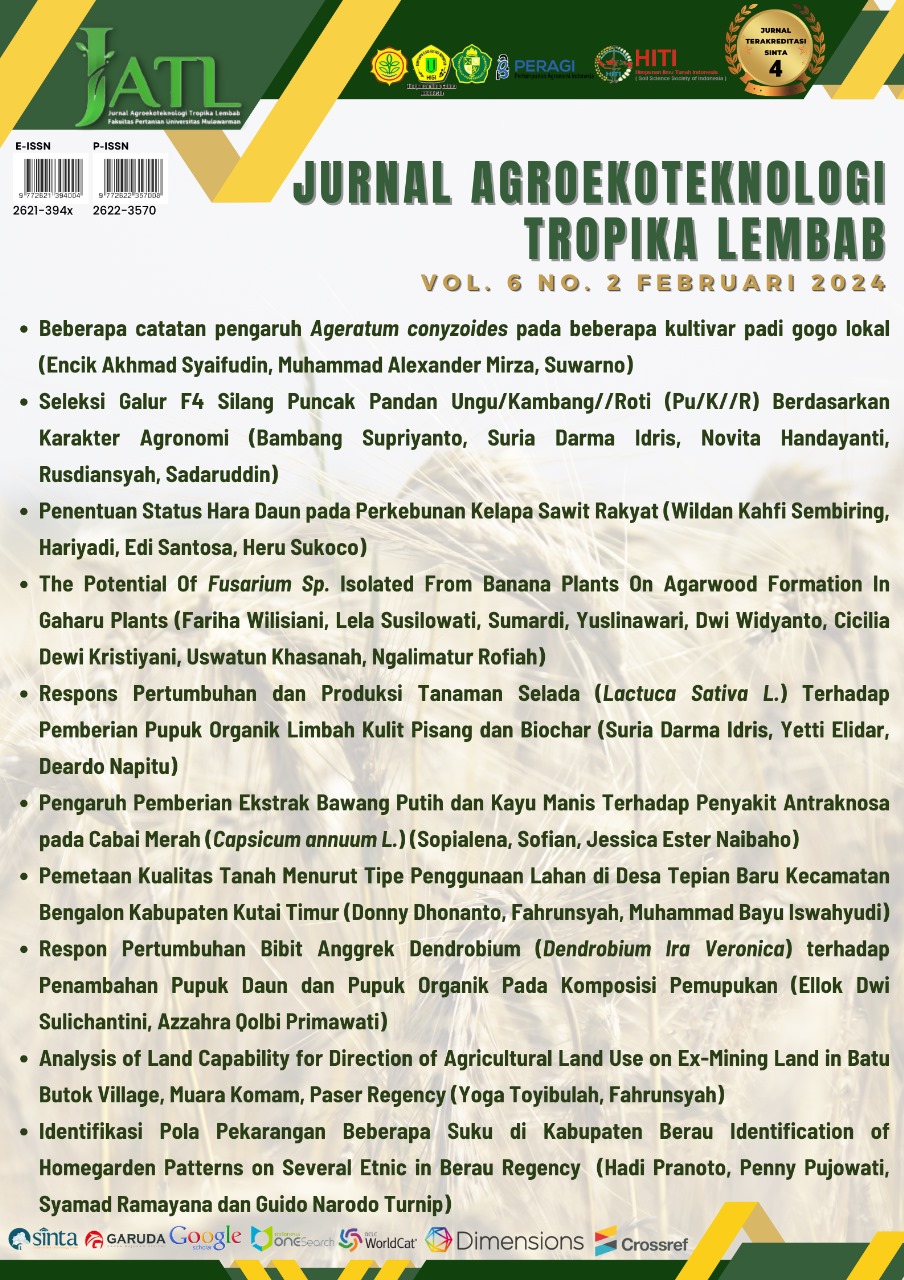
Identification of Homegarden Patterns on Several Etnic in Berau Regency
DOI:
https://doi.org/10.35941/jatl.6.2.2024.14060.61-67Keywords:
Pekarangan, Berau, Nilai Ekonomi, KeberlanjutanAbstract
Pekarangan menjadi bagian warisan budaya bangsa Indonesia sebab praktik pemanfaatannya sangat berkaitan dengan kultur Bangsa Indonesia yaitu bercocok tanam. Pemanfaatan pekarangan sebagai lahan untuk budidaya tanaman, ikan dan ternak sangat berperan dalam membantu meningkatkan nilai ekonomi rumah tangga, fungsi sosial budaya dan kemasyarakatan. Tujuan penelitian ini adalah untuk: 1) Mengetahui komponen penyusun pekarangan; 2) Mengetahui pola pengelolaan pekarangan dan nilai sosial ekonominya; 3) Mengetahui tingkat keberlanjutan pekarangan beberapa suku di Kabupaten Berau Propinsi Kalimantan Timur. Penelitian dilaksanakan pada Bulan Maret-Mei 2023, di Kelurahan Gunung Tabur, Kecamatan Gunung Tabur, Kabupaten Berau. Pengambilan sampel untuk data primer dilakukan secara purposive sampling dengan memilih 40 responden. Metode pengumpulan data melalui wawancara dan observasi, sedangkan data sekunder didapatkan dari desa dan dinas terkait di Kabupaten Berau Propinsi Kalimanta Timur. Hasil penelitian menunjukkan 1) Terdapat perbedaan komponen penyusun pekarangan. Jumlah komponen terbesar terdapat pada pekarangan Suku Toraja (59 jenis), selanjutnya Suku Jawa (56 jenis), Bugis (51 jenis) dan Berau (40). Komponen ternak, komponen terbesar terdapat pada suku Toraja (4 jenis), Bugis (4 jenis), Jawa (2 jenis) dan Berau (1 jenis), sedangkan pekarangan Suku Berau lebih didominasi tanaman hias. 2) Pola pekarangan dominan adalah pola agrosilvopastura, pola ini juga banyak ditemukan pada Suku Toraja (50%). 3) Secara umum tingkat keberlanjutan pekarangan berdasarkan Nilai Indeks Keberlanjutan tertinggi adalah pekarangan Suku Toraja (3), Suku Jawa (2,66), Bugis (2,33) dan Berau (2,00). Nilai Indeks Keberlanjutan Pekarangan adalah 2,50 dengan kategori Tingkat Keberlanjutan Sedang.Downloads
References
Aditiameri, A., Susilastuti, D., & Darmansyah, E. 2021. Analisis Pemanfaatan Pekarangan Berdasarkan Strata Luas di Kelurahan Kalisari Jakarta Timur. AGRISIA Jurnal Ilmu - Ilmu Pertanian, 14(1): 57–73.
Hamidah, S., Arifin, Y. F., & Fitriani, A. 2020. Studi Hasil Budidaya Secara Eksitu Beberapa Jenis Tumbuhan Obat Sebagai Pertimbangan Konsep Pengembangan Agroforestri Berbasis Tumbuhan Obat. Jurnal Hutan Tropis, 8(1): 1–15.
Idris, A. I., Arafat, A., & Fatmawati, D. 2019. Pola dan Motivasi Agroforestry Serta Kontribusinya Terhadap Pendapatan Petani Hutan Rakyat di Kabupaten Polewali Mandar. Jurnal Hutan Dan Masyarakat, 11(2): 92–113.
Irwan, S. N. R., Handayani, V. D. S., & Ilmiah, H. H. 2023. Pekarangan Pinggir Kota untuk Menyangga Ekosistem Perkotaan: Pemanfaatannya dan Keanekaragaman Tanaman. Jurnal Ilmu Pertanian Indonesia, 28(2): 244–254.
Maulidan, Y., Sukiman, S., Sukenti, K., Julisaniah, N. I., & Kurnianingsih, R. 2022. Study of Habitat Characteristic and Ethnobotanical Aspects of Komak Beans (Fabaceae) in North Lombok Regency. Jurnal Biologi Tropis, 22(4): 1347–1360.
Oelviani, R., & Utomo, B. 2015. Sistem Pertanian Terpadu di Lahan Pekarangan Mendukung Ketahanan Pangan Keluarga Berkelanjutan: Studi Kasus di Desa Plukaran, Kecamatan Gembong, Kabupaten Pati, Jawa Tengah. Prosiding Seminar Nasional Masyarakat Biodiversitas Indonesia, 1197–1202.
Satu Data Indonesia. 2023. Data Keadaan Iklim Rata-Rata Berau Tahun 2019-2021.
Downloads
Published
Issue
Section
License
Copyright Transfer Statement
The copyright of this article is transferred to Jurnal Agroekoteknologi Tropika Lembab and when the article is accepted for publication. the authors transfer all and all rights into and to paper including but not limited to all copyrights in the JATL. The author represents and warrants that the original is the original and that he/she is the author of this paper unless the material is clearly identified as the original source, with notification of the permission of the copyright owner if necessary. The author states that he has the authority and authority to make and carry out this task.
The author states that:
This paper has not been published in the same form elsewhere.
This will not be submitted elsewhere for publication prior to acceptance/rejection by this Journal.
A Copyright permission is obtained for material published elsewhere and who require permission for this reproduction. Furthermore, I / We hereby transfer the unlimited publication rights of the above paper to Jurnal Agroekoteknologi Tropika Lembab. Copyright transfer includes exclusive rights to reproduce and distribute articles, including reprints, translations, photographic reproductions, microforms, electronic forms (offline, online), or other similar reproductions.
The author's mark is appropriate for and accepts responsibility for releasing this material on behalf of any and all coauthor. This Agreement shall be signed by at least one author who has obtained the consent of the co-author (s) if applicable. After the submission of this agreement is signed by the author concerned, the amendment of the author or in the order of the author listed shall not be accepted.
Rights / Terms and Conditions Saved
The author keeps all proprietary rights in every process, procedure, or article creation described in Work.
The author may reproduce or permit others to reproduce the work or derivative works for the author's personal use or for the use of the company, provided that the source and the JATL copyright notice are indicated, the copy is not used in any way implying the Jurnal Agroekoteknologi Tropika Lembab (JATL) approval of the product or service from any company, and the copy itself is not offered for sale.
Although authors are permitted to reuse all or part of the Works in other works, this does not include granting third-party requests to reprint, republish, or other types of reuse.