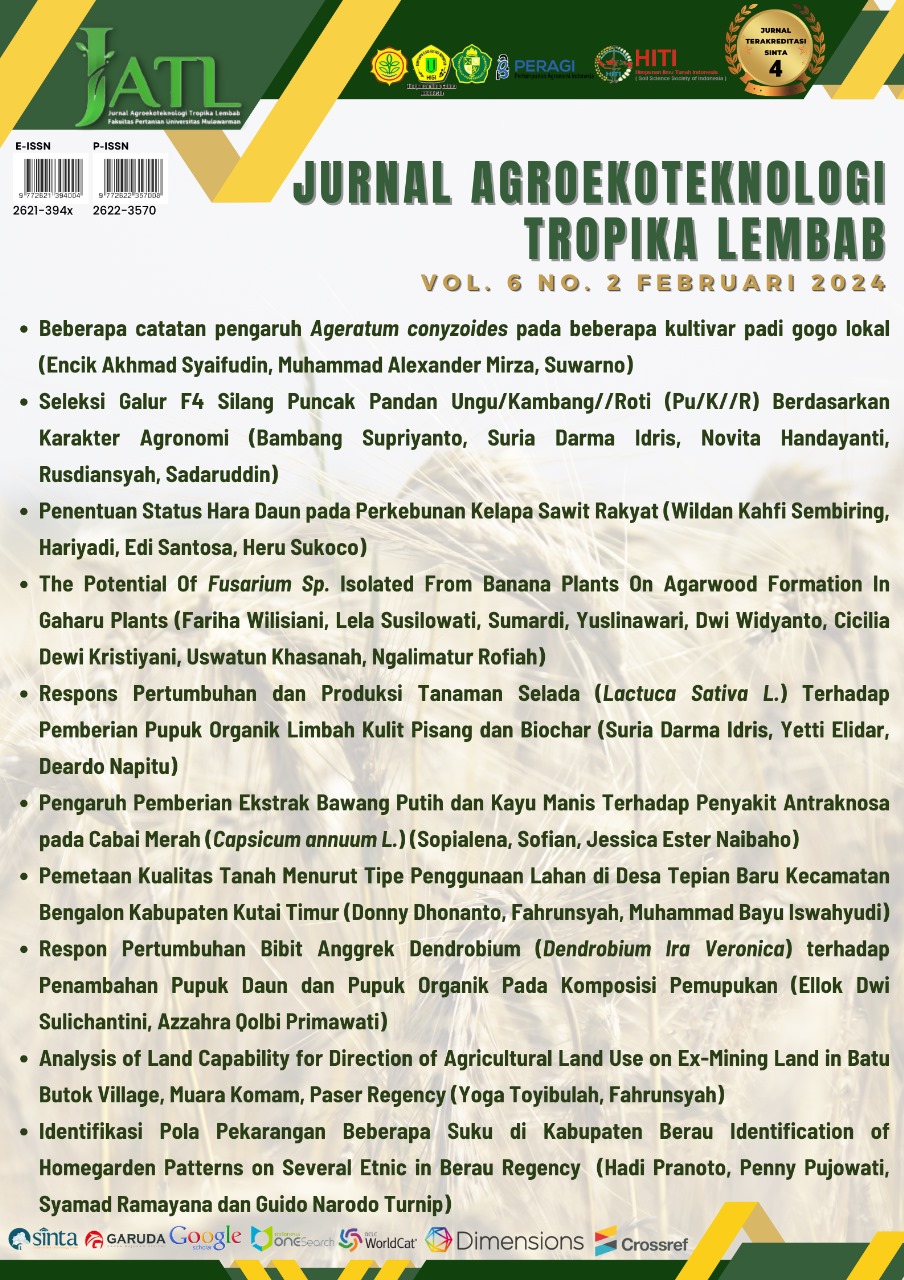
Potensi Fusarium sp. dari Tanaman Pisang sebagai Inokulan Pembentuk Gubal pada Tanaman Gaharu
DOI:
https://doi.org/10.35941/jatl.6.2.2024.14059.18-22Keywords:
Fusarium, inokulasi buatan, gaharuAbstract
Indonesia merupakan salah satu produsen gaharu terbesar di dunia dengan jumlah ekspor yang terus meningkat. Gaharu yang banyak diperdagangkan selama ini adalah gaharu yang terbentuk secara alami, sehingga berdampak pada banyaknya eksploitasi hutan alam yang tidak terkendali. Dalam budidaya tanaman penghasil gaharu, salah satu kendala yang ditemui yaitu pembentukan gaharu dengan rendemen rendah serta proses pembentukan gubal lama. Saat ini banyak dikembangkan pembentukan gaharu secara buatan dengan inokulasi Fusarium sp. untuk mempercepat pembentukan gubal. Isolat Fusarium sp. dari beberapa tanaman inangnya memiliki potensi sebagai inokulan pembentuk gubal gaharu. Dalam penelitian ini dikaji tentang inokulan Fusarium BD2 dari tanaman pisang bergejala layu Fusarium dalam pembentukan gubal gaharu. Inokulasi dilakukan dengan metode infus (kepadatan spora 106 spora mL-1) sebanyak 50 mL pada pohon gaharu yang telah dibor). Hasil inokulasi teramati adanya perubahan warna kayu gaharu di sekitar titik inokulasi. Kesimpulan penelitian ini yaitu inokulan Fusarium isolat BD2 dari tanaman pisang memiliki potensi sebagai inokulan gaharu.Downloads
References
Chen, X., Liu, Y., Yang, Y., Feng, J., Liu, P., & Sui, C. 2018. Trunk Surface Agarwood-Inducing Technique With Rigidoporus vinctus: An Efficient Novel Method For Agarwood Production. PLoS ONE, 13(6).
Chippa, H., & Kaushik, N. 2017. Keanekaragaman Jamur dan Bakteri yang Diisolasi dari Pohon dan Tanah Aquilaria malaccensis, Menginduksi Pembentukan Agarospirol Dalam Waktu 3 Bulan Setelah Infeksi Buatan. Frontier, 8:1–12.
Faizal, A., Azar, A. W. P., Azar, M., Turjaman, & Esyanti, R. R. 2020. Fusarium solani Induces The Formation Of Agarwood In Gyrinops versteegii (Gilg.) Domke Branches. Symbiosis, 81; 15–23.
Faizal, A., Esyanti, R. R., Aulianisa, E. N., Iriawati, Santoso, E., & Turjaman, T. 2017. Formation Of Agarwood From Aquilaria Malaccensis In Response To Inoculation Of Local Strains Of Fusarium solani. Trees, 31:189–197.
Herawati, C., Batubara, R., & Siregar, E. B. M. 2013. Perubahan Kimia Kayu Pada Gubal Gaharu (Aquilaria malaccensis Lamk.) Hasil Rekayasa. Peronema Forestry Science Journal, 2: 117–125.
Irfandi, F. 2017. Inokulasi Cendawan Fusarium sp. Dari Berbagai Tanaman Inang Dan Diameter Batang Terhadap Pembentukan Kemedangan Gaharu Jenis Gyrinophs versteegii. Jurnal Agroekoteknologi, 10: 13–20.
Iskandar, D., & Suhendra, A. 2012. Uji Inokulasi Fusarium sp. Untuk Produksi Gaharu Pada Budidaya A. beccariana. Jurnal Sains Dan Teknologi Indonesia, 14: 182–188.
Liu, Y. Y., Wei, J. H., Gao, Z. H., Zhang, Z., & Lyu, J. C. 2017. A Review Of Quality Assessment And Grading For Agarwood. China Herb Med, 9: 22–30.
Lukman, L., Dinarti, D., Siregar, U. J., Turjaman, M., & Sudarsono, S. 2023. Isolation And Molecular Identification Of Agarwood-Inducing Fungi And Their Virulence Test Using Aquilaria sp. Seedlings. Biodiversitas Journal of Biological Diversity, 24: 140–148.
Mohamed, R., Jong, P. L., & Kamziah, A. K. 2014. Fungal Inoculation Induces Agarwood In Young Aquilaria malaccensis Trees In The Nursery. J. For. Res, 25: 201–204.
Mukarlina, S. K., & Rianti, R. 2010. Uji Antagonis Trichoderma harzianum Terhadap Fusarium spp. Penyebab Penyakit Layu Pada Tanaman Cabai (Capsicum annum) Secara In Vitro. Jurnal Fitomedika, 7: 80–85.
Sangareswari, M., Parthiban, K. T., Kanna, S. U., Karthiba, L., &
Saravanakumar, D. 2016. Fungal Microbes Associated With Agarwood Formation. American Journal Plant Science, 7:1445–1452.
Santoso, E., & Wahyudi, A. 2010. Identification The Potential Types Of Fungi On Establishment Agarwood Stem Of Aquilaria spp. Journal of Tropical Silviculture, 1: 1–5.
Subasinghe, S. M. C. U. P., Hitihamu, H. I. D., & Fernando, K. M. E. P. 2018. Use Of Two Fungal Species To Induce Agarwood Resin Formation In Gyrinops walla. Journal of Forestry Research, 30: 721–726.
Wilisiani, F., Sumardi, S., & Hasibuan, A. 2020. Identifikasi Fusarium sp. Dari Tanaman Pisang Sebagai Inokulan Pembentukan Gaharu. Jurnal Pertanian Agros, 22: 253–257.
Downloads
Published
Issue
Section
License
Copyright Transfer Statement
The copyright of this article is transferred to Jurnal Agroekoteknologi Tropika Lembab and when the article is accepted for publication. the authors transfer all and all rights into and to paper including but not limited to all copyrights in the JATL. The author represents and warrants that the original is the original and that he/she is the author of this paper unless the material is clearly identified as the original source, with notification of the permission of the copyright owner if necessary. The author states that he has the authority and authority to make and carry out this task.
The author states that:
This paper has not been published in the same form elsewhere.
This will not be submitted elsewhere for publication prior to acceptance/rejection by this Journal.
A Copyright permission is obtained for material published elsewhere and who require permission for this reproduction. Furthermore, I / We hereby transfer the unlimited publication rights of the above paper to Jurnal Agroekoteknologi Tropika Lembab. Copyright transfer includes exclusive rights to reproduce and distribute articles, including reprints, translations, photographic reproductions, microforms, electronic forms (offline, online), or other similar reproductions.
The author's mark is appropriate for and accepts responsibility for releasing this material on behalf of any and all coauthor. This Agreement shall be signed by at least one author who has obtained the consent of the co-author (s) if applicable. After the submission of this agreement is signed by the author concerned, the amendment of the author or in the order of the author listed shall not be accepted.
Rights / Terms and Conditions Saved
The author keeps all proprietary rights in every process, procedure, or article creation described in Work.
The author may reproduce or permit others to reproduce the work or derivative works for the author's personal use or for the use of the company, provided that the source and the JATL copyright notice are indicated, the copy is not used in any way implying the Jurnal Agroekoteknologi Tropika Lembab (JATL) approval of the product or service from any company, and the copy itself is not offered for sale.
Although authors are permitted to reuse all or part of the Works in other works, this does not include granting third-party requests to reprint, republish, or other types of reuse.