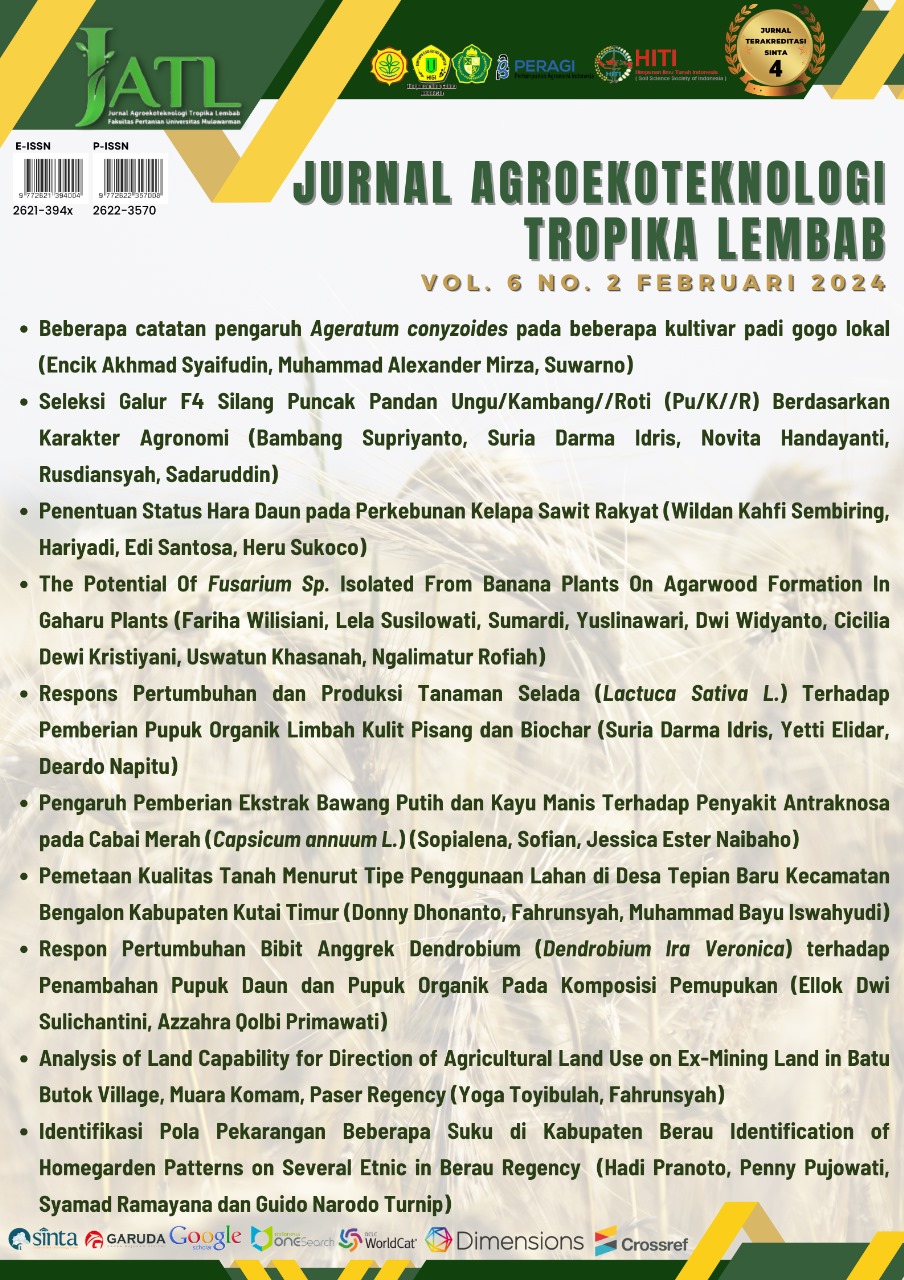
Seleksi Galur F4 Silang Puncak Pandan Ungu/Kambang//Roti (PU/K//R) Berdasarkan Karakter Agronomi
DOI:
https://doi.org/10.35941/jatl.6.2.2024.14052.6-10Keywords:
karakter agronomi, persilangan, heritabilitas, seleksiAbstract
Varietas padi lokal merupakan salah satu sumber daya genetik yang dapat dimanfaatkan dalam pemuliaan tanaman, disukai oleh masyarakat dan unggul dalam hal adaptasi terhadap lingkungan. Penelitian bertujuan untuk mengetahui penampilan karakter agronomi galur F4 hasil persilangan Pandan Ungu/Kambang//Roti (PU/K//R) pada lahan sawah tadah hujan dan memperoleh galur yang menunjukkan karakter agronomi yang sesuai kriteria seleksi serta mengetahui pengaruh faktor lingkungan terhadap karakter agronomi yang diamati. Penelitian dilaksanakan di lahan sawah tadah hujan Desa Karang Tunggal, Kecamatan Tenggarong Seberang, Kabupaten Kutai Kartanegara, Kalimantan Timur. Penelitian disusun dalam Rancangan Acak Kelompok (RAK) dengan tiga ulangan, terdiri atas 25 galur sebagai perlakuan. Data dianalisis memakai sidik ragam dan dilanjutkan dengan DMRT pada taraf 5%. Nilai heritabilitas dihitung dengan metode nilai heritabilitas dalam arti luas (h2). Parameter yang diamati meliputi: tinggi tanaman saat panen, jumlah anakan total, jumlah anakan produktif, jumlah gabah total per malai, jumlah gabah isi per malai, berat gabah per rumpun, dan berat 1.000 butir. Hasil penelitian menunjukkan terdapat perbedaan penampilan karakter agronomi tanaman padi hasil persilangan silang puncak Pandan Ungu/Kambang//Roti (PU/K//R) pada lahan sawah tadah hujan. Berdasarkan karakter agronomi dan nilai heritabilitas (h2 ˃ 0,50) diperoleh 16 galur yang berpotensi sebagai galur harapan, yaitu galur 14, 73, 88, 90, 96, 99, 104, 200, 251, 275, 287, 303, 306, 321, 373, dan 385. Ada tujuh karakter dengan nilai heritabilitas tinggi dan satu dengan nilai heritabilitas sedang.Downloads
References
Akhmadi, G, B.S Purwoko, I.S Dewi, and D Wirnas. 2017. Pemilihan Karakter Agronomi Untuk Seleksi Pada Galur-Galur Padi Dihaploid Hasil Kultur Antera. Jurnal Agronomi Indonesia 45 (1): 1–8.
Astari, R.P, Rosmayati, dan M Basyuni. 2016. Kemajuan Genetik, Heritabilitas Dan Korelasi Beberapa Karakter Agronomis Progeni Kedelai F3 Persilangan Anjasmoro Dengan Genotipe Tahan Salin. Jurnal Pertanian Tropik 3 (1): 52–61.
Astomo, A.F. 2020. Uji Daya Hasil Beberapa Galur Dan Varietas Padi Gogo (Oryza Sativa L.) Pada Tanah Ultisol. Sekolah Tinggi Ilmu Pertanian Dharma Wacana Metro, Lampung.
Azrai, M, R Efendi, Suwarti, dan R.H Praptana. 2016. Keragaman Genetik Dan Penampilan Jagung Hibrida Silang Pucak Pada Kondisi Cekaman Kekeringan. Penelitian Pertanian Tanaman Pangan 35 (3): 199–208.
Dewi, R.K, dan Wahyuni. 2020. Dasar Pemuliaan Ternak. 1st ed. Lamongan: Litbang Pemas Unisla.
IRRI. 2013. Standard Evaluation System (SES) for Rice. 5th ed.
Kristamtini, Sutarno, E.W Wiranti, dan S Widyayanti. 2016. Kemajuan Genetik Dan Heritabilitas Karakter Agronomi Padi Beras Hitam Pada Populasi F2. Penelitian Pertanian Tanaman Pangan 35 (2): 119–24.
Munazhirah. 2019. Pengendalian Hama Terpadu Keong Mas (Pomacea Canaliculata). Balai Penyuluh Pertanian (BPP), Aceh.
Nyoman, R.I. 2018. Dasar-Dasar Agronomi. 1st ed. Percetakan Pelawa Sari. Bali
Rusdiansyah, Suyadi, Sadarudin, dan A Suryadi. 2019. Karakterisasi Plasma Nutfah Padi Lokal Kalimantan Timur Sebagai Sumber Pemuliaan. Mulawarman University Press, Samarinda.
Sa’diyah, N, M Widiastuti, dan Ardian. 2013. Keragaan, Keragaman, Dan Heritabilitas Karakter Agronomi Kacang Panjang (Vigna Unguiculata) Generasi F1 Hasil Persilangan Tiga Genotipe. Jurnal Agrotek Tropika 1 (1): 32–37.
Sitinjak, H, dan Idwar. 2015. Respon Berbagai Varietas Padi Sawah (Oryza Sativa L.) Yang Ditanam Dengan Pendekatan Teknik Budidaya Jajar Legowo Dan Sistem Tegel. Jurnal JOM Faperta 2 (2): 1–15.
Syarif, A.A, dan S Zen. 2012. Adaptasi Dan Stabilitas Hasil Delapan Varietas Lokal Padi Sawah. Buletin Plasma Nutfah 18 (2): 62–69.
Syukur, M, S Sujiprihati, dan R Yunianti. 2015. Teknik Pemuliaan Tanaman. 3rd ed. Penebar Swadaya, Jakarta.
Downloads
Published
Issue
Section
License
Copyright Transfer Statement
The copyright of this article is transferred to Jurnal Agroekoteknologi Tropika Lembab and when the article is accepted for publication. the authors transfer all and all rights into and to paper including but not limited to all copyrights in the JATL. The author represents and warrants that the original is the original and that he/she is the author of this paper unless the material is clearly identified as the original source, with notification of the permission of the copyright owner if necessary. The author states that he has the authority and authority to make and carry out this task.
The author states that:
This paper has not been published in the same form elsewhere.
This will not be submitted elsewhere for publication prior to acceptance/rejection by this Journal.
A Copyright permission is obtained for material published elsewhere and who require permission for this reproduction. Furthermore, I / We hereby transfer the unlimited publication rights of the above paper to Jurnal Agroekoteknologi Tropika Lembab. Copyright transfer includes exclusive rights to reproduce and distribute articles, including reprints, translations, photographic reproductions, microforms, electronic forms (offline, online), or other similar reproductions.
The author's mark is appropriate for and accepts responsibility for releasing this material on behalf of any and all coauthor. This Agreement shall be signed by at least one author who has obtained the consent of the co-author (s) if applicable. After the submission of this agreement is signed by the author concerned, the amendment of the author or in the order of the author listed shall not be accepted.
Rights / Terms and Conditions Saved
The author keeps all proprietary rights in every process, procedure, or article creation described in Work.
The author may reproduce or permit others to reproduce the work or derivative works for the author's personal use or for the use of the company, provided that the source and the JATL copyright notice are indicated, the copy is not used in any way implying the Jurnal Agroekoteknologi Tropika Lembab (JATL) approval of the product or service from any company, and the copy itself is not offered for sale.
Although authors are permitted to reuse all or part of the Works in other works, this does not include granting third-party requests to reprint, republish, or other types of reuse.