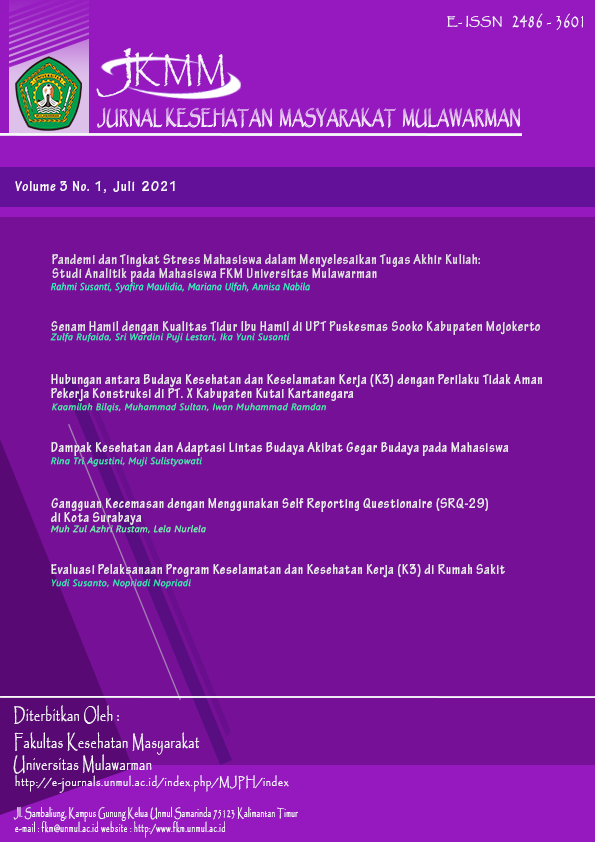
Pandemi dan Tingkat Stress Mahasiswa dalam Menyelesaikan Tugas Akhir Kuliah: Studi Analitik pada Mahasiswa FKM Universitas Mulawarman
DOI:
https://doi.org/10.30872/jkmm.v3i1.6273Keywords:
Tingkat Stres, Belajar dari Rumah, PandemiAbstract
Latar Belakang & Tujuan: Terjadinya pandemi Covid-19 mendorong pemerintah Indonesia mengambil kebijakan untuk mengalihkan aktivitas belajar dan bekerja di rumah. Hal ini menjadi perhatian bagi mahasiswa yang sedang menghadapi tugas akhir karena target dan tuntutan untuk segera lulus tepat waktu. Akibat kesulitan yang dirasakan tersebut menimbulkan perasaan negatif yang pada akhirnya dapat menyebabkan mahasiswa menunda penyusunan skripsinya. Berdasarkan permasalahan tersebut, penelitian ini bertujuan untuk mengetahui tingkat stres pada mahasiswa FKM Universitas Mulawarman yang menyusun skripsi selama belajar dari rumah di era new normal. Metode: Penelitian ini merupakan penelitian kuantitatif dengan pendekatan cross sectional dengan populasi 150 dan sampel 50. Pengambilan sampel menggunakan metode simple random sampling. Analisis data menggunakan uji Friedman. Hasil: Hasil uji Friedman Test p value 0,001 dimana nilai ini lebih kecil dari 0,05 (alpha), yang berarti terdapat perbedaan tingkat stres mahasiswa semester akhir dalam mengerjakan skripsi sebelum dan saat pandemi. Kesimpulan: Pandemi mempengaruhi tingkat stress mahasiswa/i tingkat akhir dalam mengerjakan tugas akhir sehingga diharapkan mampu mengatasi sumber stres baik internal maupun eksternal yang dihadapi selama proses penulisan skripsi.References
Ardhianti, Y., Pitriani, R., & Damayanti, I. P. (2014). Panduan Lengkap Keterampilan Dasar Kebidanan 1. Yogyakarta: Deepublish.
Cao, W., Fang, Z., Hou, G., Han, M., Xu, X., Dong, J., & Zheng, J. (2020). The psychological impact of the COVID-19 epidemic on college students in China. Psychiatry Research,287(112934). https://doi.org/10.1016/j.psychres.2020.112934
Dermawan, A. C., & Setiawati, S. (2008). Proses Pembelajaran Dalam Pendidikan Kesehatan. Jakarta: Trans Info Media.
Ducharme, L. J., Knudsen, H. K., & Roman, P. M. (2008). Emotional exhaustion and turnover intention in human service occupations: The protective role of coworker support.Sociological Spectrum, 28(1), 81–104. https://doi.org/10.1080/02732170701675268
Febriana, D., & Wahyuningsih, A. (2011). Kajian Stres Hospitalisasi Terhadap Pemenuhan Pola Tidur Anak Usia Pra-Sekolah di Ruang Anak RS Baptis Kediri. Jurnal Stikes RS. Baptis Kediri, 4(2), 66–72. Retrieved from http://puslit2.petra.ac.id/ejournal/index.php/stikes/article/
view/18429/18245
Goff, A. (2009). Stressors, Academic Performance and Learned. Universitas Carolina Utara Indrawan, D. I., Wijoyo, H., Muliansyah, D. D., Sunarsi, D.,
Lutfi, A. M., Irawati, L Handoko, A. L. (2020). Pembelajaran di Era New Normal. (N. Falahia, Ed.). CV. Pena Persada.
Kausar, R. (2010). Perceived Stress, Academic Workloads and Use of Coping Strategies by University Students. Journal of Behavioural Sciences, 20.
Kemenkes, R. I. (2020). Pedoman Pencegahan dan Pengendalian.
Mardiana, Y., & Zelfino. (2014). Hubungan Antara Tingkat Stres Lansia dan Kejadian Hipertensi pada Lansia di RW 01 Kunciran Tangerang. Forum Ilmiah, 11(2), 261–267. Retrieved from https://ejurnal.esaunggul.ac.id/index.php/Formil/article/view/881/811
Mu’tadin, Z. (2002). Kesulitan Menulis Skripsi.
Potter, & Perry. (2009). Fundamental Keperawatan (Edisi 7). Jakarta: Salemba Medika.
Purwati, S. (2012). Tingkat stres akademik pada mahaiswa regular angkatan 2010 Fakultas Ilmu Keperawatan Universitas Indonesia. FIK UI Depok.
Rachmadi, F. (2014). Pengaruh tingkat intensitas belajar terhadap terjadinya stres pada mahasiswa PSPD 2011 FKIK UIN Syarif Hidayatullah Jakarta. UIN Syarif Hidayatullah Jakarta. Retrieved from http://repository.uinjkt.ac.id/dspace/handle/123456789/25540
Savira, F., & Suharsono, Y. (2013). Self-Regulated Learning (SRL) dengan Prokrastnasi Akademik pada Siswa Akselerasi. Jurnal Ilmiah Psikologi Terapan, 01(01), 66–75. Retrieved from http://ejournal.umm.ac.id/index.php/jipt/article/view/1358/1453
Siegel, S. (1992). Statistika Non Parametrik untuk Ilmu-Ilmu Sosial. Jakarta: PT Gramedia Pustaka
Utama.
Sudarya, I. W., Bagia, I. W., & Suwendra, I. W. (2014). Analisis Faktor-Faktor yang Mempengaruhi Stres pada Mahasiswa dalam Penyusunan Skripsi Jurusan Manajemen Undiksha Angkatan 2009. E-Journal Bisma Universitas Pendidikan Ganesha, 2(1). Retrieved from https://ejournal.undiksha.ac.id/index.php/JMI/article/view/4309/3333
Suzanne, C. S., & Brenda, G. B. (2008). Keperawatan Medikal Bedah 2 (Edisi 8). Jakarta: EGC. Triana, D., & Widyarto, W. . (2013). Relevansi Kualifikasi Kontraktor Bidang Teknik Sipil terhadap Kualitas Pekerjaan Proyek Konstruksi di Provinsi Baten. Jurnal FONDASI, 1(1), 182–190.
Ulum, M. C. (2018). Hubungan Sikap Mahasiswa dengan Tingkat Stress dalam Penyusunan Skripsi pada Mahasiswa Semester VIII S1 Keperawatan Stikes Icme Jombang. Stikes Insan Cendikia Medika.
WHO. (2020). Data Coronavirus Disease 2019 (COVID-19). Retrieved from https://www.who.int/
Downloads
Published
Issue
Section
License
The copyright of this article is transferred to Jurnal Kesehatan Masyarakat Mulawarman (JKMM) and when the article is accepted for publication. The authors transfer all and all rights into and to paper including but not limited to all copyrights in the Jurnal Kesehatan Masyarakat Mulawarman. The author represents and warrants that the original is the original and that he/she is the author of this paper unless the material is clearly identified as the original source, with notification of the permission of the copyright owner if necessary. The author states that he has the authority and authority to make and carry out this task.
The author states that:
- This paper has not been published in the same form elsewhere.
- This will not be submitted elsewhere for publication prior to acceptance/rejection by this journal.
A Copyright permission is obtained for material published elsewhere and who require permission for this reproduction. Furthermore, I / We hereby transfer the unlimited publication rights of the above paper to Jurnal Kesehatan Masyarakat Mulawarman. Copyright transfer includes exclusive rights to reproduce and distribute articles, including reprints, translations, photographic reproductions, microforms, electronic forms (offline, online), or other similar reproductions.
The author's mark is appropriate for and accepts responsibility for releasing this material on behalf of any and all coauthor. This Agreement shall be signed by at least one author who has obtained the consent of the co-author (s) if applicable. After the submission of this agreement is signed by the author concerned, the amendment of the author or in the order of the author listed shall not be accepted.
Rights / Terms and Conditions Saved
- The author keeps all proprietary rights in every process, procedure, or article creation described in Work.
- The author may reproduce or permit others to reproduce the work or derivative works for the author's personal use or for the use of the company, provided that the source and the Jurnal Kesehatan Masyarakat Mulawarman copyright notice are indicated, the copy is not used in any way implying the Jurnal Kesehatan Masyarakat Mulawarman (JKMM) approval of the product or service from any company, and the copy itself is not offered for sale.
- Although authors are permitted to reuse all or part of the Works in other works, this does not include granting third-party requests to reprint, republish, or other types of reuse.
Article Processing Charge
In order to improve the quality of articles, starting in June 2025 each article to be published in JKMM is subjected to a fee of IDR 550,000 or USD 34.
These fee include the costs of reviewing, translating, proofreading, layout, and publishing articles. Price does not include printed books and postage. The fee will be paid before entering the review process by reviewer.
More information about the Article Processing Charge, please Contact the journal representative through our number in footage information below.