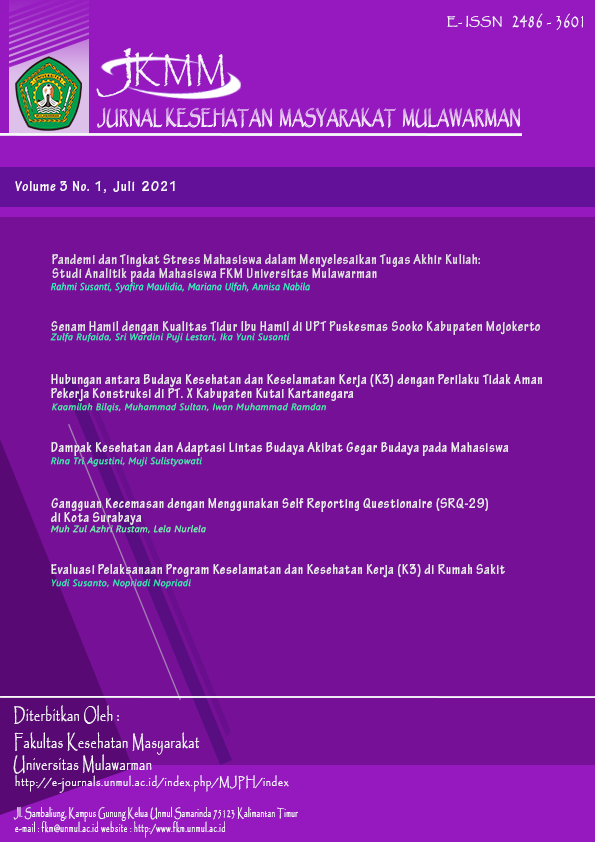
Hubungan antara Budaya Kesehatan dan Keselamatan Kerja (K3) dengan Perilaku Tidak Aman Pekerja Konstruksi di PT. X Kabupaten Kutai Kartanegara
DOI:
https://doi.org/10.30872/jkmm.v3i1.6271Keywords:
Budaya K3, Konstruksi, Perilaku Tidak AmanAbstract
Latar Belakang & Tujuan: Perilaku tidak aman adalah perilaku yang dapat memungkinkan terjadinya sebuah kecelakaan atau insiden. Penyebab dasar terjadinya kecelakaan kerja adalah perilaku tidak aman dan kondisi tidak aman. Proyek konstruksi merupakan salah satu industri yang memiliki tingkat risiko tinggi terjadinya kecelakaan kerja. Sektor konstruksi menyumbang kecelakaan kerja sebesar 63,6% di Indonesia. PT. X merupakan perusahaan bidang jasa konstruksi, khususnya pada sektor minyak dan gas. Tujuan penelitian ini untuk mengetahui hubungan antara budaya kesehatan dan keselamatan kerja (K3) dengan perilaku tidak aman pekerja di PT.X Metode: Penelitian ini merupakan penelitian kuantitatif menggunakan pendekatan cross sectional dan dilakukan pada bulan Mei-Juni 2021 dengan jumlah sampel sebanyak 75 responden (purposive sampling). Alat ukur menggunakan kuesioner. Analisis data menggunakan uji korelasi rank spearman dengan tingkat kepercayaan 95% (α = 0,05). Hasil: Hasil penelitian menunjukkan terdapat hubungan negatif antara komitmen top manajemen (p = 0,000), peraturan dan prosedur K3 (p = 0,048), komunikasi pekerja (p = 0,000), kompetensi pekerja (p = 0,000) dan keterlibatan pekerja (p = 0,000) terhadap perilaku tidak aman pekerja, artinya budaya K3 yang baik, akan diikuti perilaku tidak aman pekerja yang menurun, dan tidak terdapat hubungan lingkungan sosial kerja dengan perilaku tidak aman pekerja dengan ((p = 0,067). Kesimpulan: Disarankan kepada manajemen perusahaan untuk meningkatkan dan mempertahankan budaya K3, meningkatkan pengawasan, dan melaksanakan evaluasi budaya K3 secara berkala.References
Apriani, D. (2017). Hubungan Budaya K3 Dengan Keselamatan Kerja Pada Pekerja Pabrik Kelapa Sawit di PT UKINDO (AEP) Group Blankahan Kab. Langkat Tahun 2017. In Fakultas Kesehatan Masyarakat Universitas Sumatera Utara.
Askhary, R. A. (2017). Faktor Unsafe Action (Perilaku Tidak Aman) Pada Pekerja Konstruksi Proyek Pembangunan Rumah Bertingkat Oleh PT. Jader Cipta Cemerlang Makassar Tahun 2017. In Fakultas Kedokteran Dan Ilmu Kesehatan Universitas Islam Negeri Alauddin Makassar (Vol.4).
Azhari, D., Denny, H. M., & Setyaningsih, Y. (2021). Jurnal Ilmiah Permas : Jurnal Ilmiah STIKES Kendal Volume 11 Nomor 1 , Januari 2021. Jurnal Ilmiah Permas : Jurnal Ilmiah STIKES Kendal, 11(January), 0–10.
Caroline, J., Harianto, F., & H, R. P. (2019). Pengaruh Gaya Kepemimpinan Terhadap Budaya K3 yang Dimoderasi Tingkat Pendidikan dan Pengalaman Kerja pada Proyek Konstruksi di Surabaya. Jurnal Rekayasa Tenik Sipil Universitas Madura, 4(2), 1–6.
Christina, W. Y., Ludfi, D., & Thoyib, A. (2012). Pengaruh Budaya Keselamatan Dan Kesehatan Kerja ( K3 ) Terhadap Kinerja Proyek Konstruksi. Jurnal Rekayasa Sipil, 6(1), 83–95.
Juwitasari, E. R. (2016). Hubungan Budaya K3 Dengan Safe Behavior Pekerja Gerinda (Penelitian di PT Barata Indonesia (Persero) Gresik). In Fakultas Kesehatan Masyarakat, Universitas Airlangga.
Mulyono, K. (2013). Pengaruh Budaya K3 dan Gaya Kepemimpinan terhadap Kepuasan Kerja dan Kinerja Karyawan pada Divisi Operasi Tambang di PT. Newmont Nusa Tenggara. 71–81.
Nurhayati, D. (2018). Hubungan Antara Faktor Pembentuk Budaya Keselamatan Kerja dengan Safety Behaviour pada Pekerja di PT. Pertamina (Persero) Terminal BBM Banjarmasin Tahun 2018.Fakultas Kesehatan Masyarakat UNISKA Banjarmasin.
Parashakti, R. D., & Putriawati. (2020). Pengaruh Keselamatan dan Kesehatan Kerja (K3), Lingkungan Kerja dan Beban Kerja Terhadap Kinerja Karyawan. Jurnal Ilmu Manajemen Terapan, 1(3), 290–304. https://doi.org/10.31933/JIMT
Ramli, S. (2010). Sistem Manajemen Keselamatan dan Kesehatan Kerja OHSAS 18001. Dian Rakyat.
Ramli, S. (2013). Smart Safety, Panduan Penerapan SMK3 Yang Efektif. Dian Rakyat.
Reason, J. (1997). Managing the Risks of Organizational Accidents.
Saptiyulda, E. (2021). Kala pandemi, kasus kecelakaan kerja masih tetap tinggi. https://www.antaranews.com/berita/1971510/kala-pandemi-kasus-kecelakaan-kerja-masih-tetaptinggi
Suardi, R. (2005). Sistem Manajemen Keselamatan dan Kesehatan Kerja (1st ed.). PPM.
Supriyan, D., & Andreas, R. (2016). Pengaruh Manajemen K3 Dan Budaya K3 Terhadap Kinerja Pekerja Proyek ( Studi Kasus Proyek Pembangunan Cengkareng Business City Lot 5 ).Politeknologi, 15(1).
Syamtinningrum, M. D. P. (2017). Personal Model Hubungan Manajemen Tindakan Tidak Aman (Unsafe Action ) Pada Pekerja PT . Yogya Indo Global. Bidang Keahliah Ergonomi Dan Keselamatan Industri Jurusan Teknik Industri Fakultas Teknologi Industri Institut Teknologi Sepuluh Nopember.
Downloads
Published
Issue
Section
License
The copyright of this article is transferred to Jurnal Kesehatan Masyarakat Mulawarman (JKMM) and when the article is accepted for publication. The authors transfer all and all rights into and to paper including but not limited to all copyrights in the Jurnal Kesehatan Masyarakat Mulawarman. The author represents and warrants that the original is the original and that he/she is the author of this paper unless the material is clearly identified as the original source, with notification of the permission of the copyright owner if necessary. The author states that he has the authority and authority to make and carry out this task.
The author states that:
- This paper has not been published in the same form elsewhere.
- This will not be submitted elsewhere for publication prior to acceptance/rejection by this journal.
A Copyright permission is obtained for material published elsewhere and who require permission for this reproduction. Furthermore, I / We hereby transfer the unlimited publication rights of the above paper to Jurnal Kesehatan Masyarakat Mulawarman. Copyright transfer includes exclusive rights to reproduce and distribute articles, including reprints, translations, photographic reproductions, microforms, electronic forms (offline, online), or other similar reproductions.
The author's mark is appropriate for and accepts responsibility for releasing this material on behalf of any and all coauthor. This Agreement shall be signed by at least one author who has obtained the consent of the co-author (s) if applicable. After the submission of this agreement is signed by the author concerned, the amendment of the author or in the order of the author listed shall not be accepted.
Rights / Terms and Conditions Saved
- The author keeps all proprietary rights in every process, procedure, or article creation described in Work.
- The author may reproduce or permit others to reproduce the work or derivative works for the author's personal use or for the use of the company, provided that the source and the Jurnal Kesehatan Masyarakat Mulawarman copyright notice are indicated, the copy is not used in any way implying the Jurnal Kesehatan Masyarakat Mulawarman (JKMM) approval of the product or service from any company, and the copy itself is not offered for sale.
- Although authors are permitted to reuse all or part of the Works in other works, this does not include granting third-party requests to reprint, republish, or other types of reuse.
Article Processing Charge
In order to improve the quality of articles, starting in June 2025 each article to be published in JKMM is subjected to a fee of IDR 550,000 or USD 34.
These fee include the costs of reviewing, translating, proofreading, layout, and publishing articles. Price does not include printed books and postage. The fee will be paid before entering the review process by reviewer.
More information about the Article Processing Charge, please Contact the journal representative through our number in footage information below.