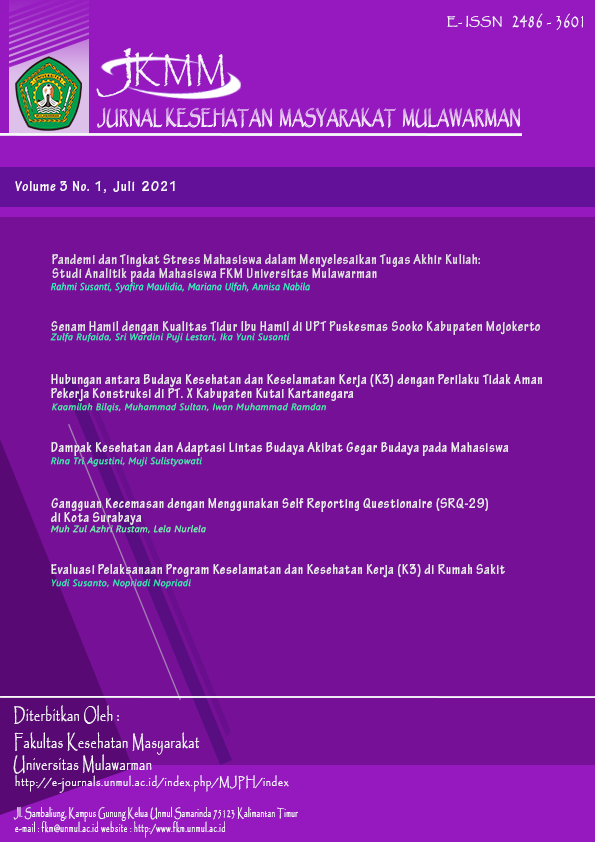
Dampak Kesehatan dan Adaptasi Lintas Budaya Akibat Gegar Budaya pada Mahasiswa
DOI:
https://doi.org/10.30872/jkmm.v3i1.6021Keywords:
adaptasi, dampak kesehatan, gegar budaya, mahasiswaAbstract
Disebabkan kualitas perguruan tinggi di Indonesia belum merata, maka bermunculan mahasiswa lintas budaya. Hal tersebut memicu terjadinya gegar budaya akibat interaksi dengan lingkungan baru. Diketahui bahwa terdapat gejala kejadian gegar budaya pada mahasiswa bukan etnis Jawa di Universitas Airlangga sebagai salah satu perguruan tinggi yang menjadi referensi studi lanjut bagi mahasiswa dari luar Pulau Jawa. Sehingga, perlu untuk mengidentifikasi dan menganalisis adaptasi lintas budaya yang dilakukan mahasiswa bukan etnis Jawa dalam menghadapi dampak kesehatan akibat gegar budaya. Penelitian ini merupakan penelitian kualitatif dengan pendekatan fenomenologi. Informan adalah mahasiswa bukan etnis Jawa angkatan 2015 di Universitas Airlangga. Penelitian dimulai dengan skrining informan dengan kuesioner, dilanjutkan wawancara mendalam untuk mengambil data utama, dan focuss group discussion sebagai triangulasi. Analisis data dimulai dengan reduksi, narasi, kesimpulan, dan verifikasi data. Hasil dari penelitian yaitu dampak kesehatan akibat gegar budaya dari aspek fisik, mental, dan sosial. Bentuk adaptasi lintas budaya yang dilakukan yaitu personal skills digunakan informan dalam mengatasi dampak kesehatan fisik, mental, dan sosial. People skills digunakan dalam mengatasi dampak kesehatan mental dan sosial. Sedangkan, perception skills digunakan untuk mengatasi dampak kesehatan sosial. Kesimpulan dari penelitian ini yaitu hampir seluruh informan telah melakukan adaptasi yang adaptif. Institusi pendidikan terutama perguruan tinggi dapat memfasilitasi mahasiswa lintas budaya dalam beradaptasi untuk mengatasi dampak kesehatan akibat gegar budaya
References
Aldiansyah, M. A., 2019. STRATEGI BERADAPTASI UNTUK MAHASISWA PERANTAUAN TERHADAP LINGKUNGAN BARU. http://dx.doi.org/10.31227/osf.io/2ek8t
Alegria, M., Alvarez, K., & DiMarzio, K., 2017. Immigration and Mental Health. Curr Epidemio; Rep., 4(2), 145–155. https://doi.org/10.1007/s40471-017-0111-2.Immigration
Anton, C., Camarero, C., Laguna, M., & Buhalis, D., 2019. ENJOYING MEMORABLE FOOD EXPERIENCES: AUTHENTICITY, CULTURAL CONTRAST OR ADAPTATION? Journa; of Hospitality Marketing & Management, 1–38. https://www.tandfonline.com/doi/pdf/10.1080/19368623.2019.1564106?needAccess =true&redirect=1
Assessing for Culture Shock., n.d. https://students.usask.ca/documents/counselling/assessing-culture-shock.pdf
Badan Pusat Statistik, 2015. Angka Partisipasi Sekolah (APS) menurut Provinsi, 2011-2015. [https://www.bps.go.id/ linkTableDinamis/view/id/1054] (29 Juli 2016).
Callahan, D., 2014. The WHO Definition of “Health” (Issue September, pp. 77–87). JSTOR. https://doi.org/10.2307/3527467
Cheng, H., Wang, C., Mcdermott, R. C., Kridel, M., & Rislin, J. L., 2018. Self-Stigma , Mental Health Literacy , and Attitudes Toward Seeking Psychological Help. Journal of Counseling and Development: JCD, 96(January), 64–75. https://doi.org/10.1002/jcad.12178
Ching, Y., Renes, S. L., Mcmurrow, S., Simpson, J., & Strange, A. T., 2017. Challenges facing Chinese International students studying in the United States. Educational Research and Reviwes, 12(8), 473–482. https://doi.org/10.5897/ERR2016.3106
Creswell, J. W., 2014. Research Design: Qualitative, Quantitative, and Mixed Methods Approaches (4th ed.). SAGE.
Fariki, Tito Sevyl., 2013. Penyesuaian Kebudayaan di Kampus Universitas Negeri Semarang. Skripsi. Universitas Negeri Semarang. lib.unnes.ac.id
Freshwater, I. V., 2019. Utilizing organizational and motivational theories to establishh a strong organizational culture for the Kalamazoo College Council of Student Representatives.
Handayani, P. G., & Yuca, V., 2018. Fenomena Culture Shock Pada Mahasiswa Perantauan Tingkat 1 Universitas Negeri Padang. Jurnal Konseling Dan Pendidikan, 6(3), 198–204. https://doi.org/10.29210/129000
Haslami, F., 2020. Pentingnya Pendidikan Multikultural Sebagai Upaya Pencegahan Culture Shock. Jurnal Sipatokkong BPSDM Sulawesi Selatan, 1(4), 314–318.
Hutapea, Bonar, 2014. Stres Kehidupan, Religiusitas, dan Penyesuaian Diri Warga Indonesia sebagai Mahasiswa Internasional. Makara Hubs-Asia, 18(1): pp.25-40. journal.ui.ac.id
Istiyanto. 2015. Hand Out Komunikasi Lintas Budaya. Fakultas Ilmu Sosial dan Ilmu Politik. http://dokumen.tips/documents/ho-klb1-komunikasi-linbud.html
Jalal, Fasli, 2014. “Peranan Gizi dalam Memanfaatkan Bonus Demografi” disampaikan dalam Kongres PERSAGI XV Yogyakarta, 25 November 2014. file.persagi.org
Keller, Myriam, 2014. 'Culture Shock' How Deal with the Challenges of Studying Abroad. ETH Zurich. www.ethz.ch
Kemristekdikti. 2015. Klasifikasi dan Pemeringkatan Perguruan Tinggi Indonesia.
Khamkhong, Y., 2018. Stress and Adaptation of EFL Students in an International College.
Lagu, M. Universitas S. R., 2016. Komunikasi Antarbudaya di Kalangan Mahasiswa Etnik Papua dan Etnik Manado di Universitas Sam Ratulangi Manado. E-Journal “Acta Diurna,” V(3).
Maizan, S. H., Bashori, K., & Hayati, E. N., 2020. Analytical Theory : Gegar Budaya (Culture Shock). PSYCHO IDEA, 18(2), 147–154. https://doi.org/10.30595/psychoidea.v18i2.6566
Moleong, Lexi J., 2000. Metodologi Penelitian Kualitatif, 13 ed. Bandung: Remaja Rosdakarya.
Mulyana, Deddy and Jalaluddin Rakhmat. 2003. “Gegar Budaya dan Masalah Penyesuaian Diri dalam Lingkungan Budaya Baru” oleh Kalvero Oberg dalam Komunikasi Antarbudaya, 7 ed. Bandung: Rosda.
Mumford, D. B., 1998. The Measurement of Culture Shock. Soc Psychiatry Epidemiol, (1998) 33: pp.149-154. www.researchgate.net/ publication
Ng, T. K., 2017. Acculturation and cross-cultural adaptation: The moderating role of social support. International Journal of Intercultural Relations, July, 1–41. https://doi.org/10.1016/j.ijintrel.2017.04.012
Rumkhullah, Erlakh, 2015. Hubungan Antara Penilaian Stres serta Upaya Coping dengan Kepatuhan Minum Obat pada Pasien Tuberkulosis Paru Fase Intensif di Kawasan Surabaya Selatan. Skripsi. Universitas Airlangga Surabaya.
Ruben, B. D., & Kealey, D. J., 1979. Behavioral assessment of communication competency and the prediction of cross-cultural adaptation. International Journal of Intercultural Relations, 3(1), 15–47.
Sardjoko, S. Kementerian PPN/Bappenas., 2016. Pendidikan Tinggi dan Pengembangan SDM untuk Meningkatkan Daya Saing dan Inovasi.
Shieh, C. J., 2014. Effects of culture shock and cross-cultural adaptation on learning satisfaction of mainland China students studying in Taiwan. Revista Internacional de Sociologia (RIS), 72(Extra 2), 57–67. https://doi.org/10.3989/ris.2013.08.10
Suhaeri., 2020. GEGERA BUDAYA DALAM ADAPTASI KEBIASAAN BARU (ABK) (KOMUNIKASI LINTAS BUDAYA WARGA GRAHA RANCAMANYAR DALAM MENGHADAPI PANDEMI COVID 19). Syntax Imperatif: Jurnal Ilmu Sosial Dan Pendidikan, 1(4), 209–218.
What is Culture Shock? (n.d.). https://silo.tips/download/what-is-culture-shock
Yunisari, P., 2017. WESTERNS’ LIFESTYLE CULTURE SHOCK EXPERIENCED BY GRADUATE STUDENTS OF ENGLISH LANGUAGE EDUCATION. Ar-Raniry State Islamic University.
Zumaidah, 2012. Gambaran Strategi Koping Fangirling Mahasiswa Reguler Fakultas Ilmu Keperawatan Universitas Indonesia. Skripsi. Universitas Airlangga.
Downloads
Published
Issue
Section
License
The copyright of this article is transferred to Jurnal Kesehatan Masyarakat Mulawarman (JKMM) and when the article is accepted for publication. The authors transfer all and all rights into and to paper including but not limited to all copyrights in the Jurnal Kesehatan Masyarakat Mulawarman. The author represents and warrants that the original is the original and that he/she is the author of this paper unless the material is clearly identified as the original source, with notification of the permission of the copyright owner if necessary. The author states that he has the authority and authority to make and carry out this task.
The author states that:
- This paper has not been published in the same form elsewhere.
- This will not be submitted elsewhere for publication prior to acceptance/rejection by this journal.
A Copyright permission is obtained for material published elsewhere and who require permission for this reproduction. Furthermore, I / We hereby transfer the unlimited publication rights of the above paper to Jurnal Kesehatan Masyarakat Mulawarman. Copyright transfer includes exclusive rights to reproduce and distribute articles, including reprints, translations, photographic reproductions, microforms, electronic forms (offline, online), or other similar reproductions.
The author's mark is appropriate for and accepts responsibility for releasing this material on behalf of any and all coauthor. This Agreement shall be signed by at least one author who has obtained the consent of the co-author (s) if applicable. After the submission of this agreement is signed by the author concerned, the amendment of the author or in the order of the author listed shall not be accepted.
Rights / Terms and Conditions Saved
- The author keeps all proprietary rights in every process, procedure, or article creation described in Work.
- The author may reproduce or permit others to reproduce the work or derivative works for the author's personal use or for the use of the company, provided that the source and the Jurnal Kesehatan Masyarakat Mulawarman copyright notice are indicated, the copy is not used in any way implying the Jurnal Kesehatan Masyarakat Mulawarman (JKMM) approval of the product or service from any company, and the copy itself is not offered for sale.
- Although authors are permitted to reuse all or part of the Works in other works, this does not include granting third-party requests to reprint, republish, or other types of reuse.
Article Processing Charge
In order to improve the quality of articles, starting in June 2025 each article to be published in JKMM is subjected to a fee of IDR 550,000 or USD 34.
These fee include the costs of reviewing, translating, proofreading, layout, and publishing articles. Price does not include printed books and postage. The fee will be paid before entering the review process by reviewer.
More information about the Article Processing Charge, please Contact the journal representative through our number in footage information below.