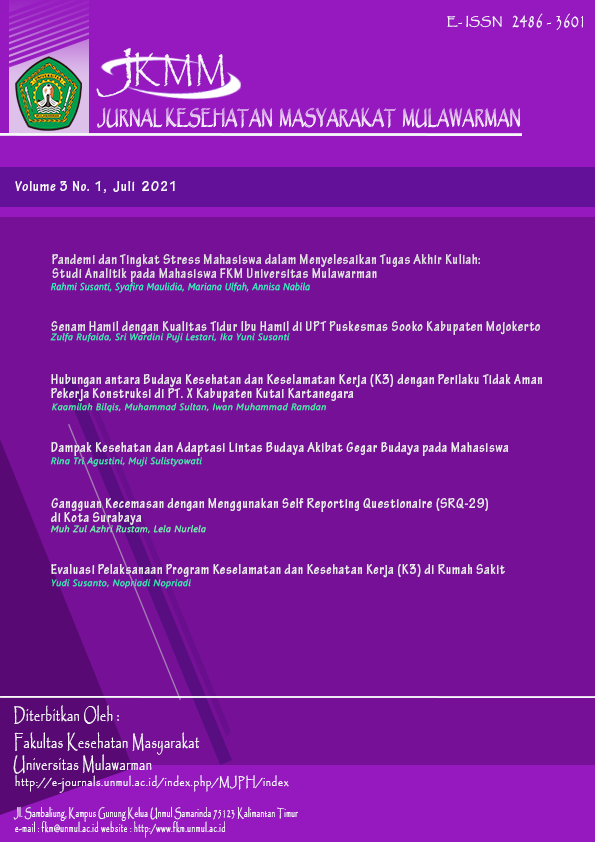
Gangguan Kecemasan dengan Menggunakan Self Reporting Questionaire (SRQ-29) di Kota Surabaya
DOI:
https://doi.org/10.30872/jkmm.v3i1.5752Keywords:
Gangguan Kecemasan, PTSD, Pelajar, SMAAbstract
Latarbelakang dan tujuan: krisis yang terus-menerus dan intensitasnya meningkat, maka dapat mengganggu
aktivitas sehari-hari sehingga disebut sebagai gangguan gangguan. Tujuan dalam peneliltian ini adalah untuk
melihat gambaran umum gangguan di Kota Surabaya. Metode: desain penelitian menggunakan penelitian
deskriptif, teknik Simple Random Sampling dalam memilih subjek penelitian dengan jumlah sampel 103 pelajar di Kota Surabaya Hasil penelitian: hasil yang diperoleh responden dengan rata-rata usia 18 tahun, dengan klasifikasi gangguan adalah 34% dan (Post Traumatic Syndrome Disorder) PTSD sebesar 29,1%. Cemas atau depresi ini hal ini biasanya terjadi karena gangguan perasaan atau mood, kehilangan minat atau kesenangan, perasaan atau perasaan rendah, susah tidur, penurunan nafsu makan, dan gangguan yang buruk pada tingkat SMA yang sering terjadi pada tingkat SMA. Gejala PTSD yang peristiwa orang tua pelajar serta bentuk respons maladaptif orang tua terhadap peristiwa traumatik yang berkaitan dengan respons maladaptif anak bencana/wabah. Kesimpulan: kesimpulan perlu adanya interaksi dari berbagai pihak terkait dalam melakukan penyuluhan sedini mungkin
References
ADAA. (2010). Generalized Anxiety Disorder. https://adaa.org/
Adejumo, A. O., Ikoba, N. A., Suleiman, E. A., Okagbue, H. I., Oguntunde, P. E., Odetunmibi, O. A., & Job, O. (2017). Quantitative exploration of factors influencing psychotic disorder ailments in Nigeria. Data in Brief, 14, 175–185. https://doi.org/10.1016/j.dib.2017.07.046
Arini, L., & Syarli, S. (2020). Deteksi Dini Gangguan Jiwa Dan Masalah Psikososial Dengan Menggunakan Self Re- porting Qustioner ( SRQ-29 ). Jurnal Keperawatan Muhammadiyah, 5(1), 167–172.
badan Narkotika Nasional RI. (2018). data statstik dan sebaran Kasus Narkoba per wilayah. Pusat Data Dan Informasi BNN RI. https://puslitdatin.bnn.go.id/portfolio/data-statistik-kasus-narkoba/
Badan Narotika Nasional. (2010). Laporan survei penyalahgunaan narkoba di Indonesia: studi kerugian ekonomi dan sosial akibat narkoba.
Badan Penelitian dan Pengembangan Kementerian Kesehatan RI. (2018). Laporan Riset Kesehatan Dasar 2018 (Vol. 53, Issue 9). Kemeterian Keseahtan. https://doi.org/10.1017/CBO9781107415324.004
Cestari, V. R. F., & Barbosa, I. V. (2017). Stress in nursing students: study on sociodemographic and academic vulnerabilities. 30(2), 190–196.
Dinas Sosial Kota Surabaya. (2019). Dinsos Terapkan Metode Terapi Art Musik untuk Kesembuhan Pasien ODGJ Liponsos. Pemerintah Kota Surabaya. https://surabaya.go.id/id/berita/51903/dinsos-terapkan-metode-terapi-a
Donner, N. C., & Lowry, C. A. (2013). Sex differences in anxiety and emotional behavior. Pflügers Archiv - European Journal of Physiology, 465(5), 601–626. https://doi.org/10.1007/s00424-013-1271-7
Duckworth, A. L. (2013). The Observer (26th ed.). True Grit.
Joewana, S. (2015). Epidemiologi; Gangguan mental dan perilaku akibat penggunaan zat psikoaktif: penyalahgunaan napza/narkoba. (3rd editio). Penerbit buku kedokteran EGC.
Kassam-Adams, N., & Winston, F. K. (2004). Predicting Child PTSD: The Relationship Between Acute Stress Disorder and PTSD in Injured Children. Journal of the American Academy of Child & Adolescent Psychiatry, 43(4), 403–411. https://doi.org/https://doi.org/10.1097/00004583-200404000-00006
Marthoenis, Meutia, I., Fathiariani, L., & Sofyan, H. (2018). Prevalence of depression and anxiety among college students living in a disaster-prone region. Alexandria Journal of Medicine, 54(4), 337–340. https://doi.org/10.1016/j.ajme.2018.07.002
Prabowo, P. S., & Sihombing, J. P. T. (2010). Gambaran gangguan kecemasan pada mahasiswa Fakultas Kedokteran Universitas “X” angkatan 2007. Jkm, 9(2), 161–168.
Rahmadian, A. A., Furqon, L.N Yusuf, S., & Rusmana, N. (2016). Prevalensi Ptsd Dan Karakteristik Gejala Stres Pascatrauma Pada Anak Dan Remaja Korban Bencana Alam. Edusentris, 3(1), 1. https://doi.org/10.17509/edusentris.v3i1.184
Subandi, M. . (2014). Interaksi Dinamis Penderita Gangguan Psikotik dengan Keluarga. In Buletin Psikologi (Vol. 22, Issue 2). https://doi.org/10.1017/CBO9781107415324.004
WHO. (2012). Anxiety and Depression. World Health Organization. http://www.who.int/ topics/ depression/en/
Wonguppa, R., & Kanato, M. (2018). The prevalence and associated factors of new psychoactive substance use: A 2016 Thailand national household survey. Addictive Behaviors Reports, 7(August 2017), 111–115. https://doi.org/10.1016/j.abrep.2017.11.001
Yustiana, A. V., & Alit Aryani, L. N. (2019). Gangguan psikotik akibat penggunaan ganja (cannabis): studi kasus. Medicina, 50(2), 400–403. https://doi.org/10.15562/medicina.v50i2.123
Downloads
Additional Files
Published
Issue
Section
License
The copyright of this article is transferred to Jurnal Kesehatan Masyarakat Mulawarman (JKMM) and when the article is accepted for publication. The authors transfer all and all rights into and to paper including but not limited to all copyrights in the Jurnal Kesehatan Masyarakat Mulawarman. The author represents and warrants that the original is the original and that he/she is the author of this paper unless the material is clearly identified as the original source, with notification of the permission of the copyright owner if necessary. The author states that he has the authority and authority to make and carry out this task.
The author states that:
- This paper has not been published in the same form elsewhere.
- This will not be submitted elsewhere for publication prior to acceptance/rejection by this journal.
A Copyright permission is obtained for material published elsewhere and who require permission for this reproduction. Furthermore, I / We hereby transfer the unlimited publication rights of the above paper to Jurnal Kesehatan Masyarakat Mulawarman. Copyright transfer includes exclusive rights to reproduce and distribute articles, including reprints, translations, photographic reproductions, microforms, electronic forms (offline, online), or other similar reproductions.
The author's mark is appropriate for and accepts responsibility for releasing this material on behalf of any and all coauthor. This Agreement shall be signed by at least one author who has obtained the consent of the co-author (s) if applicable. After the submission of this agreement is signed by the author concerned, the amendment of the author or in the order of the author listed shall not be accepted.
Rights / Terms and Conditions Saved
- The author keeps all proprietary rights in every process, procedure, or article creation described in Work.
- The author may reproduce or permit others to reproduce the work or derivative works for the author's personal use or for the use of the company, provided that the source and the Jurnal Kesehatan Masyarakat Mulawarman copyright notice are indicated, the copy is not used in any way implying the Jurnal Kesehatan Masyarakat Mulawarman (JKMM) approval of the product or service from any company, and the copy itself is not offered for sale.
- Although authors are permitted to reuse all or part of the Works in other works, this does not include granting third-party requests to reprint, republish, or other types of reuse.
Article Processing Charge
In order to improve the quality of articles, starting in June 2025 each article to be published in JKMM is subjected to a fee of IDR 550,000 or USD 34.
These fee include the costs of reviewing, translating, proofreading, layout, and publishing articles. Price does not include printed books and postage. The fee will be paid before entering the review process by reviewer.
More information about the Article Processing Charge, please Contact the journal representative through our number in footage information below.