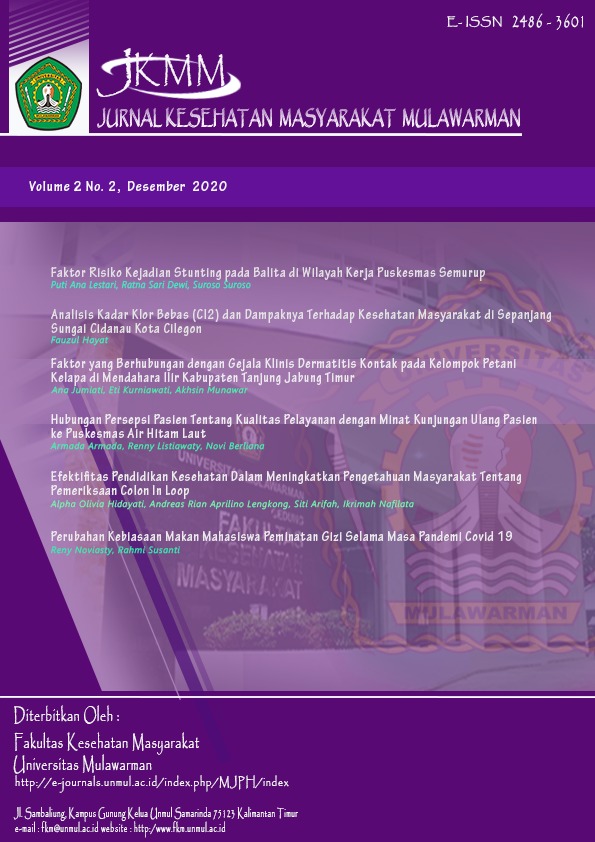
Analisis Kadar Klor Bebas (Cl2) dan Dampaknya Terhadap Kesehatan Masyarakat di Sepanjang Sungai Cidanau Kota Cilegon
DOI:
https://doi.org/10.30872/jkmm.v2i2.4673Abstract
Latar Belakang & Tujuan: Klorin digunakan dalam kehidupan sehari-hari sebagai bahan desinfektan, pemutih maupun pembersih. Pencemaran limbah yang mengandung klorin berpotensi mencemari perairan sungai Cidanau. Kadar klor bebas (Cl2) di perairan sungai melebihi baku mutu lingkungan berdampak pada kesehatan masyarakat. Tujuan dari penelitian untuk menganalisis kadar klor bebas (Cl2) dan dampaknya terhadap kesehatan masyarakat di sepanjang Sungai Cidanau Kota Cilegon. Metode: Analisis laboratorium menggunakan alat spektrofotometer pharo-Cl2 untuk menentukan kadar klor bebas (Cl2). Pengambilan sampel air sungai pada 4 (empat) titik sampling yaitu Desa Ranca Senggol Cinangka, Jembatan Cikalumpang, Jembatan Ciparay Cinangka, bendungan KTI Cinangka menggunakan grab sampling. Analisis data dilakukan membandingkan kadar klor bebas (Cl2) dengan baku mutu lingkungan air sungai menurut peraturan PP no. 82 tahun 2001 tentang pengelolaan kualitas air dan pengendalian pencemaran air. Hasil: Hasil penelitian menunjukkan bahwa kadar klor bebas (Cl2) di empat titik sampling yaitu Desa Ranca Senggol Cinangka sebesar (0,335 mg/L), Jembatan Cikalumpang sebesar (0.28 mg/L), Jembatan Ciparay Cinangka sebesar (0,295 mg/L), Bendungan KTI Cinangka sebesar (0,335 mg/L). Kasus penyakit berbasis air di wilayah Kota Cilegon diantaranya penyakit dermatitis (49,4%), gastritis (28,8%) dan kasus diare sebanyak 21,8%. Kesimpulan: Kadar klor bebas (Cl2) di Sungai Cidanau Kota Cilegon melebihi baku mutu lingkungan berdasarkan PP Nomor 82 tahun 2001 yaitu sebesar 0,03 mg/L. Penyakit berbasis air diduga akibat pencemaran klor bebas (Cl2) air sungai Cidanau. Dilakukan pengolahan air limbah di kawasan industri Kota Cilegon.
Kata Kunci: Klor Bebas (Cl2), Sungai Cidanau, Penyakit Berbasis Air
References
Agabiti N etall (2001). Short term respiratory effects of acute exposure to chlorine due to a swimming pool accident. Occup Environ Med 2001;58:399-404.
Badan Pusat Statistik (BPS) Kota Cilegon (2018). Kota Cilegon Dalam Angka tahun 2017.
Dinas Lingkungan Hidup dan Kehutanan (DLHK) Provinsi Banten (2018). Laporan Status Lingkungan Hidup Daerah Provinsi Banten tahun 2017.
Dinas Kesehatan Kota Cilegon (2019), Profil Kesehatan Kota Cilegon tahun 2018.
Hartanto (2017). Perhitungan Neraca Air Das Cidanau Menggunakan Metode Thornthwaite. Ris.Geo.Tam Vol. 27, No.2, Desember 2017 (213-225).
Fikri E (2018). Pedoman Pemeriksaan Parameter Air Limbah di Laboratorium. Jakarta. EGC.
Fairley, C.K., M.E. Hellard., M.I. Sinclair., & A.B. Forbes. (2001). A. Randomized, Blinded, Controoled Trial Investigating the Gastrointestinal Health Effect of Drinking Water Quality. 109(8).
Hasan (2006). Dampak Penggunaan Klorin. J. Tek. Ling. P3TL-BPPT. 7. (1): 90-96.
Peraturan Pemerintah Republik Indonesia Nomor 82 tahun 2001 tentang pengelolaan kualitas air dan pengendalian pencemaran air.
Lestari, Utomo, Sunarko, Virkyanov, (2008). Pengaruh Penambahan Biosida Pengoksidasi Terhadap Kandungan Klorin untuk Pengendalian Pertumbuhan Mikroorganisme pada Air Pendingin Sekunder RSG-GAS. Pusat Reaktor Serba Guna-BATAN. Kawasan Puspitek Serpong. Tangerang. Banten.
Permana, Suryani (2012). Hubungan Sisa Klor Dengan Keluhan Iritasi Kulit Dan Mata Pada Pemakai Kolam Renang Hotel Di Wilayah Kota Yogyakarta. KESMAS Vol. 7 No. 1, Maret 2013.
U.S. Environmental Protection Agency (EPA) (1999). Integrated Risk Information System (IRIS) on Chlorine. National Center for Environmental Assessment, Office of Research and Development, Washington, DC. 1999.
World Health Organization (WHO) (2003). Chlorine in Drinking-water. Background document for development of WHO Guidelines for Drinking-water Quality. WHO/SDE/WSH/03.04/45
Downloads
Published
Issue
Section
License
The copyright of this article is transferred to Jurnal Kesehatan Masyarakat Mulawarman (JKMM) and when the article is accepted for publication. The authors transfer all and all rights into and to paper including but not limited to all copyrights in the Jurnal Kesehatan Masyarakat Mulawarman. The author represents and warrants that the original is the original and that he/she is the author of this paper unless the material is clearly identified as the original source, with notification of the permission of the copyright owner if necessary. The author states that he has the authority and authority to make and carry out this task.
The author states that:
- This paper has not been published in the same form elsewhere.
- This will not be submitted elsewhere for publication prior to acceptance/rejection by this journal.
A Copyright permission is obtained for material published elsewhere and who require permission for this reproduction. Furthermore, I / We hereby transfer the unlimited publication rights of the above paper to Jurnal Kesehatan Masyarakat Mulawarman. Copyright transfer includes exclusive rights to reproduce and distribute articles, including reprints, translations, photographic reproductions, microforms, electronic forms (offline, online), or other similar reproductions.
The author's mark is appropriate for and accepts responsibility for releasing this material on behalf of any and all coauthor. This Agreement shall be signed by at least one author who has obtained the consent of the co-author (s) if applicable. After the submission of this agreement is signed by the author concerned, the amendment of the author or in the order of the author listed shall not be accepted.
Rights / Terms and Conditions Saved
- The author keeps all proprietary rights in every process, procedure, or article creation described in Work.
- The author may reproduce or permit others to reproduce the work or derivative works for the author's personal use or for the use of the company, provided that the source and the Jurnal Kesehatan Masyarakat Mulawarman copyright notice are indicated, the copy is not used in any way implying the Jurnal Kesehatan Masyarakat Mulawarman (JKMM) approval of the product or service from any company, and the copy itself is not offered for sale.
- Although authors are permitted to reuse all or part of the Works in other works, this does not include granting third-party requests to reprint, republish, or other types of reuse.
Article Processing Charge
In order to improve the quality of articles, starting in June 2025 each article to be published in JKMM is subjected to a fee of IDR 550,000 or USD 34.
These fee include the costs of reviewing, translating, proofreading, layout, and publishing articles. Price does not include printed books and postage. The fee will be paid before entering the review process by reviewer.
More information about the Article Processing Charge, please Contact the journal representative through our number in footage information below.